1918 Armistice
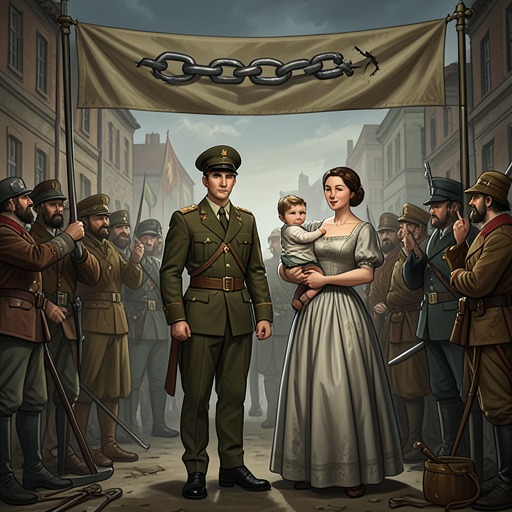
1919The 1918 Armistice is presented as a turning point whose public meaning is immediate but incomplete. A German request for negotiations invokes Woodrow Wilson’s peace proposals and asks him to secure an immediate general armistice; when the armistice arrives, soldiers and civilians celebrate exuberantly in France. Yet the episodes surrounding it resist the idea that an end to fighting can itself restore what war has damaged. For Joe Williams, a night of collective joy turns into a racist assault; for Eveline Hutchins, victory is shadowed by a bereaved woman’s reminder that the dead do not return; and for Daughter, the armistice helps mark a private decision about the life she will lead.
Diplomatic Appeal and the Meaning of Peace
A German government appeal asks the President of the United States to notify the belligerents and invite them to negotiations. It accepts Wilson’s program, citing his January 8, 1918 message to Congress and later statements, especially his September 27 address, as the basis for peace discussions. The appeal also requests that Wilson bring about an immediate general armistice on land, at sea, and in the air, explicitly presenting cessation of hostilities as a way to avoid further bloodshed. The document establishes the armistice not simply as a battlefield pause but as part of a proposed political process: negotiations are to follow, and Wilson’s stated principles are offered as their foundation.
The scenes of celebration show how far the lived meaning of the armistice exceeds that formal language. In St. Nazaire, the news releases a town-wide outpouring of relief and exhilaration. The narrative sets the official appeal for peace beside crowded streets, shared drinks, music, embraces, and Allied flags. The juxtaposition makes the armistice at once a diplomatic demand and a public event experienced through bodies, encounters, and sudden changes in expectation.
St. Nazaire: Celebration and Violence
Joe Williams spends Armistice night in St. Nazaire amid a celebration that draws soldiers and sailors out of their camps and barracks. People congratulate one another, open bottles, exchange drinks, kiss, and gather in a café where a planned meal barely gets past the soup before the revelry takes over. The gathering’s conviviality is collective: people sing and drink champagne from tumblers while girls carry Allied flags through the room.
Joe goes looking for Jeanette, with whom he has an ongoing arrangement when the Owanda is in port. He wants to find her before he becomes too drunk, and he believes she has promised to spend the night with him. In a cabaret, he sees her dancing with a Senegalese French officer, with an American flag draped over her dress. His reaction exposes the racial hierarchy beneath the night’s rhetoric of Allied fellowship: he pulls her away and strikes the officer. The excerpt ends amid people shouting and trying to intervene, leaving the immediate outcome unstated. The episode sharply reverses the scene’s celebratory mood. The armistice brings former allies together in public, but it does not dissolve the racial assumptions or possessive expectations that shape Joe’s conduct.
Private Grief Within the Public Victory
In the account of Daughter’s life, a false armistice is followed by the real one, and the public response lasts for about a week, described as a New Orleans Mardi Gras. The celebrations accompany a private resolution: Daughter decides she will remain unmarried and keep house for her father. She resumes a settled routine of lectures at Southern Methodist, church work, library books, baking, and chaperoning her brother’s young friends. The armistice does not erase her thoughts of Joe Washburn, which still make her feel she cannot endure her situation, but it forms part of the moment in which she chooses a domestic future.
That future is interrupted by memory at Thanksgiving. While preparing dinner, Daughter suddenly remembers Bud and leaves the table, overcome enough to retreat to her room. She returns and helps restore the meal’s good spirits, then tells her family she has signed up for six months of overseas work with Near East Relief. Her father objects, and Buster argues that she should stay home now that the war is over. Daughter answers that she can give six months to relief work because others gave their lives. The family’s silence when Bud comes to mind again gives the armistice a measure of its limits: victory and the end of combat coexist with bereavement, obligation, and decisions still shaped by loss.
Eveline’s Celebration and Its Aftermath
When rumors of an armistice circulate in Paris in early November, Eveline Hutchins is working in an office shared with Eleanor Stoddard. Major Wood rushes in, kisses them both, and announces the news; in the sudden excitement, Eveline finds herself kissing J.W. Moorehouse. The Red Cross office turns into a scene of spontaneous celebration, with bottles appearing and people singing. Eveline, Eleanor, J.W., and Major Wood then travel by taxi to the Café de la Paix.
The journey home introduces a quieter counterpoint. At Eveline’s apartment, the elderly concierge calls it victory but observes that it cannot bring her dead son back to life. Eveline gives her five francs and returns upstairs. The exchange is brief, but it interrupts victory’s celebratory certainty with an irreparable personal loss. Later, Paul Johnson visits Eveline and speaks hopefully of peace and Wilson’s Fourteen Points; he wonders what people will do if peace has truly begun. His optimism is sincere, but the concierge’s bereavement has already shown what no diplomatic settlement can undo. Across these scenes, the armistice ends the fighting as a public fact while leaving characters to confront its uneven private meanings: exhilaration, anger, grief, and the work of choosing what comes next.