Higginbotham
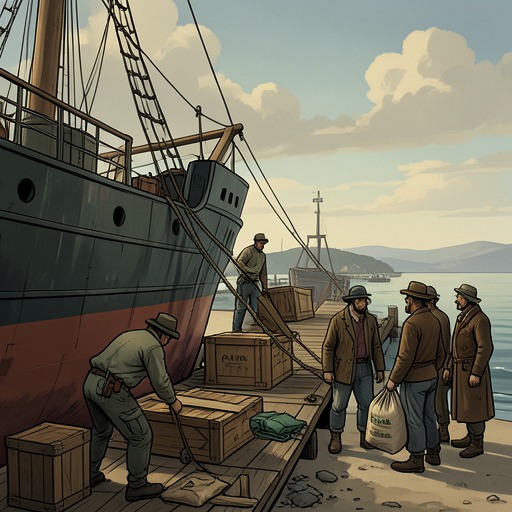
1919Higginbotham is the unsteady cargo ship that carries Joe Williams across the Atlantic to wartime France and is lost on the return voyage. Its slow engines and persistent leaks make the voyage precarious well before the ship disappears in fog; the wreck leaves Joe and other crewmen dependent on rescue, while the captain dies and the survivors face a dispute over their pay. The ship’s story links the physical risks of wartime shipping to the ordinary economic insecurity that follows disaster.
Build and outbound passage
Higginbotham is introduced as a poorly performing vessel. Joe thinks it is built like a cheesebox, and its engines repeatedly break down. Even in moderate headwinds, there are days when it makes only thirty or forty miles. The ship’s weakness is not merely a matter of comfort: the slow passage keeps Joe at sea while he worries about Del and whether he will succeed in his work, among a deck crew he regards as a collection of soreheads.
The voyage nevertheless gives Joe an unexpected companionship. He takes boxing lessons from the second engineer, Glen Hardwick, a wiry amateur boxer about forty years old. By the time they reach Bordeaux, Joe can give him a demanding workout. Glen praises Joe’s straight right and suggests it could take him far as a lightweight. The ship’s cramped, difficult passage thus also becomes the setting for a developing skill and a friendship that makes the trip more bearable.
Bordeaux and the wartime port
Higginbotham reaches Bordeaux after the United States has declared war on Germany. The welcome for Americans is conspicuously warm: the first port official aboard tries to kiss Captain Perry on both cheeks, and the town treats the Americans generously. Joe and Glen spend their evenings ashore together. During the four days the ship waits its turn to dock and unload, they drink wine and cognac and enjoy the plentiful food and attention given to the newly arrived Americans.
Joe’s time ashore also complicates his feelings about his marriage. He initially thinks he should avoid an affair because he is married to Del, then rationalizes that Del has withheld herself from him. He and Glen meet two well-dressed young women in a public garden; Joe spends the evening with Marceline, and they share supper, wine, and champagne at a small hotel. The next morning they eat coffee and rolls in bed. Joe picks up French phrases, while Marceline calls him petit lapin and says she will be his sweetie whenever he is in Bordeaux. These scenes belong to the ship’s short stay in port, but they sharpen the contrast between Joe’s anxious thoughts about home and the pleasures of his wartime liberty.
The wreck on the return voyage
The ship’s outward slowness gives way to a more immediate danger at sea. On the homeward passage, Higginbotham springs leaks so badly that Captain Perry stops worrying about submarines; whether the vessel will reach Halifax becomes uncertain. It is light and rolls like a log, and even the fiddles on the table cannot keep dishes in place. The crew is already living with the ship’s instability before the sudden impact that ends the voyage.
On a dirty, fogbound night somewhere south of Cape Race, Joe is walking the deck amidships with his chin tucked into his peajacket when a blow throws him flat. The crew never learns whether a mine or a torpedo struck them. The boats are in good order and the sea is smooth enough for the men to get away, but the four lifeboats separate as they leave the ship. Joe’s boat and the captain’s remain together; Higginbotham fades into the fog, its main deck awash the last time the men can make it out. They do not see it sink.
Rescue and what follows
The occupants of Joe’s boat are cold and wet. The men at the oars work to keep the bow toward the chop, while successive seas drench them with spray through their wool sweaters and life preservers. The fog gradually lightens into day. Joe’s boat and Captain Perry’s boat manage to stay together until late afternoon, when a large fishing schooner bound for Boston picks them up.
Captain Perry is already gravely ill when the schooner rescues them. Its master does what he can, but Perry remains unconscious when they reach Boston four days later and dies on the way to the hospital. The doctors attribute his death to pneumonia. The loss of Higginbotham therefore has a human consequence beyond the crew’s escape: the captain survives the wreck itself but not the cold and illness that follow it.
The ship’s disappearance also leaves the surviving crew without prompt payment. The next morning, Joe and the first mate visit the office of the vessel’s owners, Perkins and Ellerman, to ask for their wages. They are told that Higginbotham supposedly changed hands in mid-Atlantic: Rosenberg had bought it speculatively, could no longer be found, and Chase National Bank was claiming ownership while the underwriters disputed the matter. The agent says the men will eventually be paid because Rosenberg posted a bond, but cannot say when, and directs them to Rosenberg. Joe and the mate leave cursing; the mate goes to South Boston to tell the chief, while Joe looks for another berth.
Narrative significance
Higginbotham is presented through its material failures: engines that repeatedly stop, a hull Joe likens to a cheesebox, a rolling deck, and leaks severe enough to make a transatlantic crossing doubtful. Those details accumulate before the strike in the fog, so the wreck is both an abrupt shock and the culmination of a voyage in which the vessel has never seemed dependable. The cause remains unresolved, preserving the crew’s uncertainty rather than turning the loss into a fully explained incident.
The aftermath extends the shipwreck beyond the question of who escaped. A fishing schooner saves the men, but rescue does not restore the captain’s health or secure the crew’s wages. Higginbotham’s disappearance leaves ownership contested among a missing speculator, a bank, and underwriters, while the men who worked aboard it are told to wait. The vessel’s final significance lies in that double exposure: at sea, the crew depends on the condition of the ship and the readiness of its boats; ashore, it depends on a tangled chain of ownership for payment.