Treaty of Versailles
1919The Treaty of Versailles emerges as the formal shape of a peace negotiated through private bargains rather than the open, principled settlement Woodrow Wilson had promised. The narrative first frames the treaty as a world-scale allocation of territory, mandates, and political authority, then turns that settlement into a test of Wilson’s faith in words, democracy, and the League of Nations. Its decisive significance lies in this contrast: peace is declared an ideal, while the process of making it is rendered as a contest over power.
From public conference to private bargaining
On January 18, 1919, the Allied and associated powers assembled in the Salon de l’Horloge at the Quai d’Orsay amid uniforms, decorations, and formal ceremony. The gathering was ostensibly where peace would be dictated, but the narrative immediately undercuts the pageantry: the great public assembly, it says, was too public a place to make peace. The distinction sets up the treaty’s central political tension. Public claims and ceremonial appearances surround decisions that are made elsewhere.
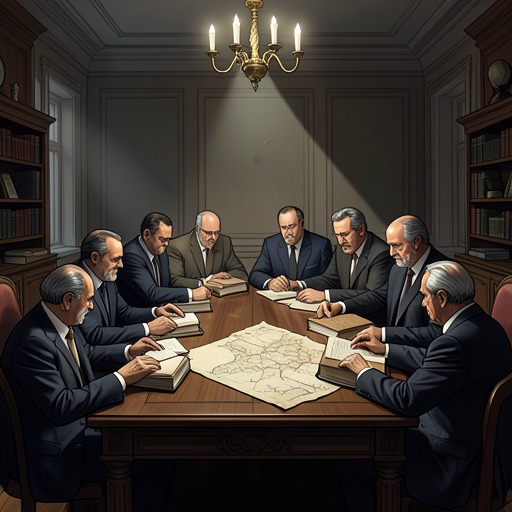
The narrative personifies that shift through Georges Clemenceau, David Lloyd George, and Woodrow Wilson. On April 7, Wilson ordered the George Washington held at Brest with steam up, ready to take the American delegation home, but he did not leave. On April 19, the sharper Clemenceau and Lloyd George drew him into the Council of Four, described as their intimate three-card game. The movement from the crowded conference to a small negotiating circle makes the treaty’s process itself part of its meaning: the settlement is not simply announced to the world but shaped by a handful of leaders bargaining behind the public scene.
The settlement as a distribution of stakes
The text describes the leaders as dealing out cards: the Rhineland, Danzig, the Polish corridor, the Ruhr, the Saar, and Fiume appear alongside self-determination for small nations, the League of Nations, mandates, freedom of the seas, Transjordan, Shantung, and the island of Yap. The list places the principle of self-determination in the same hand as strategic territory and imperial administration. It does not provide a clause-by-clause account of the treaty; instead, it presents peace as a series of questions over who will control particular places and who will speak for their inhabitants.
That tension also appears in the discussion of mandates at the Café de la Paix. An engineer from Standard Oil warns that Anglo-Persian and Royal Dutch interests are advancing in the Near East while American oil interests risk losing their primacy. Baku, Mohommarah, and Mosul become objects of geopolitical calculation, and Armenia is raised as a possible mandate despite the devastation and starvation attributed to the Turks. The exchange invokes self-determination to dispute who has a right to Baku, even as the speakers weigh whether French control would be preferable to British control. The treaty’s political vocabulary thus meets an argument openly shaped by national and commercial advantage.
Wilson’s compromise and the treaty’s completion
On June 28, the Treaty of Versailles was ready. The narrative presents this milestone not as the uncomplicated arrival of a just peace but as a reckoning for Wilson. He had to return to the United States and explain to politicians in the Senate and House, to public opinion, and to his father’s God how he had been trimmed and how far he had made the world safe for democracy and the New Freedom. The phrasing connects the treaty’s completion to the distance between Wilson’s declared purpose and the compromises of negotiation.
That distance is personal as well as political. From the moment Wilson landed in Hoboken, he stood with his back to the wall of the White House, speaking to preserve his faith in words, in the League of Nations, and in himself. The Treaty is therefore bound to an aftermath of explanation rather than triumph. Its terms have been arranged, but Wilson must still defend what the settlement means and whether the ideals attached to it have survived the bargaining.
Finance, oil, and the limits of political ideals
The narrative places the peace settlement within a broader structure of financial power. By 1917, the Allied Powers had borrowed $1.9 billion through the House of Morgan. By the end of the Peace Conference, the phrase “J. P. Morgan suggests” is said to carry compulsion over a power of $74 billion. The account does not claim that a particular loan dictated a particular treaty clause. Instead, it sets the immense leverage associated with private finance beside the leaders’ public language of democracy and peace, suggesting how much power lies outside the conference’s ceremonial frame.
The oil discussion makes the same tension concrete in a different register. At the café, American interests are measured against British and Dutch competition, and the future of Baku is debated in terms of both self-determination and control. Read alongside the Council of Four’s territorial and mandate questions, this conversation shows the kind of material contest concealed within the vocabulary of international settlement. The Treaty of Versailles stands in the narrative not as a detached legal instrument but as the outcome of negotiations in which ideals, territory, finance, and access to resources press against one another.