U.S. military identification tag
1919The U.S. military identification tag is both a practical military record and a fragile sign of personal identity. Issued with a serial number to hang around a soldier’s neck, it is meant to connect a body to an individual record. The book turns that link inside out: the tag is lost in the Marne River, the record disappears, and the state later honors an unidentified dead soldier as a national symbol.
Issue and Administrative Identification
The tag appears in a compressed account of military induction. After recruits are examined and assessed, they receive a service record and an identification tag stamped with a serial number, along with regulation equipment, a condiment can, and a copy of the articles of war. The tag belongs to a larger administrative process that measures, classifies, equips, and names the soldier. Its number promises a stable connection between the person wearing it and the institution recording his service.
That military function should be distinguished from the civilian paperwork governing conscription. When Joe Williams is stopped in New York, the police demand his draft registration card; he explains that he is a merchant seaman and believes himself exempt, but is still taken for questioning. The registration card is not the military identification tag. The contrast shows how documents can regulate movement and establish status before as well as after enlistment: one paper is demanded of a civilian under draft rules, while the numbered tag is issued as part of becoming a soldier.
Loss and the John Doe Motif
The tag’s promised connection between name and body fails in the book’s account of John Doe. A soldier recalls losing his identification tag while swimming in the Marne River, during a period of roughhousing and waiting to be deloused. The recollection places the loss amid the disordered routines of service, not in a formal ceremony or a deliberate act. Without the tag, the soldier asks how he can find his way back to his outfit, making the lost object an immediate obstacle as well as a missing identifier.
The narrative later returns to the tag in a starkly different register: it lies at the bottom of the Marne River. The service record, meanwhile, has fallen from a filing cabinet when the unit had to leave its billets in a hurry. These separate failures—one object lost in the river, one record dropped and left behind—sever the two documentary links that might have preserved the soldier’s identity. The body’s fate is rendered through the impersonal language of battlefield death, while the missing tag makes the military system’s inability to recover a name materially legible.
Discharge, Records, and the Soldier’s Place
Elsewhere, a discharged soldier’s first-person account describes walking away from headquarters in borrowed civilian clothes after his discharge has been completed. He refers to a serial number he never managed to remember and says he dropped it in the Loire. The passage does not establish that this is the same tag as the one lost in the Marne; instead, the two moments echo one another across the book’s fragmented treatment of military identity. In both, the number that should make the soldier administratively legible proves vulnerable to memory, movement, and loss.
Other scenes show the pressure of official identification without depicting the tag itself. Joe Williams is detained and questioned under wartime authority, while Ben Compton is held after a political meeting and interrogated for days. Their episodes concern policing and political control, not the loss of a military tag. Read alongside the induction sequence, however, they distinguish the many kinds of institutional scrutiny surrounding wartime life: military numbering, draft registration, and investigation each make people answerable to official systems, but they do not serve the same purpose.
The Unknown Dead and Public Commemoration
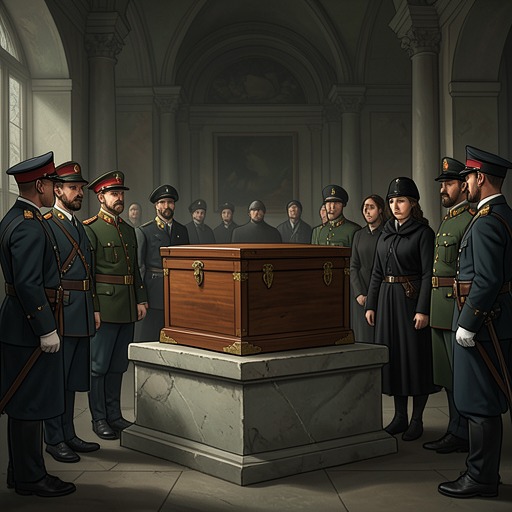
The final memorial sequence gives the lost tag its widest significance. A congressional resolution authorizes the return to the United States of the body of an American member of the American Expeditionary Forces whose identity has not been established. In a morgue at Châlons-sur-Marne, officials select one pine box from among many. The tag’s disappearance in the Marne and the absence of a reliable service record belong to the same narrative of identification defeated by war, though the text does not claim that the selected body can be matched to the lost tag.
The ceremony declines easy triumph. The day is described as too meaningful and tragic for applause; silence, tears, songs, prayer, drums, and music form the public response. The president’s speech makes the tribute deliberately impersonal, honoring a dead man whose name has escaped the record. Yet the poem-like sequence also insists on the unknown soldier’s ordinary human history: John Doe was born, lived among the varied jobs and circumstances of an unnamed life, entered military service, and was reduced to a body without an identification tag or intact record.
The medals placed where the dead man’s chest would have been—including American and allied decorations—supply public honor where personal identification cannot. The tag and the medals thus mark opposing outcomes of military recognition: the tag is a modest instrument designed to preserve an individual link, while the ceremony gathers honors around a body that cannot be named. By following the number from issue to loss and setting that loss against the national funeral, the book presents identification not as a certainty guaranteed by bureaucracy, but as a connection war can break even as public ritual tries to make the unknown soldier stand for everyone.