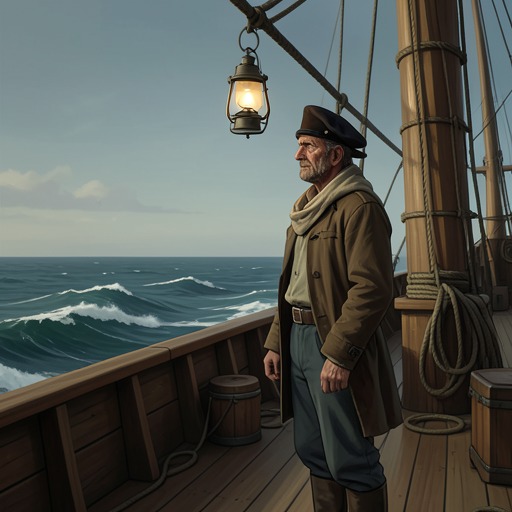
Callao
1919Callao is the United Fruit Company vessel that briefly gives Joe Williams work and a route out of Boston, then becomes the setting for a chain of delay, shore leave, and illness. Its role in the story is practical rather than heroic: Joe signs on expecting a short run and a chance to earn money, but the ship’s return voyage is interrupted at Roseau, and he falls seriously ill before the narrative records him back aboard. Through Callao, a working passage opens onto the company’s commercial power and the precariousness of the crew’s lives.
Service and purpose
In Boston, Joe has been unable to secure a berth despite repeatedly calling at the shipping agent’s office. After sitting around the Common and roaming the Public Garden, he signs on as quartermaster aboard Callao, a United Fruit Company boat. He expects the run to be brief and calculates that, within a couple of weeks, he will have earned enough money. That expectation is shaped by his wish to reach Norfolk and see Del: he has been writing to her daily, while her replies seem cool and focus on rent, spring clothes, and concern that her office might disapprove of her marriage.
The ship therefore enters Joe’s story as a means of employment and hoped-for reunion, not as a settled home. His decision answers the immediate problem of being broke and stranded, but it does not guarantee a straightforward passage or a quick return. The gap between the short run he anticipates and the events that follow gives the vessel’s ordinary commercial schedule an unforeseen personal cost.
The delay at Roseau
On the home trip, Callao waits for several days anchored in the roads at Roseau, Dominica, while the limes intended for loading are crated. The crew resents the port authorities, the quarantine, the delay in preparing the fruit, and the slow arrival of the lighters. The ship’s progress is thus held up not by a storm or battle but by the arrangements of loading and port procedure. Its cargo determines the timetable, while the men aboard spend the waiting time frustrated and idle.
On the final night in port, Joe and another quartermaster, Larry, accept a bumboat crew’s offer to take them ashore and land them down the beach, out of sight of the officers. Their excursion grows from impatience with the delay and a wish to evade supervision. In town, a young local calls a dish mountain chicken; Joe assumes the phrase means women, but learns that it is the island name for frog legs. The misunderstanding turns the men’s anticipation into a meal and a joke, while exposing the crew’s presumptuous assumptions about the place where their ship is waiting.
The company and its critic
The shore visit brings Joe and Larry to an older white man who takes them to his house. From its terrace, they can see the town, the dark hills, and Callao’s white hull lit by the work lights around the lighters. The view reconnects the men’s brief excursion to the vessel and its stalled cargo: even away from the deck, the ship remains the visible center of their work and of the port’s activity.
The host pours rum and denounces United Fruit Company as a monopoly. He argues that the company can let limes rot on the wharf if growers refuse its prices, while insisting that the crewmen themselves are not to blame for working for it. His criticism gives the delayed shipment an economic context beyond the crew’s annoyance: the fruit trade involves unequal power over prices as well as the practical business of loading. Joe and Larry drink as the old man talks about machinery for cotton spinning and cane crushing; they become very drunk and have little clear memory of getting back aboard. The episode leaves Callao associated both with the labor of moving fruit and with a system the men encounter most sharply when their work is interrupted.
Illness and separation from the ship
A couple of days after the excursion, Joe develops a fever and severe joint pain. He is out of his head when he is put ashore at St. Thomas, where he is diagnosed with dengue fever. He remains sick for two months, too weak even to write Del and tell her where he is. An orderly later tells him that he had been delirious for five days and that the hospital staff had given him up for dead. The account places the illness after the Roseau stop, but does not establish that the shipboard excursion caused it.
Joe is well enough to walk by July, but his recovery takes place ashore, not aboard Callao. He leaves the hospital and finds a place to sleep in an unused section of the marina barracks because one of the cooks there looks after him. In the account of this passage, the intended short run has ended not with the expected return and wages but with a prolonged illness and separation from the vessel. Callao’s narrative significance lies in that reversal: a berth that seems to promise a quick way toward Del instead carries Joe into an uncertain stretch of work, waiting, and sickness, with the ship’s route set by cargo and commerce rather than by his plans.