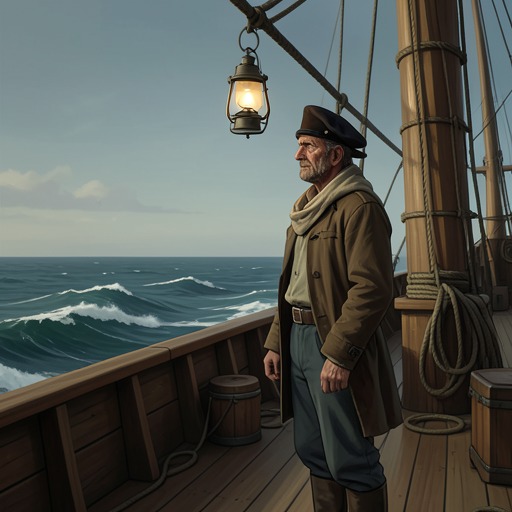
Appalachian
1919The Appalachian is a large new freighter that carries Joe Williams from a precarious life in New York City and Brooklyn into wartime merchant shipping. Its first voyage, bound for Bordeaux and Genoa, places him amid a scattered convoy, a badly weathered ship, and a burning tanker outside Genoa; its return voyage leaves him ill, but the experience precedes his training and work as a licensed second mate.
Entry into the Merchant Service
Joe signs on as an ordinary seaman after Mrs. Olsen throws him out. He has been borrowing money, drinking heavily, and spending nights at a mission in the cold. Afraid of arrest for evading the draft and fed up with his circumstances, he takes the Appalachian’s berth as an answer to immediate desperation as much as a choice of work. The ship’s lowly duties—swabbing decks and chipping paint—fit his sense that he is being treated like a jailbird again.
The forecastle holds country boys who have never seen the sea alongside older men whom Joe regards as worn-out bums. Four days out, the ship runs into a dirty blow. A small tidal wave smashes two starboard lifeboats, the convoy scatters, and the crew discovers that the deck has not been properly caulked: water keeps coming into the forecastle. The ship’s condition makes the hazard intimate, not abstract; the men sleep and live below a deck that is letting the sea in.
The storm also changes Joe’s position aboard. The mate finds him the only man on board he can trust at the wheel, so Joe is taken off paint-scrubbing and put on four-hour steering watches. The new responsibility gives him time to think about how lousy his life feels, but it also establishes his practical competence as a seaman. On arrival at Bordeaux, he would like to look up Marceline, yet none of the crew is allowed ashore.
Convoy Passage and Genoa
The Appalachian’s route continues around Spain, through the Straits, and up the French coast toward Genoa. Joe sees a single file of camouflaged freighters—Greek, British, Norwegian, and American—hugging the coast with lifepreservers stacked on deck and lifeboats swung out. Ships returning light from Italy and Saloniki pass in the opposite direction, including transports, colliers, hospital ships, and old freighters. French and British battleships remain at sea, while destroyers hail vessels and come aboard to inspect their papers. The traffic makes the voyage part of a larger wartime current, even when the shore looks peaceful.
The passage alternates between exposed water and vivid coastlines. After Gibraltar the weather turns sunny; the Spanish shore is green beneath bare pink and yellow mountains, with white houses clustered into towns. In the Gulf of Lyons, drizzle, fog, and choppy water bring the Appalachian close to colliding with a wine-laden felucca. Farther along the French Riviera, a hard northwest wind drives the ship past bright red-roofed towns, dry hills, and snow-covered peaks; after Monte Carlo, brightly colored houses and pointed church steeples give the coast a seemingly festive aspect.
At night near Genoa, a red glare ahead prompts a rumor that the Germans have captured and are burning the town. The second mate urges the skipper to turn back to Marseille, but the skipper dismisses his warning. The light proves to be a large new Standard Oil tanker burning outside the breakwater. From the Appalachian, the crew can see flames pouring from its forward end, fire spreading over the water, and the harbor, lighthouses, and houses on the hills reflected in red. The ship anchors nearby, making the fire a direct encounter rather than distant news.
The Burning Tanker
The bosun takes Joe and two younger sailors in a dinghy to see whether they can help aboard the tanker. Its stern is high out of the water, and they see no one aboard; men in a motorboat come close, but the sailors pretend not to understand them. A fireboat stands by without being able to do anything. Joe spots a rope ladder hanging into the water and climbs aboard before the others can stop him. He finds the forward deck and surrounding sea lit by fire, clothing and seabags abandoned near the davits, and no crew in sight. He takes a new sweater, then goes below and finds Havana cigars on a table and lights one.
The bosun calls from the dinghy for Joe to come back. Joe takes a wallet from the companionway, then descends the ladder slowly, smoking and looking over the red-lit harbor. He tells the others that the fire is crude oil, not gasoline, and that the tanker might burn for a week. The wallet is empty. The sailors divide the cigars, while Joe keeps silk stockings he has found aboard. Their brief, risky visit yields no rescue and no useful information about the missing crew; they return to the Appalachian and report that the tanker has been abandoned and that the port authorities must deal with it.
The fire continues to shape events around the freighter. The tanker burns all the next day; near nightfall another tank explodes and the blaze spreads farther across the water. The Appalachian then heaves anchor and moves to the wharf. That night Joe and the bosun go into town, where narrow stepped streets climb toward broad avenues, cafés, and colonnades. The burning ship’s setting has changed from an apparent enemy attack to a maritime emergency, but it remains a presence in the harbor as the crew comes and goes.
Return and Later Voyages
When the Appalachian clears for home, the tanker is still burning outside the harbor. Joe comes down with a dose during the voyage back and cannot drink for several months. Once he reaches Brooklyn, he steadies down. The account does not describe the illness further, but its immediate consequence is plain: the voyage ends with an enforced break from the drinking that had marked his earlier life.
Joe then attends the shore school run by the United States Shipping Board at Platt Institute and earns his second mate’s license. Throughout the year he makes repeated trips between New York City and St. Nazaire aboard the Owanda, a new wooden boat built in Seattle that brings its own share of trouble. In that sequence, the Appalachian is the first vessel in a progression: it takes Joe into the work, tests his skill at the wheel, and carries him through the Genoa fire before he pursues formal advancement and steadier maritime employment.
Narrative Significance
The Appalachian is both a workplace and a moving vantage point on wartime shipping. Its storm damage, lifeboats, watches at the wheel, convoy traffic, and anchorage beside the tanker give material form to the risks surrounding merchant sailors. The contrast between the ships’ orderly coastal passage and the sudden fire outside Genoa captures how quickly routine travel can become an emergency.
For Joe, the ship’s significance lies in a practical change of status rather than a grand transformation. He begins as a desperate ordinary seaman, subject to rough conditions and menial work; the mate’s trust puts him at the wheel, and the voyage is followed by training and a license. The Appalachian does not resolve all of his instability, but it connects his drift through hardship to a developing skill and a more sustained career at sea.