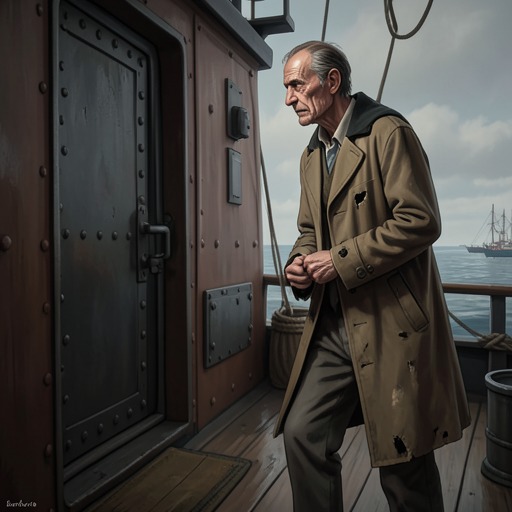
North Star
1919The North Star is the merchant ship Joe Williams joins for a wartime voyage to France and later sails on toward Cardiff. A former Great Lakes oreboat whose leaks keep its pumps working much of the time, it is both a precarious workplace and the setting for the episode that changes how Captain Perry sees Joe. Its eventual destruction leaves the crew alive, but turns Joe’s practical response in a moment of danger into a possible path out of the forecastle.
A leaking ship in wartime service
The North Star is bound for St. Nazaire with a cargo recorded as canned goods, though the men know it is shell caps. The crew receives danger bonuses for taking the ship through the war zone. Its unusual whaleback form reflects its earlier life as an oreboat on the Great Lakes, and its condition is far from reassuring: it leaks badly enough that the pumps have to run about half the time. Even so, Joe likes the group aboard, and the food is good. The ship is not simply a danger to be endured; for a time, it is also a tolerable home and workplace among men he likes.
Captain Perry has returned to sea after spending a couple of years ashore at Atlantic Highlands. He is trying to make money for his daughter, and Joe hears him tell the mate, with a wheezy laugh, that she will get the insurance anyway. The remark gives the voyage’s financial stakes a grim edge: the captain has a family to provide for, while the danger premium and insurance belong to a world in which the loss of a ship and the loss of life are understood as possibilities of the job.
The North Star makes a smooth winter crossing with the wind behind it until the Bay of Biscay. Near the French coast, the weather is very cold and the sea is calm; the land appears low and sandy at the mouth of the Loire. The crew raises its flag and signals the ship’s name while Sparks works overtime. The men are nervous about mines, and a French patrol boat eventually comes out to lead them through the winding channel between the minefields and into the river. The ship’s passage depends not only on its own crew but on being identified and guided safely through a dangerous route.
The return voyage and the submarine
The North Star’s return is slow but, at first, uneventful. After only a week in Hampton Roads, it loads steel ingots and explosives and clears for Cardiff. Captain Perry takes a northerly course, and the ship runs into heavy fog. After a week of icy weather and a large following sea, Rockall comes into sight. Joe is at the wheel when the inexperienced lookout mistakes the rock for a battleship; Captain Perry recognizes it through his binoculars and laughs.
The next morning, with the Hebrides to the south, a lookout in the bow hails a submarine. Its periscope leaves a white trail of foam, followed by the dripping conning tower. Once surfaced, the submarine fires across the North Star’s bows with a small gun, its crew still on wet decks. Joe runs aft to raise the flag, although the ship’s name and flag are already painted on both sides of the hull. Captain Perry orders full speed astern. The attackers stop firing and approach in a collapsible punt. With the North Star’s crew wearing life preservers and some men going below for their belongings, a German officer boards and gives them five minutes to abandon ship.
Captain Perry hands over the ship’s papers, and the boats are lowered. Joe runs back to the boat deck and uses his jackknife to cut the lashings on the liferafts. He and Captain Perry, with the ship’s cat, are the last to leave. The Germans have planted bombs in the engine room and row back toward the submarine. The North Star explodes just as the captain’s boat pushes off, striking it hard enough to swamp it. The men find themselves in icy water among planking and wreckage. The ship sinks quietly, its flag still flying and its signal flags blowing in the breeze: a final, vivid contrast between the vessel’s formal signals and its destruction.
Survival and the ship’s aftermath
Two boats remain afloat. After the North Star has sunk, the men make their way onto the liferafts, and the mate’s and chief’s boats take them in tow. Captain Perry calls the roll; no one is missing. The submarine has already submerged and left. The survivors begin pulling toward shore, but the tide carries them toward the Pentland Firth. When it turns, they cannot make headway against the ebb, which one man says runs at eight knots an hour. Men in the boats and on the rafts take turns at the oars through the night.
At dawn, a British scout cruiser approaches. Its searchlight suddenly glares into the survivors’ faces, and the crew takes them aboard and down to the engine room to warm up. A steward brings steaming tea with rum. The cruiser carries them to Glasgow, where they stand in the drizzle while Captain Perry goes to find the American consul. The survivors’ ordeal does not end with rescue: they are housed for twelve days in a tarpaper shack inside a barbed-wire enclosure before being told they can go home aboard the Vicksburg.
Joe’s action and the North Star’s significance
On the homeward voyage, Captain Perry tells Joe he has not yet had the chance to praise his presence of mind in cutting the raft lashings. He says half the men owe their lives to Joe, calls him bright, and urges him to study for a merchant-marine officer’s position. The American merchant marine, Perry observes, is growing during the war and needs young men like him. He offers to see what he can do about Joe’s prospects when they reach Hampton Roads, noting that Joe could obtain a third mate’s ticket with some time at a shore school.
The North Star therefore matters not only as the ship the submarine destroys, but as the material setting in which Joe’s ability becomes visible to someone with authority to help him. The leaking oreboat carries him into danger and is lost, yet the evacuation leaves the crew alive, and Joe’s decision to free the rafts earns him a new possibility. On the Vicksburg, he looks forward to telling Del that he may be able to leave the forecastle behind. The ship’s loss is irreversible; the opportunity its sinking opens for Joe is not a reward for the destruction itself, but a consequence of what he did as the North Star was being abandoned.