Tsubasa
1Q84Tsubasa is a ten-year-old girl who reaches the Dowager’s safe house after repeated sexual abuse in the Pioneers’ community. Her injuries are severe, and for weeks she cannot speak; even after finding safety, she remains withdrawn and nearly expressionless. Through Tsubasa, the private violence concealed behind the community’s respectable public image becomes concrete. Her almost wordless presence also ties that violence to the Little People and the story’s uncanny world.
Identity and Arrival at the Safe House
The consultation office sent Tsubasa to the safe house six weeks before the Dowager described her case to Aomamé. Before that, the child had been sleeping in a train station and was passed from place to place in a pitiable condition. Those caring for her initially knew only her name and age. During her first month in the refuge, she did not speak at all, seeming absent and having lost the use of speech. The Dowager spent considerable time talking to her and trying to make her understand that she was safe and need not be afraid. Tsubasa eventually began to say a few words, though her speech remained confused and disconnected.
Relationship with Aomamé and the Little People
When the Dowager introduced Aomamé as a woman who worked with her and assured Tsubasa she need not be worried, the girl gave Aomamé a quick glance and a barely perceptible nod. The exchange is small but marks a first, tentative acknowledgment of another person in the refuge. Asked how long she had been there, Tsubasa only moved her head slightly; the Dowager supplied the exact count, six weeks and three days, showing how closely she had been keeping track of the child’s stay.
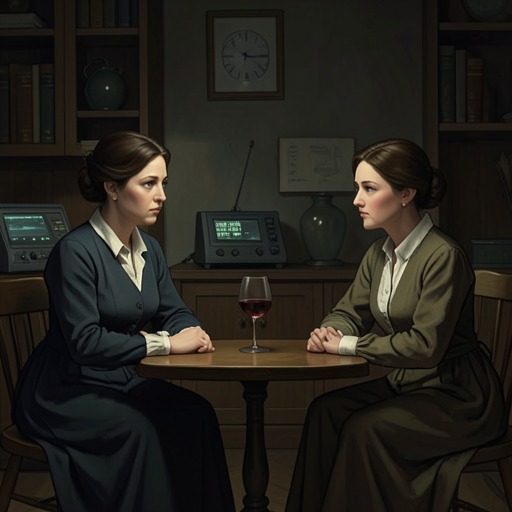
Later, Aomamé asked Tsubasa who the Little People were. Tsubasa managed to say the name, but immediately shut her mouth, and her eyes returned to their former darkness, as if speaking those two words had consumed nearly all her strength. Her hands remained still on the table, and her opaque gaze fixed on a point in the air. The brief utterance does not explain what she knows, but it makes the Little People a point of contact between the child’s traumatic past and the novel’s uncanny events: naming them is possible, while saying more appears beyond her capacity.
Abuse and Its Physical Consequences
The Dowager explains that Tsubasa was repeatedly raped and that the injuries were grave: her external genitalia, vagina, and uterus had been badly damaged. The doctor believed she would never be able to become pregnant. Even if her uterus somehow recovered, the damage would make sexual intercourse severely painful, with the pain recurring each time; the Dowager also doubts that Tsubasa would later want sexual relations at all. As this account is spoken in the child’s presence, Tsubasa listens without expression, moving her mouth occasionally but making no sound. She seems to regard the conversation as belonging to someone far away. Her silence is not evidence that the violence has left no mark: it accompanies injuries whose consequences extend into her future, while also making the extent of what she can bear to hear impossible to read.
Public Image, Hidden Violence, and Aftermath
The public account of the Pioneers sharply contradicts what Tsubasa’s case reveals. After the bloody conflict involving the Dawn, newspapers portrayed the Pioneers as a spiritually minded community forced to eliminate a diabolical revolutionary offshoot. The press treated the violence as an anachronistic final episode from a vanished political era, while presenting the Pioneers as a promising alternative. Aomamé, remembering Tsubasa’s depthless, unseeing eyes, recognizes the gap between this polished picture and the community’s concealed abuse: the leader’s sexual assaults on girls of ten or younger were presented as religious acts, but reporters who toured orderly exercise rooms, ate fresh food, and heard explanations of spiritual awakening had not seen what took place behind the scenes.
Tsubasa’s condition also leads Aomamé to connect her case to a broader pattern. Teachers, she learns, describe children from the Pioneers’ community as initially cheerful and apparently ordinary, then increasingly quiet and emotionally dulled as they grow older, until many stop attending school. Because outsiders are barred from the community’s grounds, teachers cannot learn what becomes of those children. Aomamé recognizes in their reported near-mutism and extreme insensibility the same symptoms she sees in Tsubasa, and raises the possibility that children in the group are systematically mistreated and raped. The resemblance turns the girl’s suffering from an isolated, hidden case into a reason to question what the closed community may be doing to its other children.
Tsubasa’s life in the safe house continues under the Dowager’s daily care. When Aomamé later asks Tamaru how the girl is doing, he says that she seems well and appears to have grown attached to the Dowager, who visits and looks after her every day. This attachment offers a modest sign of connection after her initial weeks of silence and fear. It does not erase the injuries or disclose how much Tsubasa can communicate, but it establishes that safety and sustained care have begun to matter in her present life.
Tsubasa’s role in the narrative is therefore both intimate and evidentiary. Her nearly wordless presence gives physical and emotional weight to the violence concealed by the Pioneers’ spiritual reputation, while her brief naming of the Little People links her traumatic history to the novel’s uncanny strand without explaining it away. The contrast between her almost imperceptible gestures and the confident public stories told about the community makes the limits of outside knowledge part of her significance: her suffering is visible in its consequences, even when she cannot give it a full account.