Fukaéri
1Q84Fukaéri, also known as Eriko Fukada and Eri, is a seventeen-year-old high-school student whose manuscript Air Chrysalis sets Tengo to work and draws him into the world she describes. Dyslexic and unable to write the text herself, she nonetheless supplies its imaginative force: she says the Little People are real, and the book’s story echoes her childhood in a mountain commune. Her composed silence offers no easy key to whether that account is literal, fictional, or both, while her brief approval of Tengo’s rewriting gives their collaboration its uncertain beginning.
Identity and Introduction
Komatsu introduces Fukaéri to Tengo as a potential prize-winning author. The proposed public name is a shortened form of her full name, Eriko Fukada; she is seventeen, still at school, and, in Komatsu’s calculation, an appealingly photogenic young writer whose success could drive sales and attract the press. He gives Tengo two color photographs in a brown envelope: one a portrait and the other a full-length image, both showing a slender girl with long straight hair and a smile that does not reach her serious eyes. Tengo is struck by the photographs and by the return of a pain associated with his own adolescence. Komatsu tells him to keep them, and Tengo places the envelope on the manuscript.
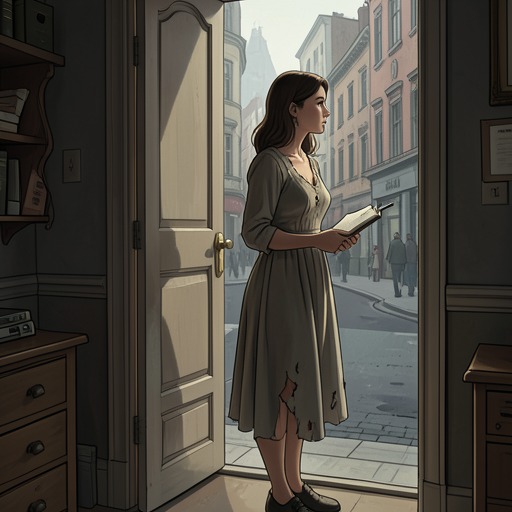
The person who arrives to meet Tengo is more arresting than the photographs. Fukaéri comes in at 6:22, led to the table by a server, and sits opposite him without taking off her coat. She offers no greeting or apology for the delay; instead, she fixes him with an almost unblinking gaze. Her small, delicate appearance and striking dark eyes heighten Tengo’s discomfort, while her slightly mismatched eyes make her beauty difficult to classify. She seems remote and hard to read, yet also draws attention. That combination—an absence of ordinary social cues and a power to hold another person’s gaze—shapes Tengo’s first encounter with her.
The Manuscript and Its Rewriting
Before meeting Fukaéri, Tengo has already questioned whether her manuscript could win a major literary prize. He considers it underworked in reading and writing exercises, but worth advancing to the final selection. He proposes that it be shortlisted rather than immediately expected to win, leaving room for her to write another work later. The distinction matters: the project is not simply an appraisal of an existing manuscript but an attempt to make a striking, imperfect text publishable.
At dinner, Tengo explains that someone submitted Air Chrysalis to a publisher for a new-writers’ prize and that Komatsu judged it remarkable. Fukaéri repeats the title, narrowing her eyes. When Tengo asks whether she consents to his rewriting it, she answers simply, “Fais-le…” She then adds that he should write as he wishes. Her permission is concise, but it is the necessary basis for the work: Tengo has insisted he cannot decide to rewrite her book without her agreement and collaboration.
Tengo starts before he has secured what he calls her final authorization, explaining that time is short and that Komatsu told him to begin. The work is demanding. Rewriting the opening takes nearly a full day; he corrects passages in pencil on printed pages, enters the revisions into a word processor, and compares the effect of the text on paper and on screen. He finds that the same sentences feel different in each medium. After a concentrated day, he judges the opening provisionally sufficient, though he expects to revisit it.
As he revises, Tengo believes he has grasped the world Fukaéri tried to describe. The scenes, initially conveyed through her limited and distinctive vocabulary, become clearer and more vivid in his careful prose. Although his changes are meant to be technical, the result seems to him to flow naturally, as if the story had been his from the outset; he is pleased that its imaginative world has gained sharper definition. His labor also excites him: after leaving the desk, he already wants to return. Yet this artistic closeness is not matched by personal knowledge. He knows that Fukaéri is seventeen, in her final year of high school, uninterested in university entrance examinations, fond of white wine, and unusually beautiful, but he cannot imagine how she will respond to the altered manuscript or read her expression.
Childhood and the Story of the Blind Goat
The central events in Air Chrysalis connect its heroine to Fukaéri’s childhood. At ten, she lived in an unusual mountain commune where each child had an assigned task. Hers was to watch an old blind goat, a creature held to have special importance for the community. She had been told not to leave it unattended. When she neglected her duty and the goat died, the adults punished her by locking her in an old earthen storehouse with its corpse for ten days. She was isolated from everyone and forbidden to speak with anyone.
In the story’s account, the goat serves as a passage between this world and the world of the Little People. They travel through its corpse at night to enter this world, then leave again at dawn. The child does not know whether these beings are good or evil, and neither does Tengo. She can speak with them, and they teach her how to make an air chrysalis. Tengo admires the precise description of the goat’s habits and behavior, which gives the manuscript’s strange events a concrete, lived texture. He wonders whether Fukaéri really tended such an animal and lived in such a community; if she had not, he concludes, the narrator would need exceptional imaginative talent.
The text does not settle the relation between Fukaéri’s life and the manuscript. The childhood account is presented through Tengo’s reading of Air Chrysalis, and he can only speculate about its factual basis. That uncertainty is sharpened when Fukaéri tells him that the Little People exist “Comme toi et moi…” and says that anyone who wants to see them can do so. Her calm certainty contrasts with the strangeness of the claim, while Tengo remains unsure whether her manner reflects candor, natural eccentricity, or a deliberate performance. He recognizes the force of her words without claiming to understand their source.
Authorship, Disability, and Public Identity
When Tengo asks whether she may have been unable to write Air Chrysalis herself, Fukaéri confirms that she did not write it. Later, the Master explains the practical reason the distinction matters: Fukaéri is dyslexic. The condition is likely congenital, and her school once regarded her as intellectually delayed because of it, though the Master emphasizes that she is in fact highly intelligent and full of ideas. The manuscript’s publication plan will name her as its author even though she could not compose its written text herself; the arrangement rests on the collaboration between her imaginative contribution and Tengo’s rewriting.
The Master also makes clear that dyslexia could create complications for a project presenting Fukaéri publicly as an author. Her difficulty with reading does not erase her intelligence or the ideas embodied in the story, but it exposes the gap between literary authorship as a public label and the distinct acts of conceiving, dictating, and writing a text. Fukaéri’s terse assent to Tengo’s work is therefore more than a convenient plot device: it establishes her consent while leaving the precise boundaries of their shared authorship unsettled.
The projected prize ceremony makes that tension visible. Komatsu says the award ceremony is to be held on May 16 at a hotel in Shimbashi, followed by a press conference, and that Fukaéri should attend at least on that occasion. If there is no serious mistake, the team will afterward insist on strict respect for her privacy, explaining that the author dislikes appearing in public. The intended publicity and the planned retreat from publicity sit side by side: the manuscript needs an author whom the press can see, while the people managing its publication anticipate protecting her from continued exposure.
The Little People and Narrative Significance
Fukaéri’s statements about the Little People are spare and consequential. She says they exist as surely as she and Tengo do, and that those who wish to see them will see them. Later, when the Master cautiously considers what might have happened inside a closed, tightly bonded group, Fukaéri quietly says that it was because the Little People came. She does not explain further. Tengo asks whether their arrival changed the Pioneers, but she does not answer; instead, she fingers the button at her collar.
The Master admits that he cannot make full sense of Fukaéri’s descriptions of the Little People, and that she either cannot or does not wish to explain what they are. He nevertheless sees the beings—or beings like them—as potentially important to the agricultural Pioneers’ sudden turn into a religious sect. His formulation preserves the same uncertainty that marks Tengo’s reading: the Little People may be supernatural presences, or the name may point toward something else, but Fukaéri’s narrative associates their arrival with a consequential change in the community.
Fukaéri thus occupies two roles that the novel does not neatly separate. She is the apparent author whose name will stand on the published book, and the person whose lived or imagined experience gives that book its charged material. Her dyslexia makes the mechanics of authorship visible; her collaboration with Tengo transforms the manuscript without resolving who can claim its language. And her refusal—or inability—to explain the Little People keeps the story’s central account suspended between testimony and mystery. The result is a character whose silence does not empty the narrative but concentrates its unanswered questions.