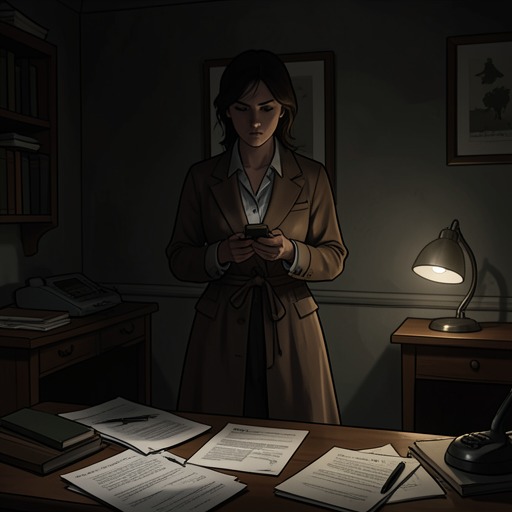
Tamaki Ootsuka
1Q84Tamaki Ootsuka is Aomamé’s first and most enduring friend: a perceptive softball captain whose brief adolescent intimacy with Aomamé becomes inseparable from a friendship shaped by loneliness, and whose suicide after years of domestic abuse leaves a lasting mark on Aomamé’s life. Through the memories of their athletic partnership, a single night of physical closeness, and the letter Tamaki wrote before her death, the novel presents a bond that offers refuge but cannot save Tamaki from the private violence she cannot escape.
Identity and Background
Tamaki and Aomamé are the same age and attend a municipal high school in Tokyo, where they play together on the softball team. Tamaki is short, quick, and exceptionally intelligent on the field. As the second baseman and team captain, she reads complicated situations swiftly, adjusts her position to each pitch, tracks the direction of a hit, and runs to cover the place where the ball will arrive. Her sure, sharp hitting and speed complement Aomamé’s power at the plate.
Tamaki’s leadership extends beyond her playing ability. She motivates the team, devises plans, offers useful advice, and encourages the other players. Though strict, she is well liked. Under her captaincy, the team improves steadily, reaches the final of Tokyo’s major competition, and competes in the inter-high-school championship. Both Tamaki and Aomamé are selected for the Kantō regional team.
Their talent gives each girl a place to belong, but neither’s home life offers security. Aomamé has broken with her parents and lives with a maternal uncle’s family; they welcome her, yet she still feels like an outsider, lonely and unsure where to find purpose. Tamaki’s family is wealthy and socially prominent, but her parents’ severe marital discord makes home difficult. Her father is often absent, her mother suffers confusion and debilitating migraines, and Tamaki and her younger brother are left largely to fend for themselves, frequently eating at neighborhood restaurants or relying on fast food and supermarket snacks. Softball becomes, for both girls, something to hold on to amid problems they struggle to resolve elsewhere.
Friendship and Adolescent Intimacy
Aomamé and Tamaki grow close through mutual respect rather than any deliberate pursuit of friendship. On team trips they spend long hours together, sharing their childhoods without concealment. Aomamé’s isolation and hunger for affection meet Tamaki’s own family troubles; their companionship gives each a trusted person with whom she can speak openly. Aomamé later remembers Tamaki as the one friend to whom she could admit anything, and says that no one before or after her ever took her place.
During a summer trip taken alone—their first such journey as friends—the girls bathe at a hot-spring establishment, share a can of beer from the refrigerator, and go to bed in a hotel room with a single narrow bed. Joking and lightly swatting at one another, they cross into sexual touching when Tamaki gently pinches Aomamé’s nipple through her thin T-shirt. They remove their clothes and explore each other’s bodies, laughing at their physical differences as well as touching and kissing. The encounter happens once; they never repeat it or discuss it afterward. Aomamé recalls it not as the beginning of an ongoing sexual relationship but as an unusually vivid, intimate episode that strengthened their closeness.
Years later, while descending a metal emergency stairway, Aomamé cannot keep the memory from returning. The recollection comes with the buoyant brass of Janáček’s Sinfonietta in her mind, and she remembers the narrow summer bed, the girls’ laughter, and the physical details of Tamaki’s body. The setting sharpens the contrast: Aomamé tries to concentrate on the dangerous descent, but memory interrupts her, and a violent wind lashes her face. Her thoughts turn from the encounter to forgotten promises and unrealized hopes, then to time itself, which seems to lose its order as the dates of her life scatter like cards in the wind. Tamaki is present here not only as a remembered friend but as part of a past Aomamé can no longer arrange securely.
Marriage, Abuse, and Death
As contact between the friends dwindles, Aomamé’s days become increasingly empty. She loses much of her former enthusiasm for softball and, at twenty-five, has no close friend or boyfriend to call. She has come to regard deep relationships as painful and solitude as preferable. Tamaki, meanwhile, marries a violent and sadistic man. The abuse begins early in the marriage and grows worse; although she is unable to leave, she does not tell Aomamé. She fears that her friend would say she had been warned and urge her to leave immediately.
Three days after her twenty-sixth birthday, on a windy late-autumn day, Tamaki hangs herself at home. Her husband, away on a business trip to Hokkaidō, finds her the following evening. He tells police that their home life had been fine and that he knows no reason for her suicide; Tamaki’s parents offer the same account. The statements conceal the prolonged physical and psychological abuse. The police infer something of Tamaki’s condition from her body, but the husband is treated only as a witness, and the death is recorded as suicide. Tamaki’s younger brother later tells Aomamé the truth in confidence.
Shortly before her death, Tamaki writes Aomamé a long letter. She says that her life has become a daily hell and that she cannot escape it or imagine where she could go. She describes herself as imprisoned by her own powerlessness, acknowledges that the marriage was a mistake—as Aomamé had said—and insists that her deepest problem lies within herself. She blames no one, calls Aomamé the only person in the world she trusted, and asks to be remembered. Her final wish is that they could have played softball together forever. The letter makes explicit both the importance of their friendship and the terrible distance between being trusted and being able to rescue someone.
Aomamé reads the letter, trembles, and repeatedly tries to call Tamaki, reaching only a recorded message. She takes a train to Tamaki’s house in Okusawa, in Setagaya, and rings the intercom at its high-walled residence. No one answers; a dog barks. Unbeknownst to her, Tamaki is dying inside, alone, with a rope tied to a stair rail. The phone and doorbell sound without response. When Aomamé later learns of the death, she is scarcely surprised. She cannot attend the funeral; instead, she shuts herself away, barely eats or sleeps, and remains seated for a long time after switching off the telephone. She feels that something inside her has broken and been replaced, and that she has crossed a boundary.
Aomamé’s Retaliation and Tamaki’s Afterlife
Tamaki’s death becomes the cause of an action Aomamé will carry as both an answer to injustice and an irreversible burden. She spends nearly a year preparing, then enters the abusive husband’s home and pierces the back of his neck with a fine needle. The puncture leaves neither a visible mark nor a drop of blood, and Aomamé arranges matters so that his death appears natural, the result of illness. No one suspects her. She does not believe she acted wrongly, but the knowledge that she deliberately killed another person remains heavy even when guilt does not.
Much later, in a private conversation with the Dowager, Aomamé finally tells the story she has kept to herself: the abuse Tamaki endured, the suicide after years of suffering, and the careful killing of the man responsible. The Dowager listens without interrupting, asks about details she does not understand, and then holds Aomamé’s hand firmly for a long time. She tells her that the act was right: if the husband had lived, he would have found other women to abuse, and Aomamé had cut the evil off at its root. Her judgment does not erase the weight of the killing, but it gives Aomamé a witness to the secret and a reason to understand her act as more than personal revenge.
The confession opens onto the Dowager’s own history. Her daughter, too, married a man whose violence steadily stripped away her self-respect and confidence until she could not escape the marriage; she died after taking sleeping pills with whisky. The Dowager explains that she herself made a man disappear for similar reasons. The parallel does not make the two cases identical, but it links Tamaki’s hidden suffering to a wider pattern of abuse, silence, and belated intervention. For Aomamé, Tamaki remains the friend whose trust she could not turn into rescue in time—and whose memory, instead, shaped the action she took afterward.
The Dowager’s response to Aomamé’s confession draws Tamaki’s story into a wider pattern of violence concealed inside marriage. The Dowager tells Aomamé that her own daughter had married a man whose perversity and earlier troubles made the marriage seem dangerous from the start, though no one could prevent it. As the abuse grew severe, the daughter lost her self-respect and confidence, sank into depression, and could not reclaim her independence. She eventually swallowed a large quantity of sleeping pills with whisky. The autopsy revealed bruises, blows, signs of fractures, cigarette burns, deformed nipples, and marks on both wrists from tightly bound cords. The husband admitted to some violence but claimed it had been consensual sexual play. His account echoes the secrecy surrounding Tamaki’s marriage: injuries could be visible, yet the victim’s suffering was still misrepresented or left without consequence. By placing the two women’s deaths beside one another, the novel shows how private abuse can persist behind respectable appearances, while Aomamé’s act of retaliation emerges from a grief tied to a recurring, not isolated, pattern.