Tengo Kawana
1Q84Tengo Kawana is a mathematics teacher who also writes novels, and his decision to rewrite Fukaéri’s La Chrysalide de l’air turns a manuscript that has captivated him into the center of a risky literary undertaking. His work begins not with a new story but with a deliberate separation of content from style: he intends to retain the text’s underlying structure while recasting the language through his own judgment and craft.
Identity and Introduction
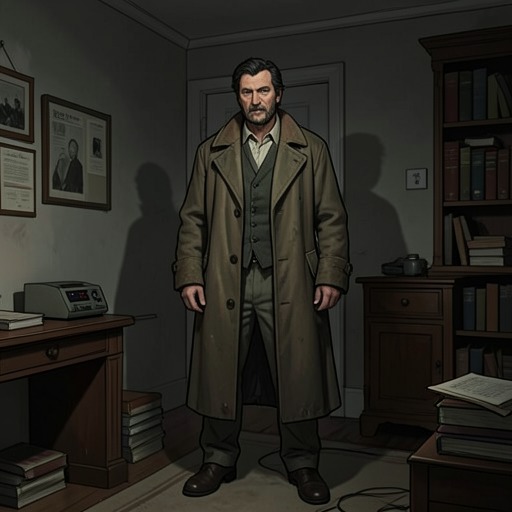
At the time Komatsu approaches him, Tengo teaches mathematics at a preparatory school in Yoyogi. He studied mathematics at university, but writing fiction is also part of his life. The Maître knows these details through Éri and confirms them with Tengo directly, identifying the unusual conjunction of his professional discipline and literary ambition.
Tengo’s entrance into the project is marked by an ordinary interruption made uncanny by its timing. Early on a Friday morning, just after five, Komatsu calls while Tengo is asleep. Tengo has been dreaming that he is crossing a long stone bridge over a broad, beautiful river to retrieve an important document left on the other bank. The river’s sandbanks, willows, and visible trout give the dream an uncommon precision; when the telephone wakes him, he is still mentally on the bridge. Before lifting the receiver, he already knows who is calling.
Komatsu’s Proposal
Komatsu dispenses with a greeting and asks whether Tengo has a word processor. Tengo does not own one, but says he knows how to use one from his work at school. Komatsu immediately instructs him to buy a machine that day, leaving the make and model to Tengo because he knows little about equipment himself. The cheapest machines cost 250,000 yen, but Komatsu says the price is no obstacle and promises to reimburse him. The point of the purchase is urgent: Tengo is to use the machine to rewrite La Chrysalide de l’air and begin as soon as possible.
The bluntness of the call reflects Komatsu’s way of acting. He has stayed up through the night and remembered, just before going to sleep, that he must speak to Tengo. He judges quickly, commits without hesitation, and acts without waiting for the approval of those around him. Tengo sees in Komatsu an editorial instinct and decisiveness that he himself lacks. Komatsu’s confidence that Tengo is the only person capable of the work helps bring him into the scheme: although Tengo knows Komatsu might abandon him without looking back if circumstances demanded it, he trusts the editor’s judgment in literary matters.
The Work of Rewriting
By half past noon, Tengo has begun. He types the opening pages of La Chrysalide de l’air onto the screen, stopping at a point where the work can be considered in a manageable section. His first aim is to revise that portion until he is satisfied, without changing what happens in it. He approaches the manuscript as a structure to renovate: preserve the sound framework, but replace or repair what can be changed, as one might renew a room while leaving its essential arrangement intact.
That distinction guides his method. Tengo adds explanations where the original is difficult to understand on a first reading, smooths the movement of sentences, cuts unnecessary material and repetition, fills gaps, and sometimes rearranges sentences or paragraphs. Fukaéri’s original uses very few adjectives and adverbs, a quality he generally preserves, though he adds a precise descriptive word when he judges it necessary. He is not simply correcting errors; he is deciding how much of the manuscript’s distinctive texture must survive a more fluent and accessible version.
The source’s childlike style makes that editorial judgment possible in some respects and difficult in others. Tengo finds it relatively easy to distinguish stronger passages from weaker ones, and to decide what to select. Yet the very quality that makes parts of the work hard to understand also gives other passages a freshness he does not want to lose. He removes obscurity while protecting that freshness, treating the manuscript neither as finished prose to be copied nor as raw material whose original character can be discarded.
Risk, Motivation, and Significance
When the Maître asks why he accepted, Tengo answers that for eight days he has been asking himself the same question. Reason, common sense, and instinct all advised him to withdraw. He describes himself as cautious and reasonable, not a gambler or adventurer, and admits that he is fearful in matters of this kind. Nevertheless, he could not refuse Komatsu or undertake the project without being drawn into its danger.
His explanation turns on the manuscript itself. Tengo says that La Chrysalide de l’air fascinated him; had Komatsu offered him any other manuscript, he would have refused immediately. The Maître tests whether Tengo is considering the project through the profound interest of rewriting the text rather than its fraudulent aspect. Tengo’s account establishes the attraction as his decisive motive, without erasing his awareness that the enterprise is risky. The bridge in his early-morning dream, with an important document waiting across the water, resonates with this passage into unfamiliar work, while the text gives him a reason to cross despite every cautious impulse urging retreat.