Tamotsu Fukada
1Q84Tamotsu Fukada is a former university intellectual, revolutionary organizer, and founding guide of the Pioneers whose political project divides against itself. He helps build an agricultural community as both a refuge and an experiment in understanding communal life, but his former students interpret his revolutionary language more literally than he intends. After the Pioneers split in 1976, Fukada remains with its moderate faction while the militants move elsewhere and take the name L’Aube. His later disappearance from public view turns the community he helped create into a source of fear and unanswered questions; Professor Ébisuno suspects that Fukada and his wife cannot leave because they know too much about its transformation.
Revolutionary beginnings
Fukada enters the account through Professor Ébisuno’s recollection of the university conflicts that shaped their lives. Ébisuno says that he left the university first; Fukada was forced out two years later. At the time, Fukada supported Mao Zedong’s revolutionary thought and the Cultural Revolution in China. Its inhumanity was not yet widely understood among the intellectuals who treated the Little Red Book as a fashionable ideological emblem. Fukada organized students into a radical group modeled on the Chinese Red Guards, participated in a university strike, and attracted supporters from other faculties. As the group grew, university authorities called in riot police. Fukada and his students, barricaded inside the campus, were arrested and sent before a criminal court; Fukada was subsequently dismissed. Eri was very young, and Ébisuno assumes she remembers none of this.
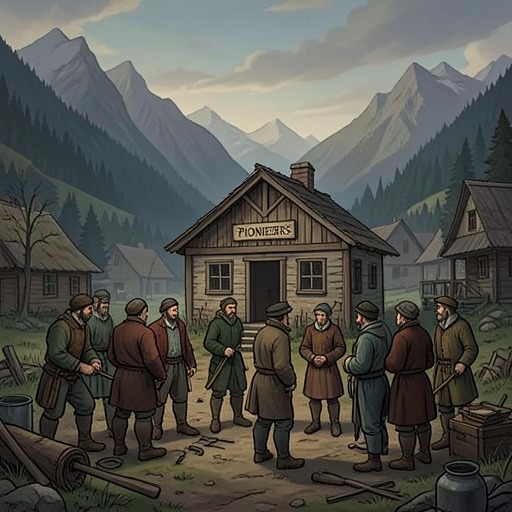
After the dismissal, around ten members of Fukada’s former student nucleus followed him into the Takashima Course. Most had been expelled from university and needed somewhere to go. For Fukada, Takashima was not the realization of his ideal but a temporary refuge and a system to investigate. He and his students were city people with no practical farming knowledge, so they began with agricultural basics, learned distribution and the limits of self-sufficiency, and studied the concrete rules of communal life. It took about two years to absorb and assess the system. Fukada then regained autonomy, leaving with a group of young people after examining Takashima’s strengths and weaknesses.
Building a community and dividing it
The people who gathered around Fukada were not a single political constituency. His original circle of former students was joined by disappointed idealists, people seeking hippie-style communal life, left-wing students disillusioned after campus struggles, and others dissatisfied with conventional life and searching for a new spirituality. Many were single, but Fukada’s family was among the families in the group. Ébisuno describes Fukada as the leader they naturally rallied around: imposing in stature, eloquent, sharply intelligent in judgment, and charismatic. Fukada and Ébisuno seemed opposites—one a political leader, the other a solitary and apolitical scholar—yet they were close friends who respected and trusted one another. Ébisuno calls Fukada the only close friend he had in his life.
Under Fukada’s initial leadership, the Pioneers’ agricultural operations became established. The community’s flexible unit structure, however, allowed two sharply different orientations to take shape. The militant faction, whose core consisted of Fukada’s former Red Guard-style group, regarded farming as preparation for revolution: its members concealed their purpose behind agricultural work and intended to take up arms when the moment came. The more numerous moderate faction rejected capitalism too, but kept its distance from politics and wanted communal, self-sufficient life close to nature. Ordinary farm work could continue, but decisions about the community’s direction repeatedly provoked disputes and fierce argument. The two positions, in Ébisuno’s account, were as incompatible as oil and water.
Fukada was eventually forced to choose between them. By then he understood that Japan in the 1970s was neither the place nor the time for a revolution. What he still valued was revolution as possibility, metaphor, or hypothesis: destructive, anti-system thinking could act as a healthy spice within society. His former students wanted something different—a real revolution, with real bloodshed. Fukada bears some responsibility for the distance between those positions. Under pressure, he had told them stirring stories that helped create a hazardous revolutionary myth, but had never clarified that revolution was meant conceptually rather than as a literal program. Ébisuno recalls him as honest, highly intelligent, and professionally capable, yet prone to being intoxicated by his own eloquence and deficient in deeper self-examination.
The 1976 split placed the moderate faction in the original village and the militant faction about five kilometres away, where it established a base for the revolutionary movement. Fukada’s family and the other families stayed with the Pioneers. The separation was broadly amicable: Fukada appears to have arranged funds for the departing faction, and the two settlements continued a limited practical relationship. They exchanged essential provisions and used the same distribution networks for economic reasons, since each needed the other’s help to survive. In the following year, Eri escaped from the Pioneers and sought refuge with Ébisuno. Around that time the breakaway faction adopted the name L’Aube.
The missing founder
The later picture of Fukada is assembled from what Ébisuno knows and what he cannot establish. The Pioneers, originally a revolutionary agricultural community, changed direction after separating from L’Aube and became a sectarian organization. Police investigated possible links between the Pioneers and L’Aube’s gun battle, then concluded that the Pioneers had no connection with that incident. The community nevertheless consolidated rapidly, while its real activities remained unknown to outsiders. Its founder’s name eventually disappeared from view.
Ébisuno sees that disappearance as a sign of a profound internal upheaval, though he cannot say exactly what occurred. The formerly moderate, outward-facing community became an austere, highly secretive sect. He wonders whether a kind of coup took place and Fukada was caught up in it. A committed materialist, Fukada would not willingly stand aside as the community he had built became religious; Ébisuno believes he would have resisted with all his strength and may have lost his authority in the process. These are explicitly suspicions, not confirmed events.
Ébisuno further conjectures that Fukada may have been kept inside because he knew too much to be released. As the community’s founder and long-standing guide, he had witnessed its history. His public name also carried weight: it remained associated with an era, and his charisma had not entirely faded. If he left, anything he said or did would attract attention. In Ébisuno’s reasoning, those conditions could make it impossible for the Pioneers to let Fukada and his wife depart freely. Their whereabouts and circumstances remain unresolved in the evidence presented.
Eri’s book and the effort to find him
Ébisuno’s concern for Fukada is inseparable from his concern for Eri. The couple matters profoundly to him and to their daughter, and he cannot accept that they have vanished without trace. He has tried for seven years without success. Although he lives peacefully in the mountains and does not welcome the media storm, he sees the publication of Eri’s book, Air Chrysalis, as a possible way to redirect public curiosity toward her parents. Since the press conference, magazines and television programs have already made proposals, all of which Ébisuno says he has rejected. If the book becomes a bestseller, he expects media attention to intensify and reporters to investigate Eri’s identity, her parents, her upbringing, and the person caring for her.
The plan is deliberate rather than a wish for publicity in itself. Ébisuno hopes that, if he lays the bait carefully, the media might do what the police cannot or will not do: discover where the Fukadas are and what has happened to them. He understands that the attention could expose Eri, but judges the risk against the possibility of breaking a seven-year deadlock. The book’s publication thus becomes more than a literary event: it is an indirect attempt to make the founder’s disappearance visible and unsettle the secrecy that surrounds the Pioneers.
Character and significance
Fukada’s importance lies in the tension between the revolution he meant as an intellectual possibility and the armed revolution his followers expected to enact. His leadership produces a community capable of practical cooperation, but his rhetoric also helps generate a militant movement that separates from it. The later split is not simply a conflict between ideals and compromise: Fukada himself occupies the unstable ground between them, responsible for words that his students take as a promise even as he comes to doubt the historical conditions for revolution.
His arc is presented largely through other people’s testimony, especially Ébisuno’s affectionate yet critical account. The friend remembers both Fukada’s force of personality and his limits: the ability to draw people together, the tendency to be carried away by eloquence, and the difficulty of looking inward. That contrast sharpens the mystery of his later absence. Once the founder’s name vanishes from the community he built, his former authority becomes an unknown quantity—perhaps a threat to the sect, perhaps the reason he cannot leave. Fukada remains central not through a confirmed later action, but through the unresolved question of what he witnessed and what his disappearance reveals about the Pioneers’ transformation.