Tengo
1Q84Tengo is a mathematics teacher, novelist, and central participant in the secret transformation of Air Chrysalis. His gift for recasting a story makes him the novel’s crucial intermediary between Fukaeri’s spoken narrative and its written, published form; the task also draws him into a reality he cannot reduce to logical proof. His career, intimate connections, and private reflections all turn on the tension between precise structures and meanings that remain unfinished.
Identity and Background
Tengo grew up in Ichikawa, Chiba Prefecture, as an only child. His mother disappeared after falling ill shortly after his birth, according to what his father told him. His father raised him alone and worked as a NHK fee collector. By the time Tengo was recounting his background to Komatsu, his father had Alzheimer’s disease and was receiving care at a medical facility at the southern end of the Boso Peninsula.
He studied mathematics and natural sciences at the University of Tsukuba, then became a mathematics teacher at a Yoyogi cram school. A public high-school position in his home prefecture was a possible alternative, but the cram school’s schedule left him more free time. He lived by himself in a small Koenji apartment and wrote fiction alongside his teaching.
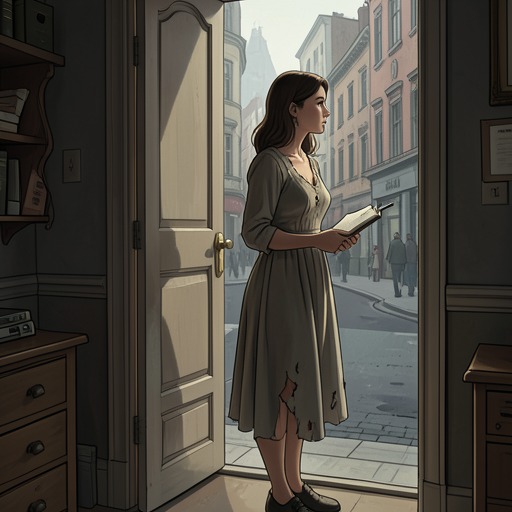
Tengo’s physical presence complicates the image of the solitary literary intellectual. A judo champion from junior high through university, he is powerfully built, with short hair, weather-tanned skin, and cauliflower-like ears. Komatsu, his editor, is drawn to this contrast between Tengo’s appearance and his identities as a writer and mathematics teacher. Komatsu also sees a particular promise in him, even before Tengo is sure that he possesses the talent to become a full-time novelist.
Writing, however, is not optional for Tengo. He does not know whether he wants to make it his profession, or whether he has the necessary talent, but he knows he cannot go even a day without writing. He experiences the need to write as fundamental, like breathing. That compulsion coexists with a career in mathematics, a field he loves but increasingly understands as unable to answer the questions that matter most to him.
From Mathematics to Fiction
As a child, Tengo was absorbed by mathematics, whose clarity and freedom felt indispensable. Within its domain, problems yielded to logic and proof. But as he approached puberty, he began to feel that mathematics offered only a temporary escape from the real world, where his circumstances remained unchanged and oppressive. Its certainty could not repair what awaited him outside its ordered territory.
Fiction offered a different kind of return. Tengo recognized that reading novels was also a form of escape, but the frustration of returning to ordinary reality was less severe. Unlike mathematics, a story did not necessarily provide a final, clear answer. Instead, it could transform the shape of a problem, leaving a suggestive possibility in its wake. Tengo imagined this possibility as an obscure incantation carried back into life: not an immediately useful solution, but something that might one day become intelligible. As an adult he still finds joy in teaching mathematics and sharing its abstract freedom, yet he can no longer believe that its formulas contain the answers he seeks.
This distinction shapes his work on Air Chrysalis. He first judges the manuscript as an unusual but imperfect story: its language is immature, its word choices sometimes childish, and it confuses a chrysalis with a cocoon in its title. What holds his attention is the balance between fantastic material and strikingly realistic detail, and the absence of imitation. The work’s roughness does not cancel its originality; it makes the question of how to revise it more consequential.
The Air Chrysalis Rewrite
Komatsu assigns Tengo the task of rewriting Fukaeri’s manuscript, not merely correcting sentences but adapting the story from beginning to end. The original narrative is to remain its skeleton: Tengo must preserve its core and, as far as possible, its atmosphere, while transforming its style. Komatsu takes charge of the overall production, while Tengo supplies the literary craft that the draft lacks.
The arrangement carries a firm rule about authorship. Tengo tells Fukaeri that he will strengthen the style without changing the story’s identity, even if substantial changes prove necessary. The work will remain the novel of a seventeen-year-old girl, and Fukaeri alone will receive the newcomer’s prize if it wins and the sole byline if it is published. Tengo and Komatsu will work with her but remain behind the scenes, like stagehands. Fukaeri responds with a small nod as she eats celery, accepting the terms without a lengthy discussion.
Before proceeding, Tengo seeks approval from Fukaeri’s guardian, the Master, because he hopes the story may also provide clues to what happened to Fukaeri during her years with the Pioneers and to the fate of her parents. The Master says that he has spent seven years trying to untangle those mysteries without finding a way through the obstacles. Since Tengo has immersed himself in the manuscript and judged it valuable, the Master considers him suited to the work. He grants permission, asks to read the revised version, and notes that Fukaeri trusts Tengo in a way she trusts almost no one else.
The labor proves demanding. After ten days, Tengo tells Komatsu that he had scarcely known whether he was alive or dead. Komatsu praises both his success in obtaining the guardian’s permission and the quality of the finished rewrite, admitting that he had underestimated him. The praise confirms Tengo’s ability to take an intuitive, unfinished work and give it a compelling new form, but the job is not simply a technical exercise: it binds him more closely to Fukaeri and the unanswered history the story may conceal.
Relationships and Growing Entanglement
Komatsu has been Tengo’s editor for five years. Their relationship began when Tengo entered the newcomer’s prize sponsored by Komatsu’s literary magazine and reached the final selection without winning. Komatsu met him at a Shinjuku café, told him candidly that he did not expect him to win, but said that he had personally liked the work and wanted to see Tengo’s next manuscript before anyone else. Thereafter, Tengo regularly submitted each new novel to Komatsu, revised it in response to his advice, and brought it back for another round of editorial guidance. Their collaboration resembles a coach gradually raising the bar for an athlete, but Komatsu’s theatrical manner means that Tengo cannot always tell whether a pause or remark is sincere or performed.
Fukaeri becomes more than the author whose work Tengo revises. He feels that she carries a message meant specifically for him, though he cannot decipher it. Her significance makes him wary: reason tells him to distance himself from her, from the bestselling Air Chrysalis, from the enigmatic Professor Ebisuno, and from Komatsu’s scheme, lest he be drawn into a dangerous world where ordinary logic fails. Yet he recognizes that he has entered the process knowingly. He has not been swept into a conspiracy without consent; he chose to participate despite sensing the risks. The mechanism is already moving, and he understands himself to have become one of its essential parts.
That inward conflict sharpens after Fukaeri stays with him. One night she falls asleep in his bed wearing one of her pajamas, while Tengo, unable to sleep, works at the kitchen table. He is accustomed to writing by day and normally distrusts the heaviness of prose drafted at night. With his word processor in the bedroom, he writes by hand in a notebook, preferring the feel of a ballpoint pen tracing characters across paper. This night, the story flows easily; near half past one, tired, he lifts the fingers of his right hand as if practicing imaginary scales.
After reading Chekhov, Tengo finds that he cannot return to his own work. The descriptions of Sakhalin’s desolate shore take hold of his imagination, and he pictures himself alone beside the Sea of Okhotsk, sharing the writer’s melancholy and a crushing sense of powerlessness. He closes the book, looks once more at Fukaeri sleeping peacefully on her back, turns off the bedroom light, and returns to the kitchen. The scene brings together his habits as a writer and the growing intimacy of his connection to her, while leaving him alone with a borrowed landscape and feelings he cannot settle into words.
Change, Time, and Narrative Role
Tengo’s reflections on time extend the limits of his mathematical outlook. He considers how the human brain, despite accounting for only two percent of the body’s weight, consumes forty percent of its energy, and how its expansion made it possible for people to conceive time, space, and possibility. Time itself, he thinks, is uniform in principle but changes as it is lived: some stretches feel heavy and long, others brief and light. Its order can reverse; the before and after may exchange places, time may disappear, or unanticipated time may be added. People may impose a regulated sense of time on existence partly as a way of preserving their sanity. The thought resonates with a story in which Tengo’s familiar reality is increasingly difficult to keep within a stable logical order.
His response to this instability is not to retreat from the work. At one point he decides to abandon the manuscript he has been writing and begin an entirely new story. He closes his eyes, listens attentively to a small inward source, and lets the words come naturally, arranging them into sentences without rushing. The choice marks an important change in his practice: rather than forcing a text toward a predetermined result, he gives himself time to hear what can be written. When Komatsu calls shortly before nine one evening in May and announces that it is ready, his unusual excitement suggests that the new work has reached a turning point.
Tengo’s understanding that he should withdraw from the Air Chrysalis affair remains in tension with his actions. In the classroom, he can make mathematical proofs appear almost like a route through the world’s mysteries; yet he has come to recognize that the questions he most needs answered lie beyond what proof can deliver. He is both wary of the novel’s occult implications and committed to shaping it, both conscious of the machinery around him and unable to stop its motion. His literary role is therefore not simply that of a ghostwriter. He becomes a maker of form inside a mystery that resists closure.
At the end of the available account, Fukaeri’s recorded message gives Tengo concrete reassurance without resolving their separation. She thanks him for worrying about her and for lending her his pajamas, says she may be unable to see him for a while, and suggests that the Little People may be angry because they made writings together. She says she is used to being in the forest and tells him goodbye. Tengo rewinds and listens again, taking several deep breaths as rain falls from the eaves; he turns a plastic ballpoint pen in his hand, then sets it down without writing. He understands that she has not been kidnapped but is hiding for a time, and that she does not intend to write another book: her story is made to be told, not written. Even this message leaves the deeper questions open. Tengo’s defining task remains to give a shape to what can be told without pretending that a finished shape amounts to a final explanation.