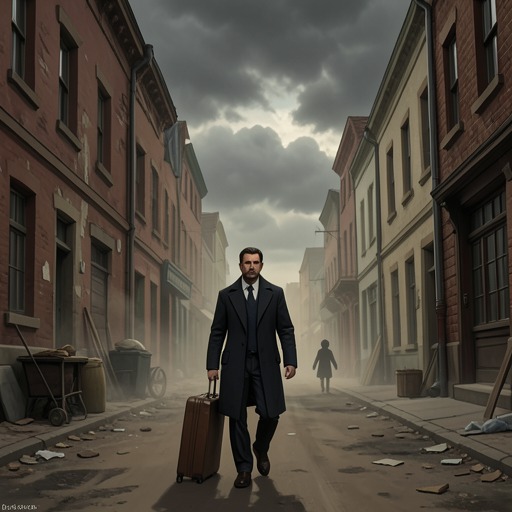
Fate rescues Rosa Amalfitano and takes her from Charly Cruz’s house
2666Oscar Fate’s escape with Rosa Amalfitano from Charly Cruz’s house is a rescue under pressure, not a clean victory. Fate finds Rosa in a room with Chucho Flores and Corona, asks her to leave with him, and draws her out by offering his hand rather than issuing an order. When Corona attacks, Fate knocks him down and takes his gun. The pair escape by car, leave Chucho at a bus stop, and head toward the city center, carrying with them the scene’s unresolved mixture of danger, shame, and sudden intimacy.
The confrontation in the house
Fate enters the room where Chucho Flores and Corona are arguing. He cannot tell what has prompted the quarrel: he suspects they may both want Rosa, then wonders whether they are arguing about him. Corona sounds genuinely angry. Fate tries to imagine himself as a frightening man from Harlem, but realizes that neither Mexican is impressed. The bravado he reaches for does not change the balance of power; instead, his direct question, asking where Rosa is, turns the encounter toward the person he has come to find.
Chucho points toward a corner Fate had not noticed. Rosa is sitting in an armchair with her legs crossed, snorting cocaine. Fate recognizes the feeling of having lived the scene before, an impression that gives the moment a troubling air of repetition rather than heroic novelty. He tells her they should go. His appeal is neither a command nor a plea: he asks her to come, putting all his soul into the words, though Rosa initially smiles sympathetically without seeming to understand.
A hand offered, a threat answered
Fate holds out his hand. Rosa rises and takes it, and the warmth of her hand makes him sharply aware of the coldness of his own. His thought that he has been dying all this time, and might have died there if she had not taken his hand, gives the rescue a bodily and emotional turning point. The contact does not erase the sordid circumstances around them, but it makes departure possible: the escape begins not with force but with Rosa accepting the gesture.
As they leave, Corona grabs Fate’s arm and raises what appears to be a blunt object. Fate turns and hits him with an uppercut in the style of Count Pickett, knocking him silently to the floor. Only afterward does Fate realize that Corona had been holding a gun. He takes it away and asks Chucho what he intends to do. Chucho raises his hands to chest height and says he is not jealous, presenting himself as unarmed rather than escalating the confrontation. Rosa looks at Corona’s gun as if it were a sex-shop contraption, a response that sharply unsettles the weapon’s threat without making the danger disappear.
The route out
The car is in the garage, so the front door is their only practical exit from the house. Rosa asks whether Corona is dead; Fate looks at the limp body for several seconds before deciding that they must go. They descend the stairs, cross an enormous kitchen marked by neglect, pass a courtyard where a pickup truck sits beneath a black tarp, and make their way through darkness to the garage.
Under the garage lights, Fate looks again at the mural of the Virgin of Guadalupe. Its single open eye seems to follow him as he moves to open the door. The image accompanies their departure as a watchful presence within an escape otherwise organized around practical choices: Chucho rides in the front passenger seat, Rosa in the back, and the man with the mustache appears at the top of the stairs, searching for them with a startled, almost adolescent expression.
Once clear of the house, they turn onto unpaved streets and cross an empty stretch that smells strongly of weeds and rotting food. Fate stops, cleans Corona’s gun with a handkerchief, and throws it into the lot. The act removes the weapon from their immediate possession but does not settle what has happened inside the house. Chucho murmurs that it is a pretty night; neither Rosa nor Fate replies.
Departure and aftermath
They leave Chucho at a bus stop on a deserted, brightly lit street. Rosa moves into the front seat and gives Chucho a parting slap in the face. Fate and Rosa then drive through a labyrinth of streets neither recognizes before reaching a road leading toward the city center. The escape thus ends not at a known refuge but in the movement away from Charly Cruz’s house and into unfamiliar streets.
Their final exchange revises the scene’s apparent division between rescuer and rescued. Fate says he thinks he has been an idiot; Rosa answers that she was the idiot. Neither elaborates, and the account does not resolve the circumstances behind their self-accusations. The brief, reciprocal admission makes the departure feel less like a triumphant extraction than a shared recognition of error, formed after both have passed through danger together.
Narrative significance
The episode’s rescue plot is repeatedly checked by uncertainty. Fate cannot read the argument that precedes his entrance, initially misreads Corona’s raised hand, and leaves without knowing whether the man he struck is dead. Even the route out depends on a mundane constraint—the car is in the garage—and ends in a district neither Fate nor Rosa recognizes. The action advances through imperfect knowledge rather than mastery.
At the same time, the sequence turns on contrasting forms of contact and force. Fate’s hand offered to Rosa is accepted; Corona’s grip on Fate’s arm triggers the blow that frees them to move. The gun is taken and then discarded, while the warmth of Rosa’s hand remains the scene’s most intimate fact. The escape therefore carries two linked consequences: Rosa is physically removed from Charly Cruz’s house, and Fate’s imagined role as a formidable outsider gives way to a fragile, mutual connection whose meaning remains open.