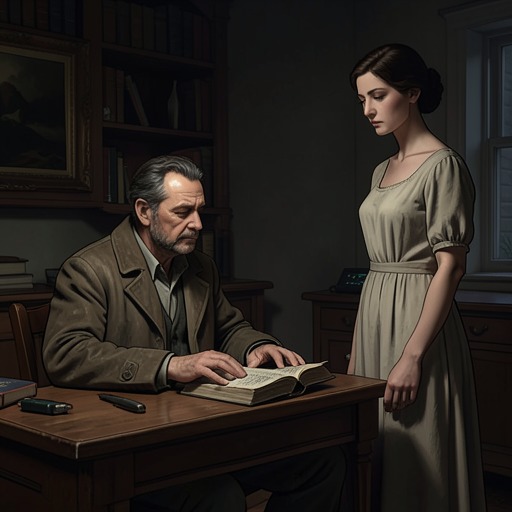
Morini visits Edwin Johns
2666Morini’s visit to Edwin Johns at the Auguste Demarre Clinic turns a journey undertaken to understand an artist’s self-mutilation into an encounter whose decisive answer is withheld from everyone but Morini. Morini asks the question that brought him there, but Johns responds with a question about publication and ultimately speaks into Morini’s ear rather than answering in public. The visit closes not with explanation but with a midnight departure: the next morning, Pelletier and Espinoza discover that Morini has checked out, and the clerk cannot tell them where he went.
The visit’s origin and purpose
The episode begins in Espinoza’s recollection of a trip through Switzerland after the work that had brought the three critics together was finished. They traveled by train toward a town between Montreux and the foothills of the Bernese Alps, hired a car, and followed a winding paved road to the Auguste Demarre Clinic. The destination was not Pelletier’s or Espinoza’s idea. Morini had learned that Edwin Johns, a painter he regarded as one of the most disturbing artists of the twentieth century, was living there.
Johns’s defining act supplied the reason for the visit: he had cut off the hand with which he painted, had it embalmed, and incorporated it into a kind of multiple self-portrait. Morini’s interest is not merely in seeing the artist or his work; in the meeting, he asks directly why Johns did it. The account preserves the question as the visit’s central purpose while leaving the answer outside the companions’ hearing.
The clinic and the meeting
After completing the formalities required by the Swiss institution, the visitors are led by a nurse through its extensive grounds. They have not seen any of the patients receiving treatment. Instead, the nurse takes them to a cottage at the rear of the property, reached across sloping grounds that Morini’s companions associate with the difficulty of caring for disturbed patients. The setting is markedly domestic: pine trees and rosebushes surround the cottage, whose furnishings include armchairs, a fireplace, an oak table, books in several languages, a computer and modem, and a bathroom with a shower.
The cottage’s comfort contrasts with the image of the clinic as a fortress. The visitors’ route has passed through a formal institutional entrance and procedures; their meeting with Johns takes place in a secluded, furnished house within the grounds. This change of setting narrows the encounter from a visit to a psychiatric institution to a conversation with one particular artist, without turning the institution itself into a simple explanation of his act.
Morini’s question and Johns’s response
During the conversation, Morini leans forward so far that Pelletier and Espinoza fear he may fall from his wheelchair. The gesture gives the question a physical urgency before he voices it: he asks why Johns mutilated himself. Johns appears to receive the question as one he has encountered before, and first asks Morini whether he intends to publish their conversation. Morini says honestly that he does not know.
As dusk settles, the nurse begins to rise to turn on the light, but Pelletier signals for her to remain seated. The scene pauses in that dimness. Johns says that he will explain why he did it, relaxes from his previously rigid posture, and bends toward Morini to speak privately into his ear. He then shakes hands politely with Espinoza and Pelletier, but not with Morini, either at the beginning or the end of the interview. The companions notice this omission; Morini says nothing. The reason for Johns’s act, and the content of his private words, remain undisclosed to them and to the reader.
Departure and narrative consequence
A nurse leads the three visitors back across the grounds to a car waiting at the gate. They return to Montreux and spend the night at the Hotel Helvetia. Pelletier and Espinoza are tired and initially decide not to go out, but later leave together to find food. Espinoza has tried calling Morini, with no answer; the two conclude that he must already be asleep.
The next morning, Morini is absent from his room. The hotel clerk reports that the computer shows he settled his bill and left at midnight, while Pelletier and Espinoza were having dinner at an Italian restaurant. Morini had come to the reception desk and requested a car. When they ask where he was going, the clerk cannot tell them. Thus the visit produces a concrete answer only in its aftermath: Morini has departed, but his destination and the effect of Johns’s whispered explanation are left unresolved.
Significance of the withheld answer
The episode sets a direct question against a private reply and an unexplained action. Morini seeks an account of a choice that joins an artist’s body to his self-portrait; Johns makes publication part of the exchange, then chooses to answer in a form that excludes the other visitors. His refusal to shake Morini’s hand afterward sharpens the separation between the questioner and the two companions who witness the meeting, without establishing what the gesture means.
The narrative then carries the unresolved exchange forward through Morini’s disappearance from the hotel. The sequence links the visit and departure by chronology, but does not state that Johns’s words caused Morini to leave or reveal what Morini understood. Its force lies in that boundary: an intimate answer has been given, yet the story withholds its contents and leaves the companions—and the reader—with the fact of Morini’s sudden absence.