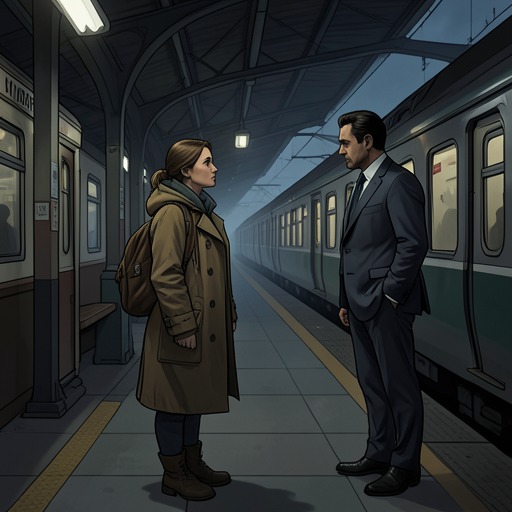
Lola leaves Amalfitano and wanders through France
2666Lola’s departure from Amalfitano becomes a prolonged life on the margins: she waits near the Mondragón asylum for the poet, loses her lodging, and eventually leaves Spain for France. Her wandering is not simply a journey toward a destination. It is shaped by the people she hopes to find, by temporary kindnesses she cannot settle into, and by an uncertain vocation of helping strangers. When contact resumes after five years, the short letter from Paris confirms that she has made a life apart from her former family, while leaving much of that life unexplained.
Waiting near the asylum
After Imma failed to return, Lola remained near the asylum, where the poet was being held and, in her understanding, ignoring her. She imagined Imma moving alone through a dangerous landscape, but the practical consequences of waiting soon overtook her: on the ninth day, the boardinghouse owner put her out. She slept at the railway station, in an abandoned warehouse among other homeless people, or outdoors near the boundary between the asylum and the world beyond it. One night she slept in an empty cemetery niche. The next morning she felt fortunate to have water and a quiet place near the asylum, and decided to wait there for Imma.
At the cemetery, Lola encountered Larrazabal inside a family mausoleum. The meeting began a temporary change in her circumstances. He invited her to stay at his apartment, offered to drive her to the asylum each morning, and gave her money without asking for anything in return. He took her to the movies, went with her to ask at the boardinghouse whether Imma had been heard from, and bought her clothes. He also told her about his family. His care was real, but it did not answer Lola’s preoccupation: she continued to visit the asylum, now once every three days, and looked through its fence for the poet, searching for a sign she expected not to understand until much later.
Larrazabal and the decision to leave
Lola’s dependence on Larrazabal remained unsettled. Sometimes she did not return to his apartment or leave word, and he searched for her at the cemetery, the asylum, the boardinghouse, and the places where San Sebastian’s transients gathered. He found her once in the railway station waiting room and another time on a bench by La Concha. While he prepared their meals, Lola spent the day roaming, drinking water and carrying only a small piece of bread or a roll in her pocket.
One night, while they were showering, Lola told Larrazabal she planned to leave and asked him for train fare. He said he would give her everything he had, but could not give her money to go away and never see her again. Lola did not press him. She nevertheless gathered enough money for a ticket, by means she did not explain to Amalfitano, and left for France at noon. The departure ends her temporary refuge with Larrazabal, but the account does not present it as a resolved break: it opens into a series of moves without a stable home or stated final destination.
Wandering through France
Lola stayed for a time in Bayonne, went to Landes, returned to Bayonne, and traveled to Pau and Lourdes. In Lourdes, she saw a train carrying sick and disabled passengers. Without knowing how it began, she started helping them as they made their way to buses outside the station or waited in lines. Her assistance continued as trains arrived from Italy and northern France. She moved through the station, where rooms had been turned into first-aid and resuscitation posts and another room served as an improvised morgue for passengers who had died during the journey. The station’s emergency work gives her wandering a temporary practical purpose, though the narrative offers no formal position or lasting security for her.
At night she sometimes slept inside a modern steel-and-glass building, entering through a small door into its rubbish compartments. At other times she stayed in the station or its bar, where older men bought her coffee and spoke to her about films and crops. Her life is thus repeatedly made possible by improvised shelter and brief encounters, rather than by any settled arrangement.
One afternoon, Lola thought she recognized Imma stepping off a train from Madrid, accompanied by a group of disabled travelers. She remained still and did not call out. Five minutes later she left the station and Lourdes, walked to the highway, and only then tried to hitch a ride. The episode preserves the uncertainty that has governed her search: even when a possible reunion appears before her, Lola does not test whether it is real, and instead resumes her movement.
Absence and the letter from Paris
Amalfitano had no news of Lola for five years. During that interval, he once saw a woman in a park whom he thought resembled Imma; the woman silently waved to a boy and then left. The episode offers no confirmation that she was Imma or that Lola was present. Its brief appearance of recognition echoes the unanswered searches and mistaken possibilities surrounding Lola’s time away, without resolving them.
Five years after Lola’s departure, a short letter arrived from Paris. She reported that she cleaned large office buildings on a night shift, beginning at ten and finishing sometime between four and six in the morning, then rode the metro home. She described Paris as beautiful when the city was asleep and the metro at that hour as profoundly sad. She also told Amalfitano that she had had another child, a son named Benoit, who lived with her, and that she had been in the hospital. She gave no reason for the hospitalization and did not say whether she was still ill. She mentioned no man and did not ask about Rosa. Amalfitano first interpreted that silence as meaning Lola considered Rosa nonexistent, then questioned his own assumption; he cried while holding the letter and only afterward noticed that it had been typed. The message restores contact but leaves the emotional distance, Lola’s health, and the circumstances of her new life unresolved.