Event 1
Powell's death and John Carter's flight into the Arizona cave
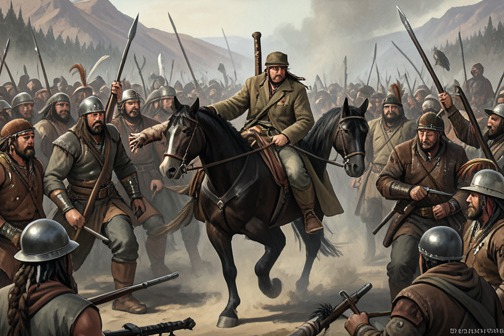
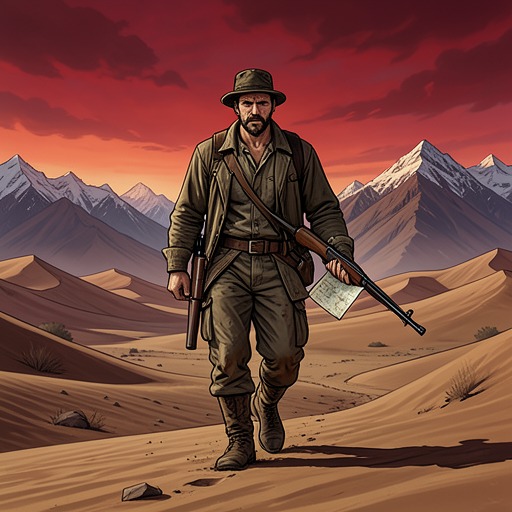
[Powell's death and John Carter's flight into the Arizona cave](entity:event-recall-event-powell-s-death-and-john-afb302712f4b) is the episode that turns a rescue attempt into a personal loss and carries Carter to the threshold of the story’s extraordinary next phase. Carter charges alone into an Apache camp to recover his friend, finds Powell pierced by arrows, and escapes with the body across his horse; after confirming Powell’s death and trying in vain to revive him, Carter collapses inside a cave. The sequence binds action to grief, then ends at the point where ordinary explanations no longer suffice.
## The Rescue Attempt
Carter reaches a level stretch of land crowded with Indian tepees and warriors gathered around something at the camp’s center. His first clear interpretation is that Powell is the object of their attention. Although the camp has not noticed Carter and he could withdraw safely into the gorge, he does not consider escape until the following day. The narration later qualifies any heroic reading of his choice: in dangerous situations, he says, an alternative course does not occur to him until hours after he has acted. His charge is presented as immediate action, not as a decision weighed against safer options.
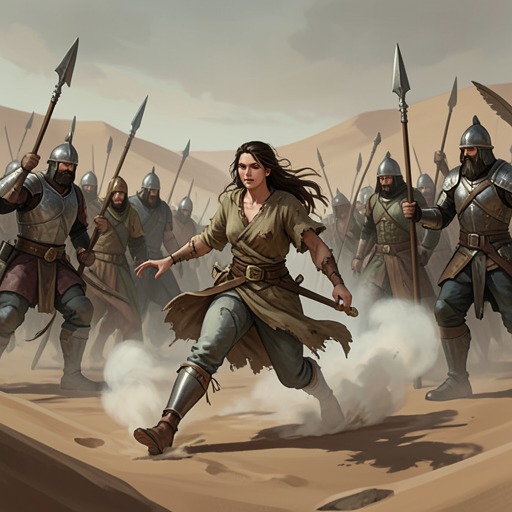
Carter draws his revolvers and rushes the assembled warriors, firing rapidly and shouting. The unexpected attack makes the Apache warriors think a much larger force is upon them, and they scatter to retrieve their bows, arrows, and rifles. That momentary confusion opens the way to Powell, but it does not make the rescue secure: once the warriors recognize that Carter is alone, they pursue him with arrows, rifle shots, and imprecations.
## Powell’s Death and the Escape
The rout exposes the scene Carter feared. Under the Arizona moon, Powell lies with hostile arrows bristling from his body. Carter is convinced that Powell is already dead, yet he is determined to prevent the body from being mutilated as well as to have saved his friend’s life. He rides close, reaches down from the saddle, catches Powell by his cartridge belt, and draws him across the withers of his mount.
The route back is no longer an easy retreat. A glance persuades Carter that returning the way he came would be more dangerous than crossing the plateau, so he spurs the horse toward a distant opening in the range. The Apache warriors discover that their target is alone and pursue him, but moonlight, their disordered reaction to his sudden attack, and the moving horse help him reach the shadows of the surrounding peaks before an orderly pursuit can form. The escape succeeds by a narrow margin, while leaving the destination to the horse’s judgment: Carter knows the trail less well than the animal and lets it travel practically unguided.
## The Cave and Powell’s Death
The horse takes a defile toward the summit rather than the pass Carter had hoped would lead to the valley and safety. Carter later recognizes that this wrong turn may have shaped the remarkable adventures of the following ten years. In the immediate sequence, however, the trail brings him to a large cave. A sharp turn around a high cliff reveals an opening roughly four feet high and three to four feet wide; there the trail ends.
By daylight, Carter dismounts and lays Powell on the ground. A careful examination reveals no trace of life. Carter forces water between Powell’s dead lips, bathes his face, and rubs his hands, continuing for nearly an hour even though he knows that his friend is dead. This effort does not change the outcome; it makes the loss concrete through the small, futile acts of care that follow the violent, hurried rescue.
Carter describes Powell as a polished Southern gentleman and a staunch, true friend, and says that he was very fond of him. Only after giving up his attempts to revive Powell does Carter leave the body on the ledge and enter the cave to reconnoiter. Their friendship is therefore not merely the reason for the charge into the camp: it governs the episode’s emotional ending, as Carter moves from armed resistance to an intimate effort to restore a life he already knows is gone.
## Collapse and Narrative Transition
The cave is a large chamber, perhaps a hundred feet in diameter and thirty or forty feet high, with a smooth, well-worn floor and signs of habitation in the distant past. Its back disappears into dense shadow, leaving Carter unable to tell whether further apartments lie beyond. The cave seems defensible: Carter believes that a single man could hold its trail against an army. That sense of comparative safety makes his sudden physical failure the episode’s final reversal.
Carter attributes the pleasant drowsiness that comes over him to exhaustion after the long ride and the reaction from the fight and pursuit. He knows that lying down would leave him vulnerable if the Apache warriors reached the cave, and he struggles toward the entrance instead. He reels against a side wall and falls prone on the floor. The next chapter is titled “THE ESCAPE OF THE DEAD,” placing the collapse directly beside a new, suggestive narrative threshold without yet explaining it in this episode. In that structure, Powell’s confirmed death and Carter’s unexplained fall form contrasting endpoints: one life cannot be restored, while the other is carried into the story’s next transformation.
Event 2
John Carter's transportation to Mars
[John Carter](entity:character-recall-character-john-carter-07deea1fdda3)’s transportation to [Mars](entity:location-recall-location-mars-9c3dea7f998c) is the decisive threshold between his life in an Arizona cave and his adventures on another planet. The passage begins with an unexplained separation from his apparently lifeless body, then turns the red planet that has long fascinated him into the destination of a sudden journey across space. Its immediate result is not only arrival on Mars but entry into a world whose environments and technologies the narrative gradually renders intelligible through close observation and technical explanation.
## From the Cave to the Threshold
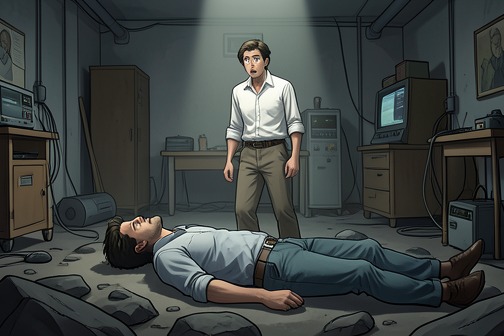
After John Carter has remained unable to move for hours, an eerie sound from the cave prompts an effort of will that he experiences as breaking the restraint upon him. He finds himself standing, yet sees his own body still lying on the cave floor, clothed and motionless, while the figure he inhabits is naked. The episode leaves him uncertain whether he has died, but physical sensations persuade him that he remains alive. His condition is therefore presented not as a settled explanation but as the uncanny starting point from which the transportation follows.
Once outside, John Carter looks across the moonlit Arizona landscape and then toward the stars. The sight of Mars arrests his attention: as a fighting man, he has long felt its attraction, and on this occasion the planet seems to call him across the immense distance. The sequence makes fascination the immediate prelude to movement. Instead of investigating the sound in the cave, he stretches his arms toward Mars and yields to the pull he feels.
## The Passage and Arrival
The departure is described as a movement of extraordinary suddenness. John Carter closes his eyes, extends his arms toward Mars, and feels himself drawn through space; the passage is marked by an instant of cold and darkness. The narrative provides no mechanical apparatus or scientific account for this transportation. Its cause, as presented in the scene, is the overpowering attraction of Mars and the inexplicable force that carries him there.
He opens his eyes on an unfamiliar landscape and knows immediately that he is on Mars. The certainty is conveyed as direct awareness rather than a conclusion reached by testing his surroundings: he does not doubt either that he is awake or that he has arrived on the planet. This assurance contrasts with his earlier uncertainty about the figure left in the cave. The transition from unexplained bodily separation to confident recognition of a new world gives the arrival its defining reversal: a man who had seemed divided from his own body now finds himself in an entirely different environment.
The first view establishes the conditions of that environment through concrete details. John Carter lies on yellowish, mosslike vegetation in a broad, circular basin edged by low hills. Under the midday sun, the heat on his naked body seems comparable to conditions in an Arizona desert. Quartz-bearing rock outcrops nearby, and a low enclosure stands about a hundred yards away; he sees no water and no other vegetation. Thirst, rather than any explanation of how he arrived, immediately sets the practical direction of his exploration.
## The Planet Made Legible
The transportation introduces a world that the narrative subsequently describes through encounters with its inhabitants and infrastructure. John Carter learns that the Green Martian rifles are light, made from a white-metal alloy and hard wood, and fire explosive radium projectiles. Their stated theoretical effective range is three hundred miles, while their practical range with wireless finders and sights exceeds two hundred. These particulars make the danger surrounding him measurable: when twenty rifles are present, his judgment against attempting escape in daylight is grounded in their reach and lethal capacity, not merely in their unfamiliar appearance.
The planet’s habitability is likewise tied to engineered systems. [Dejah Thoris](entity:character-recall-character-dejah-thoris-21b273f4b780) explains that her scientific expedition had been sent to rechart air currents and measure atmospheric density, and that its work concerned the air and water supply that sustain life on Mars. Later, John Carter learns that a vast building houses the machinery that produces the artificial atmosphere. Its process separates the ninth ray from sunlight, stores it in reservoirs occupying most of the building, combines it with refined electrical vibrations, and pumps the resulting compound to five principal air centers, where contact with space ether transforms it into atmosphere. The account gives the transport’s destination a larger significance: Mars is not simply a strange landscape, but a planet whose continued habitability depends on technical systems.
The explanation also foreshadows the danger attached to those systems. A reserve of the ninth ray is said to be sufficient to maintain the atmosphere for a thousand years, but the operating pumps remain a point of vulnerability. When word reaches the governments of Mars that the plant’s keeper has failed to report, the assistant keeper is found dead and the instruments indicate falling air pressure; the engine has stopped. The arrival scene thus precedes a crisis in which the planet’s survival depends on machinery that John Carter has learned to understand.
## A New World of Motion
A second technology extends the same explanatory pattern from survival to movement. In [Helium](entity:location-recall-location-helium-3bca5ab30817), [Kantos Kan](entity:character-recall-character-kantos-kan-f59f85673153) teaches John Carter to fly and repair a one-person aircraft about sixteen feet long, two feet wide, and three inches thick. A small, noiseless radium engine propels it, while the craft’s buoyancy depends on the eighth Barsoomian ray, confined within its thin metal walls. The narrative distinguishes this propulsion ray from the ninth ray used in atmospheric production, presenting the two as separate principles with different functions.
The transportation to Mars is therefore both an inexplicable leap and the entrance into a setting where other extraordinary capabilities receive detailed technical treatment. John Carter’s arrival does not explain the force that carries him from Arizona; instead, it begins a contrast between personal wonder and the planet’s systems of measurement, machinery, and applied rays. His first act on Mars is to explore a dry, unfamiliar basin, but the world opened by that landing extends from long-range weapons and flying craft to the artificial atmosphere on which life itself depends.
Event 3
John Carter's capture by the Tharks
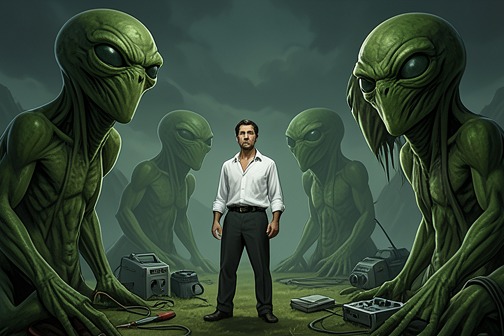
[John Carter](entity:character-recall-character-john-carter-07deea1fdda3)’s capture by the Tharks is the turning point that carries him from solitary danger into the society of the green Martians. A moment of physical escape prevents an immediate attack, but his extraordinary leap makes him an object of curiosity rather than freeing him: the warriors accept a tentative gesture of peace, take him to [Korad](entity:location-recall-location-korad-1acf75cfdf6b), and place him before their ruler.
## The Encounter at the Incubator
Carter is watching young Martians emerge from their eggs when he fails to notice twenty adult warriors approaching over the soft moss. The leader’s spear comes within ten feet of him. Carter is unarmed and naked, and the group’s weapons make a dash for safety untenable; their rifles use radium projectiles, and he judges the warriors capable of handling them with deadly effectiveness.
His immediate answer is to leap onto the incubator. The jump carries him thirty feet into the air and lands him a hundred feet away, on the far side of the enclosure. It both removes him from the spear’s reach and changes how the warriors assess him. Some check that he has not harmed the young; others stare in astonishment. Carter recognizes that his agility, extraordinary in the Martian environment, has interrupted the attack and made him a curiosity to be captured and shown to others.
## [Tars Tarkas](entity:character-recall-character-tars-tarkas-742aae9f7d7a) and the Gesture of Peace
After conferring, the warriors ride away but leave their leader by the enclosure. Tars Tarkas dismounts, sets down his spear and other weapons, and approaches Carter without arms. He removes a large metal armlet and holds it out. Carter cannot understand his language, but reads the discarded weapons and the troop’s withdrawal as signs of peaceful intent.
Carter answers with gestures rather than intelligible speech: he places a hand over his heart, bows, takes the armlet from Tars Tarkas, and fastens it above his elbow. Tars Tarkas smiles, links an arm with him, and turns with him toward his mount. When the others run forward, Tars Tarkas signals them to stop, apparently wary that a renewed rush might frighten Carter into another leap. Their initial hostility has become controlled contact, though Carter’s later description makes clear that he regards the encounter as a capture, not as a freely chosen alliance.
Tars Tarkas then directs that Carter ride behind one of the warriors. The designated rider lifts him onto the mount, where Carter holds on to the belts and straps securing the warrior’s equipment. The party sets off together, carrying him away from the incubator and toward the hills. This is the practical beginning of his captivity: the armlet and shared ride establish a temporary accommodation, but the Tharks control where he goes.
## Arrival at Korad
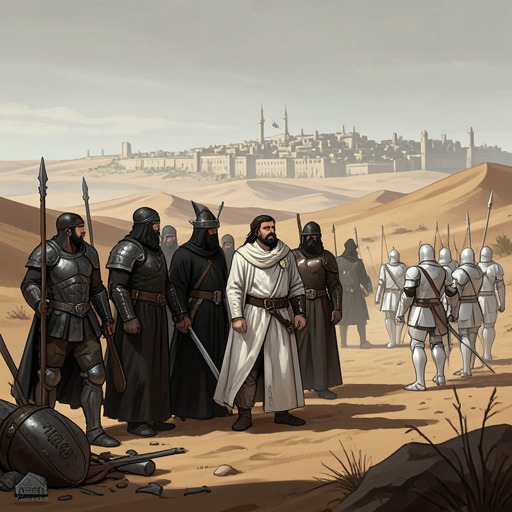
After traveling about ten miles, the party climbs toward a mountain range and passes through a narrow gorge into an open valley. On a low tableland Carter sees a great city. The riders enter by a ruined roadway that stops at the tableland’s edge in a broad flight of steps. The city’s buildings appear deserted and only moderately decayed, as if they have been unoccupied for years or possibly ages.
Near the center, a plaza and its surrounding buildings serve as a camp for roughly nine or ten hundred members of the same people. The scale of this encampment makes the meaning of the capture plain: Carter has not simply been intercepted by a small patrol but brought into a larger [Thark](entity:location-recall-location-thark-e928fe208afa) community. The ruined urban setting, now occupied by the warriors, places his personal captivity within a society settled amid the remnants of an older city.
## Presented to the Thark Ruler
At the audience chamber, Tars Tarkas lowers Carter to the ground and enters with him, keeping an arm linked with his. The approach to the chieftain is relatively informal. Tars Tarkas advances to the rostrum, where the ruler rises and speaks his name; Tars Tarkas answers with the ruler’s name and title. Carter learns later that this exchange is the customary greeting among green Martians. When strangers cannot exchange names, peaceful parties exchange ornaments, while hostile ones may exchange shots or fight their introduction with other weapons.
Tars Tarkas is identified as the community’s virtual vice-chieftain, as well as a capable statesman and warrior. He reports the expedition’s events, including Carter’s capture, and the chieftain addresses the newcomer. Carter answers in English, knowing the ruler cannot understand him, and notes that both the ruler and Tars Tarkas had returned his smile. That apparent point of common ground proves limited: Carter discovers that Thark ideas of humor can include amusement at prisoners’ deaths. His arrival therefore leads not into familiar hospitality but into a social order whose customs he must learn while held among its people.
## Significance and Consequences
The capture is shaped by a reversal: Carter escapes the spear not through a weapon or a negotiated advantage, but through a leap that astonishes his pursuers. The same feat that saves him also helps determine his fate. The warriors no longer treat him simply as a target; they regard him as a remarkable specimen worth taking back to their community. His physical difference thus becomes both protection and the means of his removal.
The encounter also establishes Tars Tarkas as Carter’s first crucial point of contact with the Tharks. He is the armed party’s leader, yet he approaches after disarming, offers an ornament, restrains his followers, and escorts Carter into the city. Those actions make communication possible without erasing the imbalance between captor and captive. The armlet is a sign of temporary peace, while the journey to Korad and presentation before the chieftain confirm that Carter has entered Thark custody.
The encounter’s consequences reach beyond the city. Later, [Dejah Thoris](entity:character-recall-character-dejah-thoris-21b273f4b780) identifies herself as the daughter of [Mors Kajak](entity:character-recall-character-mors-kajak-05b4b0708335) of [Helium](entity:location-recall-location-helium-3bca5ab30817) and explains that her expedition was a peaceful scientific party dispatched to measure atmospheric density and chart air currents. She argues that red and green Martians depend on cooperation to preserve the planet’s air and water, and condemns the Thark communal order for suppressing homes, affection, and fellowship. Her appeal draws attention to the contrast between the Tharks’ capacity for organized power and their hostility toward the red Martians. Much later, Carter learns that the atmosphere plant sustains life on [Mars](entity:location-recall-location-mars-9c3dea7f998c) through the ninth ray, and that a breakdown in its pumping system can threaten the entire planet. In this wider context, his forced entry into Thark society becomes the start of an involvement with Martian political conflict and planetary survival, although the capture itself begins with no knowledge of those stakes.
Event 4
The Thark attack on the Helium expedition
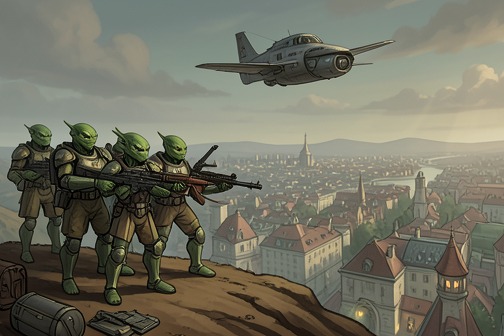
[The Thark attack on the Helium expedition](entity:event-recall-event-the-thark-attack-on-the-b0059ee54430) is both a devastating ambush and the event that brings [Dejah Thoris](entity:character-recall-character-dejah-thoris-21b273f4b780) into [John Carter](entity:character-recall-character-john-carter-07deea1fdda3)’s life. When twenty [Red Martian airships](entity:object-recall-object-red-martian-airships-b36bfa8b64df) approach a city held by [Green Martians](entity:creature-recall-creature-green-martians-2984e26448fa), the Tharks answer with a sudden, carefully directed barrage that breaks the fleet’s advance. One damaged vessel cannot escape and drifts back to the ground. Its dead crew and surviving captive reveal that the attack has reached beyond a clash of weapons: it has delivered a political prisoner whose scientific mission, as she later explains, was meant to sustain life on [Mars](entity:location-recall-location-mars-9c3dea7f998c).
## The Fleet’s Arrival and the [Thark](entity:location-recall-location-thark-e928fe208afa) Response
The confrontation begins on the third day after the incubator ceremony, as the Green Martians set out toward home. Before the procession has fully emerged from the city, orders send it hastily back. The warriors, chariots, and mastodons disappear into nearby buildings in less than three minutes, a practiced withdrawal that leaves the open ground empty. From an upper-floor window, [John Carter and Sola](entity:relation-recall-relation-john-carter-and-sola-58086faa344e) see what has prompted it: one gray airship sails over a nearby hill, followed by nineteen more, all low and slow-moving toward the city.
The ships display banners above their upper works and devices painted on their prows; figures crowd their forward decks. Carter cannot tell whether the crews have discovered the Green Martians or are simply observing the deserted city. The Tharks do not wait to find out. Warriors in buildings facing the valley open fire without warning, turning the ships’ peaceful-looking approach into a battle.
The leading vessel swings broadside and returns fire with its guns, moving along the Green Martian front before turning to make another pass. The other craft follow, each opening fire as it reaches position. The Thark volley, however, has already disrupted the attackers. Carter sees the Green Martians shoot with extraordinary accuracy: figures fall from the decks, while banners and upper works erupt under the impacts. Their fire is not merely a broadside exchange but a deliberate effort to disable the fleet’s capacity to fight.
## A Coordinated Defeat
The Green Martians divide their fire among specific targets. Their best marksmen concentrate on the wireless finding and sighting equipment that directs the large guns; other groups attack the smaller guns, gunners, officers, crew, steering gear, propellers, and upper works. This distribution of targets helps explain why the ships’ return fire proves ineffective: the initial volley catches their crews unprepared and their guns’ sighting apparatus exposed. The attack’s effectiveness lies not only in the weapons but in the Tharks’ disciplined assignment of aims.
Twenty minutes after the first volley, the fleet turns away. Several ships limp under the control of depleted crews, and their guns fall silent as they concentrate on escaping. The Green Martians rush to the roofs and continue firing after the retreating craft. One by one, the ships dip below the distant hills; the last remains barely in sight, moving so slowly that it appears almost unmanned.
That vessel has borne the brunt of the attack. It veers back toward the city in an erratic circle, apparently unable either to fight or to steer itself clear. The Tharks cease firing once its helplessness becomes clear. Carter can see bodies scattered across its decks but cannot identify the crew. The ship drifts about fifty feet above the ground, while most of the warriors pursue it and roughly a hundred remain behind on the roofs in case the fleet returns or reinforcements arrive.
## The Wreck and Its Captive
The drifting airship is on course to strike buildings about a mile south of Carter’s position. Some Green Martians ride ahead, dismount, and enter the building the craft is likely to hit. Just before impact, warriors swarm onto the vessel through its windows and use their spears to ease the collision. They then throw out grappling hooks, and others haul the large ship down to the ground. The capture of the vessel converts the retreating fleet’s final crippled craft into a prize for its attackers.
Once the airship is secured, the Green Martians search it from stem to stern. They examine the dead sailors for signs of life and bring up a small, living figure from below. The captive is less than half the height of a Green Martian warrior and walks upright on two legs. From his distant vantage, Carter first mistakes the prisoner for an unfamiliar Martian creature; he has not yet understood that she is a person from the expedition’s opposing civilization.
The warriors remove the captive and systematically strip the ship of its contents. The recovered goods include arms and ammunition, silks and furs, jewels, carved stone vessels, food, and liquids. Among the stores are casks of water, the first Carter has seen since arriving on Mars. The salvaging takes several hours and requires chariots to carry away the loot. Afterward, the warriors tow the airship out into the valley and appear to pour the contents of carboys over the bodies and the vessel’s decks and upper works.
## Dejah Thoris and the Encounter’s Turn
The attack has consequences beyond the battlefield. The danger of another strike keeps the Green Martian caravan at the deserted city; [Lorquas Ptomel](entity:character-recall-character-lorquas-ptomel-45d1a550b3a6), wary of exposing chariots and children on the open plain, delays the homeward march for more than a week. When Carter and [Sola](entity:character-recall-character-sola-363769a78949) later enter the plaza, he sees the captive being dragged into a nearby building by two Green Martian females. His response is a mixture of hope, fear, exultation, and depression, with relief and happiness strongest: he recognizes in her a slender, girlish figure like the women of his former life on Earth.
The prisoner is Dejah Thoris, daughter of [Mors Kajak](entity:character-recall-character-mors-kajak-05b4b0708335) of [Helium](entity:location-recall-location-helium-3bca5ab30817). As she is taken through the doorway that will serve as her prison, she turns and meets Carter’s eyes. She makes a small sign with her free hand, and hope briefly brightens her face. Carter does not understand the gesture or answer it. Only after she has been dragged from sight does he realize that she had appealed for help and protection. Her hope gives way to dejection, mingled with contempt for the man who appeared not to respond. The battle has thus brought them face to face, but his ignorance of Martian custom prevents their first meeting from becoming a rescue.
## The Mission Behind the Battle
When Dejah Thoris explains her identity and expedition, the capture acquires a larger significance. She says the party was sent by her grandfather, the Jeddak of Helium, on a scientific mission to rechart air currents and measure atmospheric density. The airships’ peaceful colors and banners, she says, had marked their purpose; the expedition was unprepared for battle. Her account frames the engagement as an attack on researchers as well as a military defeat for Helium.
Dejah Thoris argues that the expedition’s work benefits the Green Martians too. She says that the research and its results help maintain the air and water supply without appreciable loss, and warns that Mars cannot support human life without that work. Her appeal contrasts the [Red Martians](entity:creature-recall-creature-red-martians-4846dcdc101c)’ technical stewardship with the Green Martians’ communal society, which she condemns as cruel and lacking homes, art, written language, and love. She urges them toward amity and cooperation, offering the aid of the Red Martians in the effort to regenerate a dying planet. The captured airship therefore carries more than weapons and a prisoner: the encounter exposes the conflict between the Martian peoples and the possibility, asserted by Dejah Thoris, that their survival depends on cooperation.
The technological setting sharpens the stakes. Earlier, Carter had learned that the Green Martians’ rifles use small, explosive radium projectiles and can be effective at extraordinary range: their theoretical radius is three hundred miles, though their practical reach with wireless finders and sights is a little over two hundred. In the battle, the ships’ guns and the Tharks’ targeted fire make weaponry and sighting systems central to the outcome. Later, Carter learns that Mars’s artificial atmosphere depends on the ninth ray, separated from sunlight and processed before being pumped to the planet’s air centers; the enormous plant has a thousand-year reserve, but its operation remains vulnerable to failure. When word eventually reaches the governments that the plant’s assistant keeper has been found murdered and that the engine has stopped, the earlier scientific mission’s concern with atmospheric conditions gains urgent force. The battle does not itself cause that later crisis, but it introduces Dejah Thoris and her expedition’s work into a story in which the planet’s life-support systems become a matter of immediate survival.
Event 5
John Carter's fight with the great white apes
[John Carter](entity:character-recall-character-john-carter-07deea1fdda3)’s fight with the great white apes is the episode in which he and [Woola](entity:character-recall-character-woola-cb1e5baf499f) save one another, transforming a watchful animal into his most steadfast companion. The encounter begins when Carter tries to evade Woola and ends with Carter protecting the wounded creature from a Martian warrior; its consequences echo later, when Woola follows Carter across a trackless waste and again rescues him from danger.
## Causes and Setting
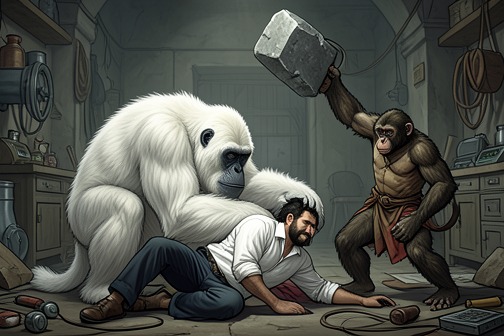
While Carter is a captive among the green Martians, Woola guards him with a devotion that Carter initially does not understand. The animal blocks the chamber’s exit and, when Carter attempts to leave the city, charges after him. Carter uses his extraordinary leaping ability to reach a high window and believes he has outdistanced his pursuer, only to be pulled into the building by a great white ape.
The ape pins Carter down while another approaches with a stone cudgel. These creatures are described as immense, upright beings with additional limbs; Carter sees the second ape preparing to strike him. The danger is immediate, but the reversal comes from the very guardian Carter had tried to escape: Woola bursts into the room and attacks the first ape, interrupting the threatened blow.
## The Fight and Its Reversal
Woola’s intervention gives Carter a chance to rise, but the struggle between the animal and the ape remains unresolved. The ape’s mate flees at first, while the one fighting Woola grips the guardian and gradually weakens him. Carter watches Woola losing strength and recognizes that his protector may not survive the fight unaided.
Carter takes up the cudgel that had fallen during the attack and strikes the ape on the head, killing it and ending its hold on Woola. The victory brings a second danger: the surviving mate returns, enraged at the sight of its dead companion. Carter first considers escape, judging that flight offers a better chance than confronting a creature whose strength greatly exceeds his own.
## Carter Protects Woola
Carter’s decision changes when he sees Woola lying on the floor, weakened and apparently appealing to him for help. The animal had put itself between Carter and the ape; Carter therefore turns back rather than abandoning it. He throws the cudgel at the advancing ape, disrupting its charge, then uses two punches to bring it down. He retrieves the weapon and finishes the fight before the ape can recover.
[Tars Tarkas](entity:character-recall-character-tars-tarkas-742aae9f7d7a), [Sola](entity:character-recall-character-sola-363769a78949), and several warriors arrive as Carter completes the encounter. They had noticed his absence and followed the enraged ape into the building, where they witnessed his fight. Their response reflects the green Martians’ esteem for physical prowess and courage: Carter’s earlier feats, his jumping, and this battle raise him in their regard. Sola differs from the warriors, attending to Carter’s condition and checking him for injuries rather than treating the danger as entertainment.
## The Aftermath and Their Bond
The rescue is not over when the apes are defeated. As the party prepares to leave, Carter notices that the warriors’ attitude toward the recovering Woola seems threatening. One warrior draws a pistol and is about to shoot the animal. Carter knocks the weapon aside; the shot strikes the window casing instead. He then helps Woola to its feet and signals for it to follow him. Tars Tarkas allows Carter to act as he chooses, and Woola returns with the group.
The exchange establishes a reciprocal bond: Woola has saved Carter from the ape, and Carter has saved Woola first from the struggle and then from the warrior’s weapon. Carter identifies Woola as a friend alongside Sola, whose care for him has been consistent. The contrast matters in a society where, as Carter observes, compassion and gratitude are poorly understood: the creature regarded as a mere beast displays the loyalty he finds lacking among many of the green Martians.
## Recurrence and Significance
Woola’s loyalty persists beyond the chamber. Carter later says that the animal guarded him throughout his captivity, never voluntarily leaving him and saving his life twice. Carter’s experience with Woola also informs how he treats the thoats he acquires: rather than relying on blows to establish control, he patiently wins their confidence. They come to follow him and obey his commands, demonstrating that kindness can yield both attachment and practical reliability.
The bond is tested again when Carter, [Dejah Thoris](entity:character-recall-character-dejah-thoris-21b273f4b780), and Sola lose their way in the wilderness. Woola has followed them across the trackless waste and presses close to Carter as he sleeps. Much later, during Carter’s solitary search for a waterway, Woola appears again and saves him from an attacker. The animal is visibly weakened by hunger, but its return confirms the loyalty first made mutual in the fight with the apes. The episode’s significance therefore lies not only in Carter’s physical victory: it establishes a continuing relationship in which protection, gratitude, and humane treatment cross the boundary between human and animal.
Event 6
John Carter rescues Dejah Thoris at the Thark council
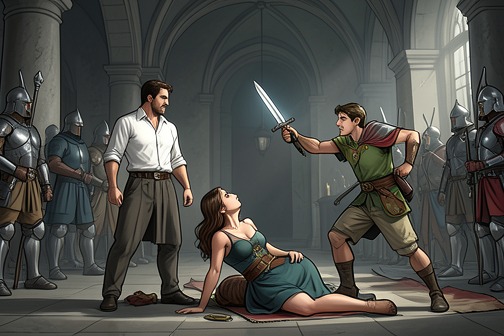
[John Carter rescues Dejah Thoris at the Thark council](entity:event-recall-event-john-carter-rescues-dej-d0c73199f1a2) when a young warrior strikes her down as she pleads before the assembled chieftains. Carter crosses the hall before the blow can be followed by further abuse, defeats the attacker in single combat, and helps [Dejah Thoris](entity:character-recall-character-dejah-thoris-21b273f4b780) leave under his protection. The rescue reverses the council’s apparent verdict: the assembly does not punish Carter, and the warrior’s death brings him the rank and authority that make his intervention politically consequential.
## Causes and Background
The council hears Dejah Thoris speak while she is a captive among the Tharks. [Lorquas Ptomel](entity:character-recall-character-lorquas-ptomel-45d1a550b3a6) and the other warriors sit silently after she finishes; Carter believes they have been moved, and imagines that a chieftain able to overcome inherited custom might begin a new era. [Tars Tarkas](entity:character-recall-character-tars-tarkas-742aae9f7d7a) rises to speak, his expression showing an inward struggle against custom and his own nature. For a moment, the scene offers the possibility that her appeal has reached the council.
That possibility is abruptly broken. A young warrior appears to sense the older men’s hesitation, comes down from the rostrum, strikes Dejah Thoris, and laughs at her as she lies on the floor. The attack exposes the limits of the council’s momentary sympathy: its members do not immediately challenge the assault, and their established moral code can treat cruelty toward a captive as a source of humor. The rescue begins when Carter responds to the endangered woman rather than accepting the assembly’s passivity.
## Carter’s Intervention and the Duel
Carter says that he had already sensed what was coming. As he sees the attacker aim a blow at Dejah Thoris, he crouches to spring and crosses half the hall before the strike lands. The narrative’s brief description of the moment cannot be mistaken for hesitation: Carter explains that his written account takes longer than the action itself. His sudden movement makes protection immediate, not a decision reached after the council has settled into silence.
The warrior is twelve feet tall and heavily armed. Carter strikes him as he turns at a warning cry; when the warrior draws his short sword, Carter draws his own and leaps close, holding on to the warrior’s chest and tusk while continuing to fight. At that range, the larger warrior cannot use his sword effectively or draw his pistol. The encounter is governed not only by physical advantage but by [Thark](entity:location-recall-location-thark-e928fe208afa) custom, which restricts a warrior in private combat to the weapon used to attack him. Although the attacker attempts to draw a pistol, that choice does not give him an effective way to dislodge Carter. The fight ends quickly with the warrior dead.
Carter’s violence is directed at stopping the assault, and its consequence is immediate: the council’s attempted degradation of Dejah Thoris becomes a contest that Carter wins. The assembled warriors do not intervene against him. Once he has regained his feet, he raises Dejah Thoris and carries her to a bench, shifting from combat to care. He tears silk from his cape to staunch the blood from her nose; her injury proves slight, and she soon speaks to him.
## Recognition and Consequences
Dejah Thoris asks why Carter has risked his life for her after refusing even friendly recognition during her first hour of peril. She cannot reconcile his earlier distance with his willingness to kill one of his companions on her behalf, and asks what kind of man he is. Her question identifies the rescue’s personal reversal: Carter, whom she had taken for a hostile or indifferent fellow captive, has acted as her defender.
Before Carter can fully answer her, a warrior approaches bearing arms, equipment, and ornaments taken from the dead man. The trophies clarify why Carter had been allowed to wear arms and the regalia of a Tharkian chieftain. He had not understood that his earlier blow in the audience chamber had killed his opponent; now the new trophies make the pattern plain. Under the Tharks’ rough customary justice, he has acquired the position and possessions of the man he defeated. His chieftaincy is therefore not a title granted after a deliberation: it follows from combat and is recognized through the dead warrior’s equipment.
That recognition changes the balance in the chamber. Carter understands that the respect and freedom he has received, including his unusual tolerance in the audience chamber, derive from his status as a chieftain. When Tars Tarkas remarks on how readily Carter now speaks the language of [Barsoom](entity:location-recall-location-barsoom-21f121c8dcaf), Carter answers him; the exchange underscores that Carter has moved from a stranger unable to communicate to a warrior whom the Tharks recognize as one of their own by rank, even though he remains a prisoner by circumstance.
## Departure and Significance
Carter turns back to Dejah Thoris, helps her to her feet, and starts for the exit. He ignores the guardians hovering around her and the chieftains’ questioning looks, reasoning that his new standing makes him responsible for acting as a chieftain should. Neither the guardians nor the council stops them. Dejah Thoris, Princess of [Helium](entity:location-recall-location-helium-3bca5ab30817), leaves beside Carter, followed by the faithful [Woola](entity:character-recall-character-woola-cb1e5baf499f), while the chamber remains silent.
The rescue’s decisive change is thus both intimate and political. Carter intervenes because Dejah Thoris is under attack, but the result also reveals how Thark authority works: victory grants the defeated warrior’s rank and possessions, and that acquired status gives Carter room to act. The scene places a protective response to vulnerability inside a society that publicly recognizes power through combat. Carter does not overturn the Tharks’ customs; he uses their rules and the authority won through them to carry Dejah Thoris out of the council chamber. The sequence closes not with a council’s formal judgment, but with the pair’s unobstructed departure and the silence of those who have accepted Carter’s standing.
Event 7
Escape from Thark and John Carter’s capture
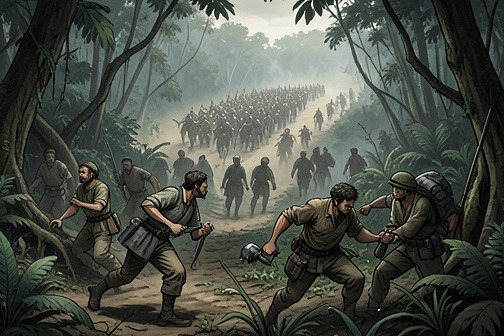
[Escape from Thark and John Carter’s capture](entity:event-recall-event-escape-from-thark-and-j-905664bd2fae) follows an attempted flight from [Thark](entity:location-recall-location-thark-e928fe208afa) that becomes a separation, a desperate stand, and a second captivity. Although [John Carter](entity:character-recall-character-john-carter-07deea1fdda3) and his companions leave with a route and provisions in mind, the journey goes wrong; when a large force closes in, Carter draws pursuit away from [Dejah Thoris](entity:character-recall-character-dejah-thoris-21b273f4b780) and [Sola](entity:character-recall-character-sola-363769a78949) and is captured. [Woola](entity:character-recall-character-woola-cb1e5baf499f)’s later return makes the episode not only a reversal in Carter’s freedom, but also a measure of the loyalty binding him to the animals he has treated with kindness.
## The escape plan and the danger in Thark
Carter decides to leave Thark that night with Sola and Dejah Thoris. They will take two thoats and provisions sufficient for two days, since the animals cannot be driven too hard over a long distance. The plan depends on reaching a waterway far to the north, one they crossed on their earlier journey. Its distance is part of its advantage: Carter believes the people pursuing them will not expect them to make for so remote a route.
As preparations begin, Carter discovers that the escape has already been compromised. While trying to reach Dejah Thoris’s chamber, he overhears a chieftain ordering four warriors to seize him if he returns. They are to bind him and take him to the vaults beneath the jeddak’s quarters, where [Tal Hajus](entity:character-recall-character-tal-hajus-14f013d0004f) can find him. The speaker says Dejah Thoris is already safe in Tal Hajus’s hands and credits [Sarkoja](entity:character-recall-character-sarkoja-d5ad8cd7c04a) with arranging the scheme. The warning changes the urgency of the escape: Carter is not simply leaving a hostile city; he is returning toward an ambush while Dejah Thoris faces immediate danger.
## Rescue, departure, and a costly change of route
Carter reaches the chamber where Tal Hajus is threatening Dejah Thoris. He has an opportunity to use his sword, but checks himself because he remembers [Tars Tarkas](entity:character-recall-character-tars-tarkas-742aae9f7d7a) and the long-held hope that Tars Tarkas might confront Tal Hajus. Instead, Carter strikes Tal Hajus unconscious, takes Dejah Thoris by the hand, and signals Sola to follow. He lowers both women from a rear window with straps and leather from his equipment, then brings them through the city’s shadows to the thoats waiting in the courtyard.
The three ride out of Thark with Sola on one thoat and Dejah Thoris behind Carter on the other. Rather than head northwest for the nearest waterway, they turn northeast toward another artery leading to [Helium](entity:location-recall-location-helium-3bca5ab30817), two hundred dangerous miles across the mossy waste. The altered direction makes the escape more difficult, but follows the logic of concealment: the route they choose is less likely to be anticipated. Dejah Thoris says that, if they reach safety, Helium’s debt to Carter will be beyond repayment; if they do not, he has still saved the last of her line from a fate worse than death.
## The separation and Carter’s capture
The party rides through the night and the following day, resting only briefly. By the second night, the riders and thoats are exhausted. After sleeping for five or six hours, they continue, but see no distant trees, the landmarks that would indicate the great waterways. Carter realizes they are lost. Their direction cannot be settled by the sun, moons, or stars, and their hunger, thirst, and fatigue leave them with little reserve. They set out for low mountains in the hope of finding the missing waterway from a ridge.
Woola finds them in the wasteland, having followed their trail. Carter wakes to the old hound pressed close beside him and understands that Woola has followed to share their fate. The reunion is short-lived as a practical advantage: a thoat soon falters and collapses. Carter initially considers killing the animal rather than leaving it to suffer from hunger and thirst, but Sola believes the night’s coolness and rest may revive it. They remove its trappings and leave it behind, continuing on with one mount. Sola and Carter walk so that Dejah Thoris can ride.
Near the hills, Dejah Thoris spots several hundred mounted warriors descending from a pass. Carter tells her that someone must hold them off and that he can evade them more effectively alone. Dejah Thoris refuses to leave him to die and declares that she will stay with the man she loves. Carter responds by kissing her for the first time, then lifts her back onto the thoat behind Sola and orders Sola to keep her there by force. He sends them away before turning to face the pursuers.
Carter has one hundred rounds in his rifle magazine and another hundred in his belt. He fires from the moss until the first returning warriors are dead or take cover, then continues until his rifle is empty and the larger force is nearly upon him. Once he sees that Dejah Thoris and Sola have disappeared among the hills, he runs in the opposite direction to draw the warriors away from them. His escape attempt ends when his foot catches on a projecting piece of quartz. Surrounded, he draws his sword, but the pursuing warriors overwhelm and capture him.
## Captivity and Woola’s continuing loyalty
Carter is brought to the [Warhoon](entity:location-recall-location-warhoon-6ddc3fcb3bb9) camp and, once fit to travel, is strapped to a thoat and escorted to the main column. Near dark he is taken before the jeddak of the Warhoon hordes, Bar Comas. Carter’s capture therefore does not return him to Thark or resolve the danger to his companions; it transfers him into the power of a new group, extending the escape into another captivity.
Woola’s loyalty continues beyond the separation. Later, during Carter’s solitary search for a waterway, a large creature pins him down in the dark. Woola arrives and saves him. In the light of the rising moon Carter recognizes his preserver, but fears Woola’s absence from Dejah Thoris may mean she is dead. The reunion is thus mixed with uncertainty about the woman Carter sent away for her safety. Woola is visibly emaciated and eats the dead creature; Carter, himself nearly as destitute, cannot eat uncooked flesh and has no way to make a fire. After Woola has eaten, Carter resumes his search. The rescue confirms the dog’s attachment to Carter even across the trackless waste, while leaving the outcome for Dejah Thoris and Sola unresolved in this episode.
## Loyalty, kindness, and the reversal of escape
Woola’s actions carry a history that distinguishes him from a mere guard or mount. During Carter’s earlier captivity among the green men, the watch dog guarded him constantly and twice saved his life. In one encounter with a great white ape, Woola burst into the room as Carter was about to be attacked, engaging the ape and giving Carter the chance to escape. Carter’s later devotion to Woola follows this record of protective action.
The same ethic shapes Carter’s treatment of thoats. While the warriors commonly subdued resistant animals with blows, Carter chose to win his thoats’ confidence after first establishing that they could not unseat him. Within days, they followed him affectionately and obeyed his commands, a change the Tharks attributed to an unknown power. Carter explained to Tars Tarkas that kindness improved both the animals’ lives and his own effectiveness as a warrior: dependable obedience could matter in battle as well as on the march. The escape tests this belief in a different way. Woola cannot prevent Carter’s capture, but his willingness to follow, share hardship, and later return to save him makes loyalty an active bond rather than a tool of command.
The episode also reverses the expected course of a rescue-and-escape plot. Carter succeeds in rescuing Dejah Thoris from Tal Hajus and gets her and Sola out of Thark, but the expedition fails to reach safety, loses a thoat, and separates him from the women. His decision to draw the pursuing force away offers them a chance to escape at the cost of his own freedom. He is captured, and the narrative moves onward into Warhoon captivity, while Woola’s return supplies a fragile counterpoint: even when the route is lost and the human companions are absent, a relationship formed through care endures.
Event 8
沃洪竞技场大赛
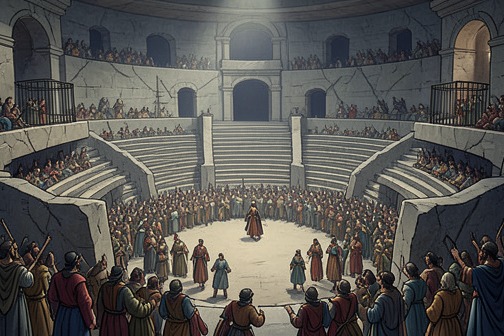
The [Warhoon](entity:location-recall-location-warhoon-6ddc3fcb3bb9) Great Games are a ten-day spectacle in which captives and animals are compelled to fight for survival, and the only prize is freedom for the final victor. For [John Carter](entity:character-recall-character-john-carter-07deea1fdda3) and [Kantos Kan](entity:character-recall-character-kantos-kan-f59f85673153), the contest becomes both a lethal trial and an opportunity: their mutual trust allows them to deceive the crowd, fake Carter’s death, and escape after dark rather than fight each other to the end.
## Setting and Rules
During their imprisonment, Carter and Kantos Kan are brought to an enormous amphitheater excavated below ground in the ruins of the Warhoon city. Debris partly fills the excavation, making its original size difficult to judge, but its remaining seating can hold the assembled twenty thousand [Warhoons](entity:organization-recall-organization-warhoons-a7299e73fb18). The arena itself is uneven and neglected. Stones taken from ruined buildings form barriers around it, while cages at either end hold the next combatants until their turn.
The cages contain a varied succession of victims: calots, thoats, mad zitidars, green warriors, women from other hordes, and unfamiliar wild beasts. Kantos Kan explains the contest’s central rule: at the end of each day, only one prisoner will be alive and free; the other contestants will have died in the arena. Winners of individual bouts are set against one another until a final victor remains. On the following morning, new victims fill the cages, and the process continues through the ten days of games.
## The Day’s Contests
The amphitheater fills within an hour. Dak Kova, accompanied by his jeds and chieftains, watches from a raised platform at the center of one side. At his signal, a dozen green Martian females are brought into the arena, each with a dagger, and set against twelve released calots. Carter turns away from the encounter; when he looks back after Kantos Kan tells him it is over, three dogs remain. The contest proceeds through further pairings, including a mad zitidar released among the surviving animals.
Carter is matched against both men and beasts. Armed with a long sword, and possessing greater agility and generally greater strength than his opponents, he wins repeatedly. His victories earn applause from the crowd, which eventually calls for him to be taken from the arena and admitted to the Warhoon hordes. That acclaim does not alter the rules: his survival depends on continuing to win, and the contest narrows until only Carter, Kantos Kan, and a towering green warrior from a northern horde remain.
## The Final Three
The green warrior has defeated everyone he has faced. Carter doubts that Kantos Kan can overcome him: the opponent stands nearly sixteen feet tall, while Kantos Kan is just under six feet. Kantos Kan, however, has survived his own earlier fights, at times by only a narrow margin, especially against green warriors. Their unequal size makes the next bout appear to favor the giant, but Kantos Kan relies on a technique Carter has not previously seen.
At roughly twenty feet from his opponent, Kantos Kan draws his sword arm back over his shoulder and hurls his weapon point-first. The throw strikes the green warrior in the heart and kills him, making Kantos Kan the winner of the first of the two final encounters. The outcome leaves the two friends to face one another for the game’s promise of liberty.
## Deception and Escape
Carter whispers to Kantos Kan to prolong their fight until nearly dark, hoping the delay will give them a chance to escape. The Warhoons appear to suspect that neither man wants to kill the other and respond with angry cries when they fail to land a fatal thrust. As darkness approaches, Carter gives Kantos Kan a way to make the contest appear finished: Kantos Kan thrusts his sword between Carter’s left arm and body, and Carter falls while holding the weapon so that it seems to protrude from his chest.
Kantos Kan then performs the expected finishing gesture, placing a foot on Carter’s neck and drawing his sword away. In the darkness, the blade slips harmlessly into the sand, but the spectators cannot distinguish the deception from a genuine death. Carter tells Kantos Kan to claim his freedom and then look for him in the hills east of the city. Kantos Kan leaves; once the amphitheater has emptied, Carter climbs to the top and slips away. Because the excavation lies far from the plaza, in an uninhabited part of the dead city, he reaches the hills without much difficulty.
## Significance
The games make survival a public performance governed by the Warhoons’ rules: victory appears to require killing every remaining opponent, and the crowd’s applause can accompany the same system that keeps prisoners in danger. Carter and Kantos Kan escape not by overpowering the assembled horde but by exploiting its assumptions about what a final victory and a death must look like. The staged ending preserves their friendship while turning the darkness, rather than the arena’s promised prize, into their route to freedom.
Event 9
卡特进入大气工厂并逃脱
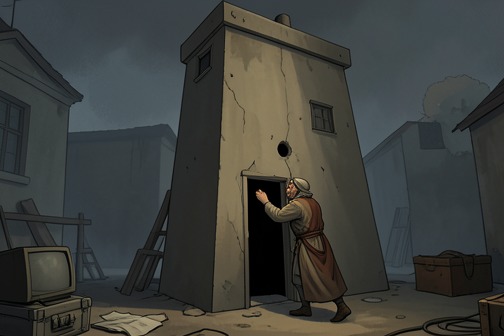
[John Carter](entity:character-recall-character-john-carter-07deea1fdda3)’s entry into the [Atmosphere Plant](entity:location-recall-location-atmosphere-plant-55a859bfcfcc) and his escape from it reveal that [Barsoom](entity:location-recall-location-barsoom-21f121c8dcaf)’s breathable air depends on a vast, guarded installation—and turn an exhausted fugitive’s refuge into a lethal confinement. The episode joins scientific exposition to suspense: the plant’s invisible processes sustain life across the planet, while its doors can be opened by thought and its keeper, fearing that a stranger has learned too much, prepares a dagger.
## Arrival at the Plant
After fifteen days searching for the waterway, John Carter sees the high trees that mark his destination. Around noon he reaches a huge building covering roughly four square miles and rising two hundred feet. Its immense walls appear unbroken except for a tiny door, and there is no visible sign of life. Exhausted, he finds a small hole near the entrance and tries to use it as a speaking tube. A voice asks who he is, where he comes from, and why he has come; he explains that he has escaped from the [Warhoons](entity:organization-recall-organization-warhoons-a7299e73fb18) and is near death from hunger and fatigue.
The entrance does not open like an ordinary door. It withdraws fifty feet into the wall before sliding aside, admitting [John Carter and Woola](entity:relation-recall-relation-john-carter-and-wool-e32468b9a81e) into a narrow concrete corridor. Once they pass, it closes behind them; massive steel cylinders descend from the ceiling and lock into recesses in the floor. Two further doors operate in the same manner before the passage reaches an inner chamber. There, food and drink have been set out on a stone table, and the unseen host directs John Carter to eat and feed his calot while subjecting him to a searching examination.
## The Plant and Its Secret
The keeper concludes from John Carter’s brain, internal organs, and heart that he is not a native of Barsoom. In their ensuing conversation, John Carter learns that the building houses the machinery that manufactures the planet’s artificial atmosphere. The system depends on the ninth ray, a component of sunlight separated by precisely adjusted instruments on the roof. Three-quarters of the enormous building is devoted to reservoirs holding the captured ray.
The stored material is treated with refined electrical vibrations and pumped to Barsoom’s five principal air centers. There, contact with the ether of space transforms it into atmosphere. The reserves are said to be sufficient to maintain the existing atmosphere for a thousand years; the danger lies not in an immediate shortage of stored material, but in a failure of the pumping apparatus. In an inner chamber, John Carter sees twenty radium pumps, each capable of supplying the entire planet. The keeper has watched them for eight hundred years, operating them in rotation, one pump for a little more than a [Barsoomian day](entity:time-recall-time-barsoomian-day-27d77bc45f55) at a time.
The apparent security of this planetary safeguard rests on secrecy as well as engineering. Every Red Martian is taught the principles of atmosphere manufacture, but only two people at a time know how to enter the plant. Its walls are a hundred and fifty feet thick, and a glass roof five feet thick protects it from attack by airships. The keeper regards the [Green Martians](entity:creature-recall-creature-green-martians-2984e26448fa) and a deranged Red Martian as possible assailants, because all Barsoomians understand that life everywhere on the planet depends on the plant continuing to work.
## Thought-Operated Doors and Growing Suspicion
John Carter secretly senses the keeper’s thoughts and learns that the outer doors respond to a particular combination of thought waves. He tests his discovery by casually asking how the keeper opened the entrance from inside. The man’s mind briefly supplies nine Martian sounds, then suppresses them as he refuses to disclose the secret. John Carter does not tell him that he has perceived the combination, but the keeper’s manner changes: although his spoken words remain courteous, his thoughts and expression show suspicion and fear.
The keeper offers a letter of introduction to an agricultural officer who may help John Carter travel onward to [Zodanga](entity:location-recall-location-zodanga-cf9f7e3039cf), and warns him not to reveal that he is bound for [Helium](entity:location-recall-location-helium-3bca5ab30817), which is at war with Zodanga. The keeper and his assistant, he explains, belong to no nation but to Barsoom as a whole; their talisman protects them even among Green Martians, though they avoid placing themselves in their hands. Beneath this assurance of impartial service, however, John Carter senses a murderous intention. As the keeper wishes him a long sleep, John Carter perceives the image of the man standing over him at night with a long dagger, rationalizing the planned killing as necessary for the good of Barsoom.
John Carter recognizes the bind: he could kill the keeper first, but would then be trapped inside the plant, and the machinery’s failure would endanger life across the planet. His concern for [Dejah Thoris](entity:character-recall-character-dejah-thoris-21b273f4b780) restrains him from choosing violence, even though he cares little for the fate of the other inhabitants. That conflict makes the plant’s protection double-edged: its secrecy safeguards the atmosphere, but knowledge of that safeguard leaves John Carter both endangered and responsible for avoiding a disaster.
## Escape and Immediate Aftermath
That night, John Carter moves stealthily through the plant’s winding corridors, with [Woola](entity:character-recall-character-woola-cb1e5baf499f) close beside him. A noise sends them into the shadows of a recess. The keeper passes carrying the long, thin dagger, sharpening it on a stone; John Carter reads his thoughts and learns that the man intends first to inspect the pumps, a task expected to take about thirty minutes, then return to the bedchamber and kill his guest. The threat is no longer an inference: the same host who fed the fugitives is preparing to murder one of them.
When the keeper disappears toward the pump room, John Carter crosses the hall to the innermost of the three great doors. He concentrates on its lock and sends the nine thought waves he had unknowingly learned by reading the keeper’s mind. The door slides aside, and he repeats the operation until all three barriers have opened. John Carter and Woola emerge into the darkness, free of the fortress but still hungry for a safe route onward; the food they received is their only immediate advantage. By morning he reaches the central turnpike and enters a nearby enclosure, where low concrete buildings remain shut despite his hammering and calls. Exhausted and sleepless, he lies down and orders Woola to keep watch.
The escape thus reverses the scene’s central power imbalance without resolving the larger danger. The keeper’s secret, designed to restrict access to the machinery sustaining Barsoom, becomes the means by which John Carter passes through the plant’s formidable defenses. Yet the doors release him only from one immediate threat: he leaves without a guide, and the installation’s continued operation remains bound to the machinery he dared not compromise.
## Significance and Wider Consequences
The plant’s workings place the danger of this encounter within a planetary system rather than a private dispute. Its keeper explains that the ninth ray is separated from sunlight by instruments on the roof, stored in reservoirs occupying three-quarters of the building, and combined with refined electrical vibrations before being pumped to Barsoom’s five principal air centers. The reserve can sustain the existing atmosphere for a thousand years, but that abundance offers no protection if the pumps stop. The account makes the installation’s engineering both a marvel and a point of extreme vulnerability: life depends not simply on stored energy, but on the uninterrupted operation of the machinery and the secrecy that controls access to it.
That vulnerability becomes concrete later, when [Tardos Mors](entity:character-recall-character-tardos-mors-0ce91197be7c) tells a council that the keeper of the atmosphere plant has failed to report for two days. Calls from many capitals have brought no response; a thousand cruisers have searched, and one returns with the assistant keeper’s mutilated body, found in pits beneath his house. The instruments show air pressure falling across Barsoom, and the pumping engine has stopped. This later crisis does not establish that John Carter’s escape caused the failure: he leaves the plant operating, and the episode gives no account tying his actions to the engine’s stoppage. It instead throws the earlier episode into sharper relief. The plant’s scale, defenses, and reserve supply could not remove the danger created when its small circle of custodians and machinery ceased to function.
The episode also links the story’s technological vocabulary to practical action. Elsewhere, John Carter learns that the eighth ray propels Martian aircraft; here, the ninth ray is the hidden basis of the atmosphere that makes life possible. Both explanations present scientific knowledge as an instrument of survival, but the plant episode turns technical exposition into a locked-room danger: the doors yield to thought waves, the air system is guarded by human custodians, and the secret that lets John Carter escape is acquired by sensing another mind. Freedom comes through a piece of knowledge, while the planet’s safety depends on machinery he cannot risk disabling.
## Significance and Wider Consequences
The plant’s workings place the danger of this encounter within a planetary system rather than a private dispute. Its keeper explains that instruments on the roof separate the ninth ray from sunlight; reservoirs occupying three-quarters of the building store it, and refined electrical vibrations prepare it to be pumped to Barsoom’s five principal air centers. The reserve can sustain the existing atmosphere for a thousand years, but that abundance offers no protection if the pumps stop. The installation’s engineering is therefore both a marvel and a point of extreme vulnerability: life depends not simply on stored energy, but on the uninterrupted operation of machinery and on the secrecy controlling access to it.
That vulnerability becomes concrete later, when Tardos Mors tells a council that the atmosphere plant’s keeper has failed to report for two days. Calls from many capitals have brought no response; a thousand cruisers have searched, and one returns with the assistant keeper’s mutilated body, found in pits beneath his house. Instruments show air pressure falling across Barsoom, and the pumping engine has stopped. This later crisis does not establish that John Carter’s escape caused the failure: he leaves the plant operating, and the episode gives no account connecting his actions to the engine’s stoppage. Instead, the crisis throws the earlier episode into sharper relief. The plant’s scale, defenses, and reserve supply cannot eliminate the danger created when its small circle of custodians and its machinery cease to function.
The episode also connects the story’s technological explanations to practical action. Elsewhere, John Carter learns that the eighth ray propels Martian aircraft; here, the ninth ray underlies the atmosphere that makes life possible. Both explanations present scientific knowledge as an instrument of survival, but this episode turns technical exposition into a locked-room threat: thought waves release the doors, human custodians guard the air system, and the secret that lets John Carter escape comes from sensing another mind. Freedom comes through knowledge, while the planet’s safety depends on machinery he cannot risk disabling.
Event 10
Tars Tarkas becomes Jeddak of the Tharks
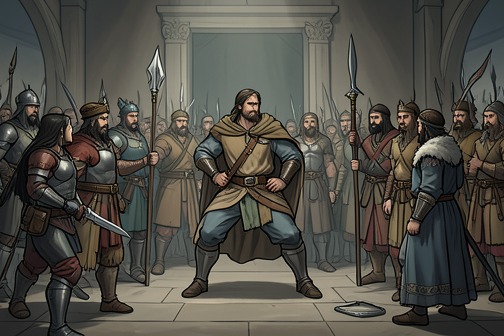
[Tars Tarkas becomes Jeddak of the Tharks](entity:event-recall-event-8248acf8503f) in a council confrontation that converts his reputation as a formidable warrior into formal rule. [John Carter](entity:character-recall-character-john-carter-07deea1fdda3) exposes [Tal Hajus](entity:character-recall-character-tal-hajus-14f013d0004f)’s failure to meet the Tharks’ own standard of leadership; with the council’s assent, the two leaders fight, and [Tars Tarkas](entity:character-recall-character-tars-tarkas-742aae9f7d7a) succeeds to the position. His first decision as Jeddak is to raise Carter to the rank of chieftain, and he then puts Carter’s proposal for a campaign against [Zodanga](entity:location-recall-location-zodanga-cf9f7e3039cf) before the council. The succession thus joins personal vindication to a decisive change in the Tharks’ political course.
## Causes and Background
The succession follows Tars Tarkas’s return to [Thark](entity:location-recall-location-thark-e928fe208afa) with Carter. As they eat, Carter repeats the account [Sola](entity:character-recall-character-sola-363769a78949) had told him during their earlier march: the history of the suffering inflicted on the only person Tars Tarkas had ever loved. Tars Tarkas says little, but his face registers both anger and pain. Carter’s account changes his willingness to face Tal Hajus; he no longer resists the proposal that they go before the Jeddak, though he first asks to speak to [Sarkoja](entity:character-recall-character-sarkoja-d5ad8cd7c04a).
Tal Hajus greets their arrival with a demand that Carter be restrained and punished. Rather than submit to the ruler’s command, Carter addresses the assembled chieftains. He argues that he has earned a hearing: he has previously been a chief among the Tharks and, that day, fought beside their greatest warrior. His appeal is not simply for personal protection. It places the question of Tal Hajus’s authority before the council and asks the Tharks to judge their leader by their own customs.
## The Council’s Test
Carter’s case rests on the contrast between the Tharks’ admiration for courage and Tal Hajus’s conduct. He charges that the Jeddak was absent from the fighting, while Tars Tarkas had proved himself in battle. Carter also points to his own earlier victory over Tal Hajus and asks whether such a ruler deserves to command. He presents Tars Tarkas as both a great warrior and a noble man, then calls on the council to recognize him as Jeddak.
The appeal gains a strong response: the warriors applaud, and Tal Hajus does not answer. [Lorquas Ptomel](entity:character-recall-character-lorquas-ptomel-45d1a550b3a6) intervenes in the name of justice and the customs of the Tharks, insisting that Tal Hajus cannot set aside the established procedure. He asks the chieftains whether the Jeddak should prove his fitness to rule against Tars Tarkas. The twenty chieftains around the platform raise their swords in agreement. That collective assent leaves Tal Hajus no alternative but to draw his long-sword and meet his challenger.
## Combat and Accession
The combat is brief. Tars Tarkas kills Tal Hajus and becomes Jeddak of the Tharks, with the defeated ruler’s death bringing the council’s challenge to its conclusion. The change of leadership is therefore not a peaceful transfer: the council authorizes a test, and the outcome settles who has the right to rule. Tars Tarkas’s accession conforms to the Tharks’ combat-based standard of authority while displacing a ruler Carter has just depicted as unworthy of it.
Tars Tarkas’s first act as Jeddak is to make Carter a full-fledged chieftain, granting him the rank he had earned through his combats during the first weeks of his captivity. The decision gives Carter an acknowledged place within the Thark leadership rather than leaving him dependent on personal favor alone. It also demonstrates that the new ruler recognizes Carter’s standing before the warriors and makes that recognition immediately official.
## Political Consequences
Carter uses the favorable response to Tars Tarkas and himself to seek Thark support against Zodanga. He tells Tars Tarkas the story of his adventures and explains the proposal he has in mind. Tars Tarkas endorses it before the council: [Dejah Thoris](entity:character-recall-character-dejah-thoris-21b273f4b780), Princess of [Helium](entity:location-recall-location-helium-3bca5ab30817), has become Zodanga’s prisoner, and the Jeddak of Zodanga intends that she marry his son as the price of sparing her country from devastation. The leadership change therefore supplies the political authority for a new campaign, joining the rescue of Dejah Thoris to the Tharks’ conflict with Zodanga.
Within three days, Tars Tarkas leads an army toward Zodanga. Carter rides beside him, with [Woola](entity:character-recall-character-woola-cb1e5baf499f) following his mount. The force begins with one hundred thousand warriors, assembled with the promise of Zodanga’s riches; during ten days of marching, Tars Tarkas persuades another fifty thousand to join. The army travels by night and shelters in deserted cities during the day. When it halts outside Zodanga, it numbers one hundred and fifty thousand. Tars Tarkas’s political and diplomatic ability is tested as well as his battlefield authority: maintaining even a semblance of harmony among the gathered hordes is difficult, but he brings the army to the city without a major fight among its members. Their longstanding hatred of the red men, particularly the Zodangans’ campaign against the green men and their incubators, helps suppress their internal quarrels.
## Significance
The episode makes the succession a turning point in both character and political action. Tars Tarkas, previously introduced as a powerful statesman and warrior, becomes the leader who can convert personal allegiance into collective action. Carter’s intervention helps expose Tal Hajus’s weakness, but the council’s formal assent and Tars Tarkas’s victory—not Carter’s speech alone—establish the new Jeddak’s authority.
The contrast between the council’s appeal to custom and its violent means of enforcing that custom is central to the event. Authority is challenged publicly, judged against courage in battle, and confirmed through combat. Once Tars Tarkas prevails, the same authority is used to recognize Carter’s earned rank and to put a military proposal before the Tharks. The result is a succession that changes more than the name of the ruler: it redirects the Tharks toward a large-scale expedition and makes their internal leadership part of the wider struggle over Dejah Thoris and Zodanga.
Event 11
佐丹加陷落
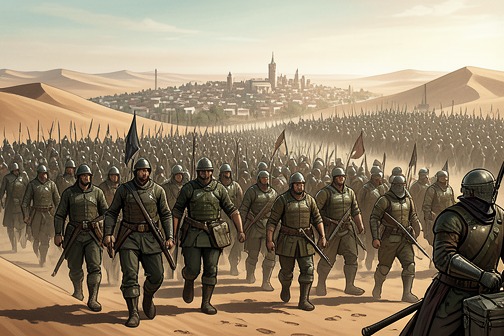
The Fall of [Zodanga](entity:location-recall-location-zodanga-cf9f7e3039cf) is both a military conquest and a rescue at the moment of a forced political union. [John Carter](entity:character-recall-character-john-carter-07deea1fdda3) brings a [Thark](entity:location-recall-location-thark-e928fe208afa) army to the city, opens a way through its defenses, and reaches the palace just as [Dejah Thoris](entity:character-recall-character-dejah-thoris-21b273f4b780) is being joined to [Sab Than](entity:character-recall-character-sab-than-8002ec0a473a). His intervention breaks the ceremony and precipitates a battle whose victory leaves the throne room under Thark control and Zodanga’s ruling family dead.
## Causes and the March on Zodanga
The expedition’s scale grew from the promise of loot. [Tars Tarkas](entity:character-recall-character-tars-tarkas-742aae9f7d7a) enlisted three smaller hordes, and within three days the force was one hundred thousand strong. The column marched at night, resting by day inside deserted cities; as it crossed the dead sea bottoms, Tars Tarkas recruited warriors from additional hordes. Ten days after setting out, the army reached Zodanga with one hundred and fifty thousand fighters.
The force was formidable but not naturally unified. Its component hordes had their own quarrels, and keeping them together without internal battle was itself a major feat of leadership. Near Zodanga, those rivalries receded before a shared hostility toward the red men, especially the Zodangans, whose campaigns had targeted Green Martian incubators. The siege thus draws its strength from both immediate opportunity and a longer history of conflict.
## Breaching the City
At the walls, the task of gaining entry fell to John Carter. He kept Tars Tarkas’s main force in two divisions beyond earshot of the city and approached a small gate with twenty warriors. The walls, built of massive carborundum blocks, stood seventy-five feet high and fifty feet thick. Carter’s escort considered them nearly impossible to scale, but he turned the warriors into a human staircase, climbed to the uppermost man, and used joined lengths of leather to descend the other side.
Carter had learned from [Kantos Kan](entity:character-recall-character-kantos-kan-f59f85673153) how to open the gates. Once the twenty warriors were inside, he found himself near the palace grounds and decided to divide the attack: one detachment would move toward the palace while the main force struck the soldiers’ barracks. He sent for fifty Tharks and arranged for his men to open two large gates. The approach depended on silence; no shots were to be fired and no general advance was to begin until Carter reached the palace with the reinforcement. The plan succeeded, allowing Tars Tarkas and the fifty riders to enter before the larger assault unfolded.
## The Ceremony and Carter’s Intervention
Inside the palace grounds, Carter saw a brightly lit audience chamber crowded with Zodangan nobles and their families. [Than Kosis](entity:character-recall-character-than-kosis-8e7e035c564b) sat with his consort on golden thrones, while a formal procession brought forward golden collars and the ornaments of Zodanga’s ruling house. Two figures concealed in scarlet silk stood before the throne. When the coverings were removed, Carter recognized Sab Than and Dejah Thoris: Kantos Kan had failed to prevent the ceremony.
The collars made the political purpose plain. Dejah Thoris was about to be bound to the Zodangan prince, an outcome Carter regarded as intolerable. He shattered a great window, entered the chamber, and struck the golden chain before the union could be completed. Sab Than attacked him with a dagger, but Carter restrained him rather than kill him. The custom against killing a member of the opposite sex checked Carter’s hand, even as the hall filled with drawn swords.
Carter announced that Zodanga had fallen and pointed to the entrance, where Tars Tarkas and his warriors were riding into the palace. The assembled Zodangans did not flee; they met the Tharks in combat. The interruption of the ceremony therefore becomes the hinge between the hidden entry and the open battle: the palace assault is revealed, and the private rescue is caught up in the city’s conquest.
## Battle in the Throne Room
Carter thrust Sab Than away from the platform and drew Dejah Thoris to his side, but Than Kosis confronted him with a sword. As they fought, Sab Than returned to help his father. Dejah Thoris moved between them; Carter’s sword struck Sab Than, making him jeddak of Zodanga by his father’s death. The new ruler then broke free and faced Carter again, joined by officers who attacked while Carter tried to defend himself without killing the prince.
The danger widened when Zodangan fighters called for Dejah Thoris to be killed, accusing her of plotting the attack. Carter tried to move her behind him and toward a narrow doorway behind the throne, but officers blocked the route. Tars Tarkas then fought through the crowd and reached the platform, giving Carter crucial support as the Tharks pressed through the chamber.
The Zodangans fought to the end rather than escaping. When the battle ceased, only Tharks remained alive in the great hall besides Carter and Dejah Thoris. Sab Than lay dead beside Than Kosis, and the chamber’s Zodangan nobles and warriors had been killed. The episode’s victory is therefore decisive but not bloodless: the ceremony is stopped and the palace taken, while the city’s ruling household and much of its elite are destroyed.
## Consequences and Significance
The assault resolves the immediate threat of Dejah Thoris’s marriage to Sab Than while overturning Zodanga’s leadership. Carter’s actions connect the military plan to the personal stakes: he first secures entry for the army, then diverts part of it toward the palace, and finally risks being overwhelmed to keep Dejah Thoris from harm. Tars Tarkas’s arrival turns that precarious defense into victory.
The sequence also brings together competing rules and loyalties. Carter refuses to kill Sab Than when the prince first attacks because of the customary prohibition on killing the opposite sex, yet the battle later ends with Sab Than dead in the struggle. Meanwhile, the Zodangans’ refusal to retreat contrasts with the Tharks’ overwhelming numbers. The fall of the city is presented not as a simple triumph but as the collision of love, custom, revenge, and conquest, with the throne room serving as the point where all four become inseparable.
Event 12
Lifting of the Siege of Helium
The lifting of the siege of [Helium](entity:location-recall-location-helium-3bca5ab30817) is the turning point at which the campaign against [Zodanga](entity:location-recall-location-zodanga-cf9f7e3039cf) becomes a direct rescue of the besieged city. A Green Martian army, assembled by [Tars Tarkas](entity:character-recall-character-tars-tarkas-742aae9f7d7a) and joined to Helium’s forces, helps defeat the Zodangan fleet and then crushes the besiegers between two advancing lines. The siege ends in triumph for Helium, but the victory carries a stark cost: Zodanga has been reduced, its people and soldiers are captured or killed, and even surrender is marked by the ritual deaths of defeated commanders.
## Background and stakes
The alliance that makes the relief possible emerges from an enemy camp. After hearing [Dejah Thoris](entity:character-recall-character-dejah-thoris-21b273f4b780) describe her expedition as a peaceful scientific mission, and appeal for fellowship between red and green Martians, Tars Tarkas shows a momentary struggle against the customs that govern his people. The appeal offers a way to join the two peoples’ efforts to sustain life on a dying planet; the invasion that follows, however, is not a peaceful undertaking. The account presents the attack on Zodanga as retaliation against a kingdom that had long pursued the green tribes and especially sought to destroy their incubators.
Tars Tarkas gathered forces on a scale unprecedented in the history of [Barsoom](entity:location-recall-location-barsoom-21f121c8dcaf). Three smaller hordes joined his initial column of one hundred thousand warriors after he promised them Zodanga’s loot. Traveling by night and sheltering by day in deserted cities, the army recruited another fifty thousand along the route. Ten days after setting out, it reached the outskirts of Zodanga at midnight, 150,000 strong. Keeping such a force together was itself an achievement: the hordes were prone to quarrel, and their shared hatred of the Zodangans temporarily overcame their internal rivalries.
The first phase of the campaign destroyed Zodanga’s resistance and opened the way toward Helium. When Tars Tarkas and [Kantos Kan](entity:character-recall-character-kantos-kan-f59f85673153) returned with news that the city had been completely reduced, the lesser hordes had already begun looting and fighting among themselves. Rather than lose more time trying to control them, the victors collected the warriors they could, manned captured vessels with Zodangan prisoners, and sailed for Helium. The expedition’s immediate stake had shifted from conquest to the relief of the besieged cities.
## The fleet’s arrival and air battle
Five hours after the decision to depart, 250 battleships carrying nearly 100,000 Green Martian warriors left the roofs of Zodanga’s dock buildings; transports carrying their thoats followed. Behind them, about 40,000 warriors of the lesser hordes remained in the conquered city, looting, murdering, and fighting. Fires had been set in a hundred places, and smoke rose over Zodanga as the fleet traveled toward Helium. The rescuing force thus approached the siege from the aftermath of a conquest that had left its own city of departure burning.
In mid-afternoon, the fleet sighted Helium’s scarlet and yellow towers. Zodangan battleships rose from the besieging camps to meet it, and the [Green Martians](entity:creature-recall-creature-green-martians-2984e26448fa) opened fire as the ships left the ground. The twin cities of Helium recognized the newcomers as allies and sent hundreds of vessels to join them. The resulting engagement was the first real air battle witnessed by the narrator, and it immediately altered the balance around the city.
The Green Martians could not use their captured ships’ main batteries effectively: having no navy of their own, they lacked skill in naval gunnery. Their small-arms fire, however, proved consequential. While Heliumite and Zodangan vessels circled and exchanged broadsides, the Green Martian ships remained above the contest, their marksmen contributing to the outcome. One Zodangan battleship was torn open, overturned, and plunged toward the ancient sea bottom; its destruction galvanized the Heliumite squadron. Helium’s ships then maneuvered above their opponents and attacked with keel bomb batteries. Some besieging vessels became wrecks, while others tried to escape only to be surrounded by small fliers and held beneath Heliumite battleships ready to send boarding parties aboard.
Within little more than an hour of the Zodangan squadron’s rising to meet the relief fleet, the air battle was over. The surviving enemy vessels were taken toward Helium under prize crews. Yet the defeated fleet’s submission did not simply consist of lowering arms. Under an old custom, the commander of each vanquished ship had to signal surrender by leaping from its bow to its death. One after another, the commanders jumped with their colors held aloft; the fighting did not cease until the commander of the whole fleet took the same plunge. The ritual made victory visible, but it also prolonged the deaths of men after their ships had been beaten.
## The attack on the besieging camp
The fleet’s victory did not by itself end the siege. The transports holding the Green Martians’ thoats had remained apart from the air battle. With no landing stages available, the animals had to be lowered in slings onto open ground about ten miles from the city. The unloading took the rest of the day and half the night; Zodangan cavalry attacked twice, though with little loss, and withdrew after dark.
As soon as the last thoat was on the ground, Tars Tarkas ordered an advance. His force approached the Zodangan camp in three parties from the north, south, and east. About a mile from the main camp, the attackers met the outposts and, as arranged, took contact as the signal to charge. The battle did not begin with a surprise victory: the Zodangans were ready behind entrenched lines, and repeated assaults were repulsed. By noon, the relief force faced a serious numerical disadvantage. The Zodangans had assembled nearly a million fighting men from across the planet’s ribbon-like waterways; fewer than 100,000 Green Martians opposed them, and no word had yet arrived from Helium’s ground forces.
At noon, heavy firing along the line between the Zodangans and the cities announced that Helium’s reinforcements had arrived. Tars Tarkas renewed the charge at the same moment that Helium’s soldiers surged over the opposite breastworks. The Zodangans were caught between the two forces, pressed from both sides like material between millstones. They fought fiercely, but the position had become untenable. The plain before the city turned into a killing ground before the last Zodangan surrendered.
## Aftermath and significance
With the surrender, the prisoners were marched back to Helium, and the victorious force entered the greater city in a triumphal procession. Women and children lined the avenues, joined by the few men whose duties had kept them within the city during the battle. They applauded without end and showered the arriving warriors with ornaments of gold, platinum, silver, and precious stones. The Green Martians drew particular excitement: never before had an armed body of their kind entered Helium’s gates as friends and allies. Their presence made the end of the siege more than a military relief; it publicly embodied a new alliance between peoples previously defined by hostility.
The liberation also reveals the limits of the transformation. The cooperation between Helium and the Green Martians is real and decisive, but it has been achieved through siege, invasion, and mass killing, while the conquest of Zodanga unleashes looting and violence among the victorious lesser hordes. The relief of Helium therefore closes one immediate danger without offering a peaceful resolution to Barsoom’s conflicts. Its jubilant welcome stands beside the burning city left behind and the commanders forced to die to certify defeat: triumph and brutality remain joined in the victory.
Event 13
约翰·卡特与德佳·索丽丝成婚
The marriage of [John Carter and Dejah Thoris](entity:relation-recall-relation-john-carter-and-deja-fba7bb621911) turns a hard-won alliance into a shared life in [Helium](entity:location-recall-location-helium-3bca5ab30817). After the [Thark](entity:location-recall-location-thark-e928fe208afa) leaders and their allies had been entertained and sent home with gifts under military escort, the return of [Tars Tarkas and Sola](entity:relation-recall-relation-67de10245bf7) to Helium made the ceremony possible and joined personal commitment to the new peace.
## Peace and the Road to the Ceremony
For ten days, the Thark hordes and their allies were feasted and entertained. They then set out for their own lands with costly presents, escorted by ten thousand Heliumite soldiers commanded by [Mors Kajak](entity:character-recall-character-mors-kajak-05b4b0708335). The lesser jed of Helium and a small group of nobles accompanied them to Thark to strengthen the bonds of peace and friendship. The scale and formality of this return show that the wedding belongs to a political settlement as well as to the private history of the couple.
[Sola](entity:character-recall-character-sola-363769a78949) travelled with her father, [Tars Tarkas](entity:character-recall-character-tars-tarkas-742aae9f7d7a), after he had publicly acknowledged her as his daughter before his chieftains. Three weeks later, Mors Kajak and his officers returned from Thark with Tars Tarkas and Sola aboard a battleship sent to bring them back in time for the wedding ceremony. Their return connects Sola’s restored place within her family to the reconciliation between the two peoples.
## The Marriage and Life in Helium
The ceremony made [Dejah Thoris](entity:character-recall-character-dejah-thoris-21b273f4b780) and [John Carter](entity:character-recall-character-john-carter-07deea1fdda3) one. The account places their marriage amid the renewed ties between Helium and the Tharks, with Tars Tarkas and Sola present after their journey from Thark. The wedding is therefore both a personal culmination and a public sign of a changed political relationship.
John Carter subsequently served for nine years in Helium’s councils and armies as a prince of the house of [Tardos Mors](entity:character-recall-character-tardos-mors-0ce91197be7c). Honors continued to come to him, while the people’s affection for Dejah Thoris remained a daily presence in their life. The narrative moves from the ceremony to the durable obligations and esteem that followed it, showing marriage as the beginning of a long shared place in Helium rather than an isolated festive moment.
## The Palace Egg and Their Hopes
Their future takes material form in a snow-white egg kept in a golden incubator on the palace roof. For nearly five years, ten soldiers of the jeddak’s Guard had stood watch over it. Whenever John Carter was in the city, he and Dejah Thoris stood hand in hand before the incubator, planning for the shell to break and for the child’s arrival.
On the last night recalled in this passage, they sat together speaking quietly about the romance that had woven their lives together and the coming child they hoped would complete their happiness. The scene gives the marriage an intimate counterpoint to its public and political setting: after years of service and honors, the couple’s attention rests on the fragile egg and the future it represents.
Event 14
火星大气危机与恢复
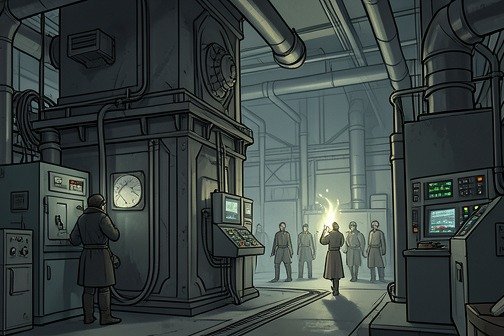
The atmosphere plant crisis is the novel’s planetary-scale emergency: when the machinery sustaining life on [Mars](entity:location-recall-location-mars-9c3dea7f998c) stops, the threat to the atmosphere makes the survival of every community depend on a secret remembered by [John Carter](entity:character-recall-character-john-carter-07deea1fdda3). The crisis joins the book’s engineering exposition to its final race against time, and turns a seemingly obscure key into the means by which life on Mars can continue.
## The system behind the crisis
The crisis becomes intelligible through what John Carter learned at the atmosphere plant earlier in the story. Its machinery produces the artificial atmosphere on which Mars depends, using the ninth ray, separated from sunlight by instruments on the building’s roof. Three-quarters of the vast structure is devoted to reservoirs that store the ray; electrical vibrations are then incorporated into it, and pumps send the resulting compound to the planet’s five principal air centers. Contact with the ether of space transforms the compound into atmosphere.
The plant appears to hold a large reserve: its stored ninth ray is sufficient to maintain the existing atmosphere for a thousand years. But that reserve does not make the system invulnerable. The plant’s keeper warned that the principal danger was an accident to the pumping apparatus. Inside, twenty radium pumps could each supply all Mars with atmosphere, but they were used alternately, one at a time, in shifts lasting a little over twenty-four and a half Earth hours. The system’s extraordinary capacity rests on machinery that must keep operating.
Its human custodians share the plant’s isolation. The keeper had watched the pumps for eight hundred years, with one assistant dividing the watch; each spent half a [Martian year](entity:time-recall-time-martian-year-f073a5e8a632)—about 344 Earth days—alone in the immense facility. This earlier account gives the later emergency its particular force: Mars has stored enough of the substance needed to make air, but the planet’s survival still depends on a small number of people and equipment at one remote site.
## Failure and the three-day deadline
The crisis reaches the council after the atmosphere plant’s keeper has made no wireless report for two days. Repeated calls from a score of capitals bring no answer. The governments of [Barsoom](entity:location-recall-location-barsoom-21f121c8dcaf) ask [Helium](entity:location-recall-location-helium-3bca5ab30817) to intervene, and a thousand cruisers search for the missing assistant keeper. One returns with his body, establishing that he has been killed and that an assassin has reached the people responsible for maintaining the system.
The discovery is followed by an alarming measurement: instruments show air pressure falling rapidly across Mars. The pumping engine has stopped. The plant’s immense walls cannot readily be breached; the work of penetrating them has already begun, but it would take months. The reserve of stored ninth ray offers no immediate remedy if the pumps cannot move the atmosphere compound into the planetary distribution system. The council is told that Mars has, at most, three days to live.
The silence that follows the announcement makes the scale of the danger plain. A young noble answers not with a plan to escape the approaching end but with a call for Helium’s people to continue their duties as if a thousand useful years still lay ahead. That response presents the crisis as a test of civic conduct as well as a practical emergency: the threatened atmosphere has made the ordinary future disappear, but the people still have to decide how to meet what remains of it.
## The forgotten key and the race to the plant
As the failing air approaches its final consequence, John Carter sees [Dejah Thoris](entity:character-recall-character-dejah-thoris-21b273f4b780) collapse beside the incubator and understands that her condition will become fatal if the supply is not restored. In that moment, nine long-forgotten sounds return to his conscious mind. Their meaning becomes clear: they are the key to the atmosphere plant’s three great doors. The technical secret that makes action possible is not a new device or a forceful attack on the walls, but a remembered sequence that can open the sealed entrance.
Carter obtains a flier and races toward the plant. With the air already too thin for him to travel high, he follows a straight course over an old sea bottom, discarding everything but the engine and compass to reduce the burden. An hour before dark, he reaches the plant and lands at its small door. A large crew has been trying to break through the walls, but has made little progress; most of its members are no longer conscious. The emergency at the plant has become more advanced than it was at Helium.
A surviving man tells Carter that the two people who knew the locks’ secret are dead and that no one else on Mars knows how to open them. For three days, people driven by fear have surged around the entrance without solving its mystery. Carter has arrived with the answer, but the failing atmosphere has left him weak, and he can barely control his thoughts. The remembered sounds therefore matter not as information alone: he must still use them while he is close to losing the strength to act.
## The doors open and the air returns
Carter sends the nine thought waves at the first door. It slowly recedes, and he cannot rise to follow it. He urges his companion to continue to the pump room and release all the pumps, explaining that this is Barsoom’s only chance to exist the next day. The companion’s survival and ability to reach the machinery now carry the action beyond Carter’s own physical capacity.
From the ground, Carter opens the second door and then the third. He sees the other man crawling through the final doorway toward the pump room, and loses consciousness. The immediate outcome established in the scene is thus the opening of the whole sequence of barriers and the passage of a surviving man into the machinery’s interior; Carter’s instruction makes clear what must happen there for the atmosphere to be restored. The larger recovery is inseparable from the actions of both men: one remembers and opens the locks, while the other is sent to the pumps.
The crisis brings together the novel’s explanation of artificial air and its climactic danger. A world sustained by an enormous reserve and twenty individually powerful pumps can still be brought to the edge of extinction when its engine stops, its custodians are killed, and its locks remain inaccessible. The solution depends on knowledge preserved in memory, the machinery’s ability to function once reached, and a fragile handoff made when Carter can no longer continue himself. In that reversal, the atmosphere plant shifts from a remote technical marvel to the single point on which Mars’s threatened future depends.
Event 15
约翰·卡特返回地球
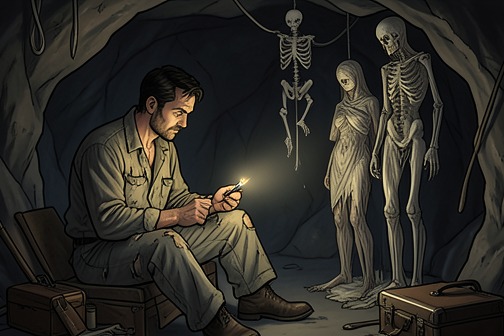
[John Carter](entity:character-recall-character-john-carter-07deea1fdda3)’s return to Earth is the closing reversal of his journey: after ten years on [Barsoom](entity:location-recall-location-barsoom-21f121c8dcaf), he wakes in Arizona, where the familiar landscape confirms that he has been taken away from the world he loves. Yet the return provides no reunion and no answer. With [Dejah Thoris](entity:character-recall-character-dejah-thoris-21b273f4b780) and the fate of Barsoom left beyond his reach, physical homecoming becomes an image of separation rather than restoration.
## The Awakening in the Cave
John Carter regains consciousness in darkness, wearing strange, stiff garments that crack and crumble as he sits up. The clothes mark a sudden change in his bodily circumstances: when he had fallen unconscious at a small doorway, he had been naked. Feeling through his pockets, he discovers matches wrapped in oiled paper and strikes one to illuminate the cave. His return begins not with a clear explanation of how he got there, but with the material evidence of a changed condition.
The match reveals a cavern occupied by the mummified remains of a little old woman, hunched over a small charcoal burner and a copper vessel containing greenish powder. Behind her hangs a line of human skeletons, suspended from the roof by rawhide thongs. A further thong connects the skeletons to the dead woman’s hand; when John Carter touches it, the bones swing and rustle. The grotesque arrangement gives the cave the character of a place marked by death, sharply contrasting with the ordinary living world beyond its entrance. John Carter hastens outside, eager to leave the tableau behind.
## Recognition of Arizona
On a small ledge outside the cave, John Carter sees a moonlit landscape that at first seems impossible: distant mountains, a nearly motionless moon, and a cactus-covered valley. He recognizes that the scene is not on [Mars](entity:location-recall-location-mars-9c3dea7f998c) but in Arizona. The recognition is intensified by the ledge itself. Ten years earlier, he had looked from the same place toward Mars with longing; now he stands there again, returned to Earth from the planet that had become the center of his life.
The return reverses that earlier orientation without fulfilling its emotional promise. Arizona is recognizable, but it is not a consoling destination. John Carter bows his head in sorrow and turns down the trail from the cave. Above him, Mars remains visible as a red point in the sky, but its distance—forty-eight million miles—makes the lost world inaccessible. The return restores a location, not a life: the familiar Earth is now the place from which he must look toward everything he has left behind.
## Questions Left on Mars
John Carter’s arrival does not resolve the crisis that preceded his disappearance. He wonders whether the Martian reached the pump room and whether vitalizing air arrived in time to save the people of Mars. The questions keep the ending open at the level of collective survival: the text does not confirm whether the planet’s inhabitants were saved.
His most intimate uncertainty concerns Dejah Thoris. John Carter cannot know whether she is alive or whether her body lies beside the tiny golden incubator in the sunken garden of the inner courtyard of the palace of [Tardos Mors](entity:character-recall-character-tardos-mors-0ce91197be7c). The precise image makes the unanswered question painfully concrete. His return leaves her fate suspended at a particular place on Mars, while he is stranded on Earth with no means, in this passage, to verify what happened.
## Ten Years of Separation
John Carter says that he has waited and prayed for ten years for an answer to his questions and to be taken back to the world of his lost love. His longing makes the return an ongoing condition rather than a completed transition: he is on Earth, but emotionally oriented toward Mars and Dejah Thoris. He declares that he would rather lie dead beside her than live on Earth millions of terrible miles away. The possibility of death beside her is presented as preferable to survival in separation, underscoring how little comfort the return itself affords.
Earth does offer material prosperity. The old mine, found untouched, has made John Carter fabulously wealthy. Yet he dismisses wealth as worthless beside the loss that preoccupies him. That contrast prevents the familiar signs of success from turning the episode into a triumphant homecoming: riches cannot answer his questions, bring him back to Mars, or tell him whether Dejah Thoris survived.
## The Ending’s Temporal Frame
The episode is narrated retrospectively from John Carter’s study overlooking the Hudson. As he sits there, twenty years have passed since he first opened his eyes on Mars, while the ten-year wait for news and return belongs to the interval after his awakening in Arizona. This later vantage point establishes that he remains on Earth long after the return, still describing himself as separated from his lost love and without an answer to his central questions.
The narrative closes not on a reunion or a confirmed catastrophe, but on the persistence of uncertainty. John Carter’s return completes the movement back to his native planet while withholding the emotional and practical restoration that the word homecoming might promise. Mars remains visible, remembered, and unreachable; Earth is where he lives, but not where his longing rests.