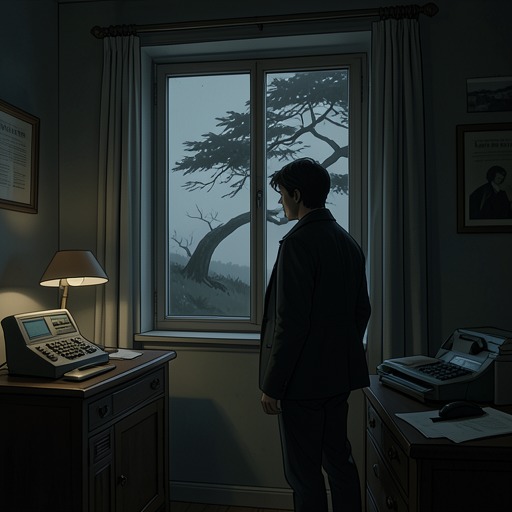
Survivor guilt and trauma after the crash
AccidentSurvivor guilt and trauma after the crash shape how Jamie Applegate and Chloe Thorensen live with its consequences. Jamie escaped physically uninjured while Phillip Chapman died and Chloe and Allyson Clarke were seriously hurt; Chloe, in turn, carried guilt for persuading Allyson to go out with her. Their friendship gives each a place to speak about grief, but the question of who caused the collision remains entangled with what they have lost.
The Crash and the Search for Responsibility
In the hospital’s immediate aftermath, Page Clarke asks who was driving, having heard that the driver was dead and assuming it was Trygve Thorensen. She learns that the driver was seventeen-year-old Phillip Chapman. The uncertainty surrounding the crash leaves families reaching for an explanation while confronting an outcome that cannot be undone.
Trygve Thorensen is angry at Phillip, at Chloe for lying to him, and at the other driver if she caused the collision. Yet the highway patrol cannot determine which car crossed the line or why: the impact was so severe that the available evidence does not establish fault. Tests showed alcohol in Phillip’s blood, but not at a level that would classify him as drunk; Laura Hutchinson appeared sober, and the police did not test her. The uncertainty does not relieve the survivors’ distress. It leaves open competing explanations at the very moment when blame seems to offer a target for grief.
Jamie and Chloe: Grief Made Speakable
When Chloe returns home, Jamie visits her there after having seen her often in the hospital. The change of setting brings the night of the crash back into view: they had secretly gone on a date, and their deception had preceded the collision that injured Chloe and Allyson and killed Phillip. They talk quietly for a long time while their families remain in the kitchen. Their closeness does not erase that history; it makes room for them to face it together.
Chloe says that she cannot call Allyson, and Jamie cannot call Phillip. The absence is not abstract: each has lost the ordinary possibility of reaching someone who mattered. Chloe’s words also give Jamie permission to express guilt and anguish that he has struggled to voice. He feels the injustice of having survived unscathed while the other three young people bore the crash’s consequences. He has seen a therapist and attended a support group for people who survived plane crashes, fires, and other accidents in which friends or family members died. Talking with others brought relief, and he tells Chloe about that experience.
Their connection develops through both serious conversations and ordinary knowledge of one another. By the time they have been close friends for six weeks, Jamie knows Chloe’s tastes, hopes, and plans for the future. At home, their long conversation turns to Allyson and Phillip; in a later light moment, Chloe jokes about going dancing, a reminder that her humor remains even as her injuries continue to limit her. The ease between them offers companionship, not a cure for their grief.
Chloe’s Guilt and the Return of Memory
Chloe’s own guilt centers on having talked Allyson into going with her. She thinks of the night repeatedly, and fragments of it return. She attends a therapy group with Jamie because she feels guilty about her part in persuading Allyson to come. The account presents this guilt alongside her physical recovery: even after the immediate danger has passed, the event continues to return in memory and in questions about what might have been different.
The shared group experience and their private talks make the crash discussable without making its losses reversible. Jamie can tell Chloe about his survivor support group; Chloe can acknowledge her responsibility as she understands it. Neither conversation establishes that either young person alone caused the tragedy. Their guilt is personal, while the crash’s causes remain uncertain.
Blame, Vindication, and Lasting Consequences
Public accounts intensify the struggle over responsibility. An article about the crash presents Hutchinson sympathetically and implies that the young people had been drinking, leaving readers with the impression that Phillip was at fault without directly making that claim. Trygve distrusts the framing: he points out that the evidence is inconclusive and that Phillip’s age makes it easier to cast him as reckless, despite Jamie’s account that Phillip was responsible. Trygve also recalls that Jamie reported Phillip had consumed half a glass of wine and two cups of black coffee, followed later by a cappuccino. These details do not settle who caused the collision, but they expose the gap between evidence and the story that public perception may prefer.
Later, news reports state that Hutchinson was arrested in La Jolla after a fatal collision and that tests showed she had been driving while intoxicated. Page breaks down, believing that Hutchinson had also been drunk in the earlier crash and had nearly killed the young people. The later arrest vindicates Phillip in the eyes of those who had watched blame gather around him, but it does not by itself prove what happened on the Golden Gate Bridge. Chloe’s anger is sharpened by the possibility that Phillip would have borne blame indefinitely; she also recalls that someone had recently come forward to say Hutchinson had been drinking before leaving the party, and asks why the police had not noticed.
The trauma therefore persists in two forms: the private burden of surviving, grieving, and wondering about one’s own choices, and the public struggle over whose account of the crash will be believed. Jamie and Chloe find some relief by speaking and seeking support, while the later evidence changes how others understand Phillip’s reputation. It cannot bring him back, undo Chloe’s guilt, or awaken Allyson from her coma. The story keeps those limits in view: explanation may shift, but the survivors still have to live with what happened.