Staying present or escaping in a crisis
AccidentStaying present or escaping in a crisis names the novel’s contrast between remaining available to people in distress and retreating from an unbearable situation. During Allyson Clarke’s prolonged critical illness, Page Clarke keeps vigil, Trygve Thorensen supports her with emotional and practical care, and Brad Clarke struggles to remain at the hospital or consistently at home. The distinction is not simply between courage and fear: it concerns who takes responsibility when the outcome cannot be controlled, and how absence redistributes that responsibility across a family.
The crisis and its unequal demands
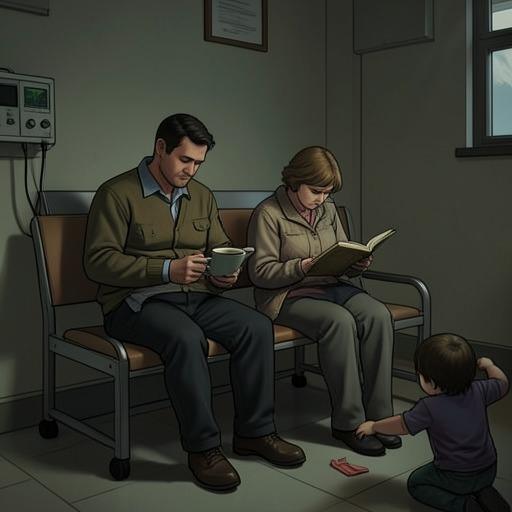
Allyson’s condition makes the family wait amid uncertainty rather than act toward a clear resolution. Doctors warn that the swelling in her brain may signal further injury or a consequence of surgery, and they cannot assure Page that Allyson will survive. Page responds by staying beside her daughter, holding her hand through the night and continuing to speak to her. The vigil gives Page a way to express love when she cannot change the medical situation; her presence is an act of care, not a claim that she can determine the outcome.
That sustained attention has a cost. Page has eaten very little, and Trygve notices that she needs to care for her own health as well as remain concerned for Allyson. He urges her to eat and rest, and offers to take her to breakfast. When Page explains that she has not even organized who will collect Andy Clarke from school or take him to baseball, Trygve offers to help with those everyday obligations. The crisis therefore expands beyond the hospital bed: school pickups, meals, rest, and the needs of a frightened child become part of the work of keeping a household functioning.
Trygve’s support is concrete rather than abstract. He stays with Page at the hospital, encourages her to take breaks, and offers to transport Andy when she is occupied. He draws on his own experience of family strain to understand that a person may lose the desire to eat during a difficult period and still need to make an effort to do so. His care does not remove Page’s fear, but it prevents her from having to shoulder every immediate responsibility alone.
Page’s vigil and the children’s experience
For Page, remaining near Allyson becomes a firm decision. Even when doctors say that Allyson is not in immediate danger at that moment, Page prefers to stay in the hospital rather than go home. She recalls having felt a similar need to stay close when Andy was in an incubator; physical nearness matters to her even when access to the patient is restricted. When she does leave briefly, she asks Brad to tell Andy that she loves him, keeping her attention connected to both children across the separation between hospital and home.
Page also describes the choice in stark terms when confronting Brad: she will stay with Allyson until the family knows whether her daughter will survive, and, if she does not, Page intends to be beside her. This resolve does not mean Page is untouched by despair. She is frightened, exhausted, and grieving the possibility of permanent loss. Her commitment is significant precisely because she does not know how the crisis will end.
The children register these absences and pressures in different ways. Andy is terrified by the possibility that his sister may die and by the uncertainty of where his father is; he is also suddenly staying with neighbors. Page recognizes that his school and activities still require attention even while the hospital dominates her days. When she eventually brings him to visit Allyson, she explains in advance that his sister has a head injury, is being helped to breathe by a machine, and will not answer him. Andy arrives eager to see her, carries a gardenia for her, and places it beside her on the pillow before touching her hand and kissing her. His visit makes visible how care is learned and shared: Page prepares him for what he will encounter, and he finds a small, personal way to be present for his sister.
Brad’s withdrawal and its consequences
Brad’s response is markedly less consistent. At one point, Page repeatedly tries to reach him while the medical team is expected, but he does not answer. Through Trygve, she learns that Brad has not collected Andy and has not called. Trygve suspects that Brad may be having an affair or drinking to cope, but at that moment he does not know where Brad is. Whatever the explanation for his absence, its immediate effect is clear: Page is left to manage the children and the hospital crisis without the partner whose help she expected.
When Brad does appear, Page challenges him over his responsibilities to both children. She stresses that Andy is frightened and that Allyson needs her father as well, particularly while her future is uncertain. Brad admits that seeing Allyson in her condition is more than he can bear and says that he cannot stand to look at her. Page understands his pain but refuses to treat withdrawal as an unavoidable substitute for care. She maintains that Allyson is still alive and still has a chance, and asks him not to give up on her before that chance is gone.
Brad’s distance continues in less dramatic forms. During a later day of waiting for Allyson’s surgery, he and Page sit for hours in the hospital without discussing what matters between them. Afterward, he asks whether Page will come home, but she stays because being near Allyson feels necessary. Brad does leave to be with Andy, and Page encourages him to do so; nonetheless, she notices that he neither touches nor kisses her when he departs. Their strained politeness and physical distance register a marital bond already altered by his affair and by the way each has faced the crisis.
Care, marriage, and changing expectations
The contrast between Page’s vigilance and Brad’s avoidance intensifies their conflict, but the novel does not make presence a simple measure of emotional strength. Brad’s inability to face the ICU is connected to his fear and distress; he tells Page that he cannot bear seeing Allyson as she is. Yet Page’s own fear does not prevent her from staying, and the unequal distribution of care leaves her to carry both the vigil and much of the family’s ordinary work. The difference between what each feels and what each does becomes consequential for their relationship.
Trygve offers another model of presence. He acknowledges that hospitals once made him feel sick, but explains that his children compelled him to do what they needed when Dana did not. He remains beside Page while the doctors assess Allyson, helps with Andy, and continues to make time for the families’ practical needs. His actions support Page without demanding that she stop caring for Brad or decide the future of her marriage immediately. Later, he tells her that he will not pressure her and that her marriage comes first if it can be repaired. Their first kiss comes exactly two weeks after the accident, in the midst of a crisis that has brought both families near loss; the moment suggests a possible future, but does not erase the grief or the cost that preceded it.
As the strain continues, Brad says that he feels pulled in different directions and cannot make himself visit Allyson consistently. Page eventually tells him to move out, recognizing that their arrangement is no longer working and that the marriage had begun to end before she understood the full extent of his other life. Their separation is not presented as a solution to Allyson’s illness. Rather, it makes explicit the fracture that the crisis and Brad’s choices have laid bare, while Page faces the prospect of continuing to care for the children without him as a daily partner.
Presence without control
The novel’s contrast between staying and escaping is shaped by the limits of what anyone can do. Page cannot make Allyson recover by holding her hand, and Trygve cannot promise that the family will be spared further loss. His assurance that Allyson may yet survive coexists with the doctors’ uncertainty. In this setting, care means staying attentive, communicating honestly, and taking on practical work without pretending that these actions control the outcome.
When Allyson later wakes and is being weaned from the respirator, the family’s relief does not immediately end the need for care: she remains in intensive care for observation. Page tells the Thorensens that Allyson said her first word, and the family responds together. The crisis has not simply tested individual devotion; it has rearranged who supports whom, exposed the cost of Brad’s absence, and made ordinary gestures of care newly consequential. Staying present becomes both a form of love and a measure of responsibility, while escape leaves others to carry what the absent person cannot face.