What counts as “normal”
AccidentWhat counts as “normal” is a question the story makes urgent through injury, disability, and the prospect of a changed future. For Page Clarke, it begins as a mother’s question about whether Allyson Clarke might return to the healthy, familiar life she had before the accident. The answer she receives is not a simple yes or no: normality has degrees, abilities can change temporarily or indefinitely, and even survival cannot guarantee an unchanged mind or body. Against that fear, Trygve Thorensen’s account of raising Bjorn Thorensen offers a less absolute measure of a worthwhile life—one grounded in the person’s actual capabilities, relationships, and growth.
Medical Prognosis and the Familiar Standard
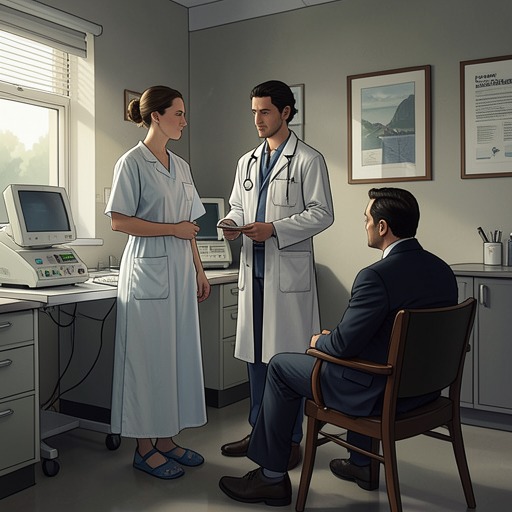
When the chief surgeon explains Allyson’s condition, Page tries to restate the information plainly: Allyson has two major injuries, may die, and could live with lasting brain effects or blindness. Page then asks whether she can ever be okay again, meaning normal. The question carries the weight of a comparison with the daughter she knew before the crash, rather than a neutral request for a clinical definition.
The surgeon answers that there are degrees of normal. Allyson’s motor skills and reasoning could be affected, and her personality might change; outcomes might range from relatively minor effects to severe impairment. A relatively normal recovery remains possible if she is very lucky, but the surgeon does not consider it likely that such extensive injuries will leave no lasting effects. He also refuses to turn a possible best case into a promise. The uncertainty is specific: a further injury might develop after the operation, and the immediate danger remains real. Normality is therefore presented both as a medical possibility and as a future no one can yet predict.
Bjorn as a Different Measure
During the long wait while the girls are in surgery, Page worries about what it would mean if Allyson were permanently affected, then remembers Bjorn and apologizes to Trygve. He recognizes the fear from his own experience: when Bjorn was diagnosed with Down syndrome, Dana Thorensen struggled to accept that their baby was not perfect, feared what his future would be, and wanted to place him in an institution. Trygve rejected that possibility. He says he does not believe people should be abandoned because their lives are difficult, and describes helping Bjorn as a responsibility he took on when Dana wanted no part of it.
Trygve’s account does not deny Bjorn’s limitations or claim that he will become like other people. He says Bjorn will not go to college or become a doctor, but also names what Bjorn can do: he is gifted at carpentry, artistic in a childlike way, affectionate, loyal, sociable, a good cook, and responsible to a point. He loves sports, children, and people, and is learning to drive. Trygve hopes he can have a good life despite his limitations. These details replace an abstract comparison with an account of Bjorn as a particular person whose abilities and attachments matter in their own right.
That account also shows how a family’s expectations can change. Dana initially imagined institutional care, whereas Trygve describes Bjorn’s everyday contribution, including buying groceries, and says he is proud of him. He does not measure Bjorn against an idealized version of who he might have been; he says Bjorn is already the best he could be. Page understands the example, but cannot simply transfer it to Allyson. She wonders how a parent could discard the old measuring sticks, welcome each step or word, and accept a life that might contain less than the one previously imagined. Trygve cannot answer how to forget what Allyson was. His more modest suggestion is to begin with gratitude that she is alive, if she survives.
Gratitude, Loss, and Adjustment
The story resists treating gratitude as an easy cure for grief. Trygve’s hope that Allyson might live does not make Page’s loss of her former expectations disappear. Page remembers that the previous day Allyson had been a healthy fifteen-year-old asking to borrow her pink sweater; now she is in brain surgery, fighting for her life. Page says she is grateful Allyson is not dead, but that comparison with the day before makes the demand to be grateful feel inadequate. The two truths coexist: survival would matter profoundly, and the present crisis is still devastating.
Chloe Thorensen’s operation provides a different, more concrete but still uncertain future. The surgeon reports that her pelvis has been set, her hip replaced, and rods and pins placed in both legs, with possible removal in a year or two. He expects a long hospital stay and says the next weeks will matter. Chloe will not return to ballet, but the doctors are optimistic that she may walk and perhaps dance again; having children is also described as a possibility. The changed future is neither the old one restored nor a life defined only by what has been lost. The gap between ballet and the possibility of walking or dancing makes the cost of injury visible without reducing Chloe to that cost.
Judgment Under Uncertainty
The question of normality sits beside another question the family cannot settle: who caused the collision. At the hospital, Page learns that Phillip Chapman, a seventeen-year-old, was driving the other car. Trygve is angry at Phillip, Chloe for concealing the outing, and the other driver if she was responsible, but the highway patrol says the collision was so severe that the available evidence cannot establish which car crossed the line or why. Phillip’s blood test shows alcohol, but not enough for him to be considered drunk; the Senator’s wife appears sober, and police do not test her. The characters have to live with the difference between suspicion and proof.
Later, Trygve challenges a newspaper account that appears to clear Laura Hutchinson while indirectly making Phillip seem responsible. He argues that the reporting and the Senator’s aides’ public presentation favor a respectable adult over a young driver, even though the investigation remains inconclusive and people who knew Phillip describe him as responsible. He also admits that he first wanted someone to blame, including Jamie Applegate, before reconsidering what he knew. The later report that Laura has been arrested for intoxicated driving after a fatal collision in La Jolla intensifies Page’s suspicion about the earlier crash and seems to vindicate Trygve’s doubts; it does not, by itself, resolve the evidence about the earlier collision. This parallel strengthens the story’s caution about turning a familiar category—normal, responsible, guilty—into a conclusion before the facts are known.
The Limits of a Single Definition
Normality remains unsettled because the story does not offer a replacement ideal that fits every person. The surgeon can describe possible impairments, but cannot promise a particular recovery. Trygve can show that Bjorn’s limitations coexist with talents, affection, and a meaningful place in family life, but Page still faces the distinct possibility of losing the daughter she knew. Chloe’s prospects similarly involve both permanent change and possible new capacities. In each case, the future must be approached without pretending that a loss is insignificant or that disability cancels a person’s value.
The question thus changes shape: from whether someone can return to an earlier standard, toward how a family might recognize a life as it actually unfolds. The story leaves that adjustment unfinished while Allyson’s survival and long-term condition remain uncertain. Its strongest answer is not that every outcome is equivalent, but that no prognosis, limitation, or comparison can fully define the person whose future is at stake.