National Command Authority Restrictions on the Georgia Mission
AfterburnThe National Command Authority Restrictions on the Georgia Mission defined the boundary between supporting an international relief effort and entering the fighting in the Republic of Georgia. Under the directive, U.S. forces could help open routes for aid and enforce a United Nations no-fly zone, but were not to take part in combat between the Red and Blue Russian factions. The distinction made the mission’s limits a matter of command authority as well as operational purpose.
Background and Limits
On paper, Operation Sustain Hope resembled Operation Restore Hope, the costly and abortive United Nations-backed Marine operation in Somalia from 1992 to 1994. That comparison framed the proposed Georgia deployment as a humanitarian intervention, but the National Command Authority specified a narrower and firmer condition: U.S. forces were not to involve themselves in the fighting between the two Russian factions under any circumstances. The directive thus separated the provision of relief from the conflict surrounding it, even as the operation would place American forces in the region where that conflict was unfolding.
The political question of whether American forces should serve under United Nations commanders had already been debated for years. The Georgia mission therefore sat within a larger dispute over international command: who could direct U.S. forces, and how far that authority extended. The directive’s prohibition on combat involvement supplied a national limit on the mission even as its tasks were coordinated with the United Nations.
Authorized Mission in Poti
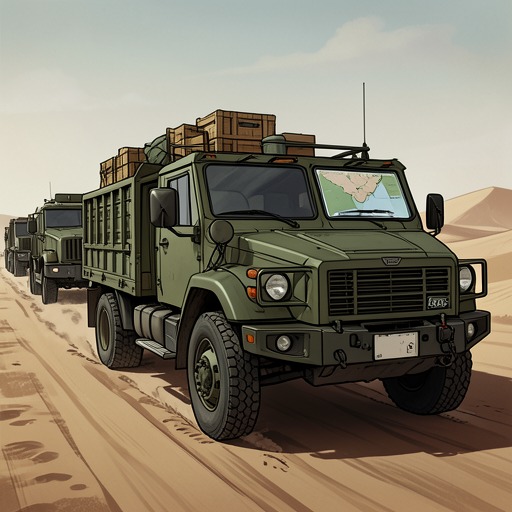
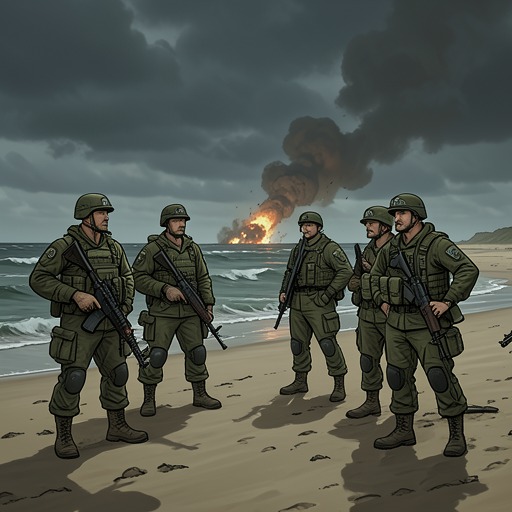
The Marines were to go ashore at Poti only after the United Nations Crisis Assessment Team gave approval. Their specified task was to secure port and airfield facilities in and around the Georgian port, allowing relief supplies to arrive by ship and plane. The conditional timing and concrete objectives constrained the deployment: the landing was not an open-ended authorization to enter the conflict, but a step tied to approval and the delivery of assistance.
At the same time, aircraft from the Jefferson battle group were assigned to enforce a United Nations-directed no-fly zone over western Georgia. The combination of securing entry points for aid and restricting air activity gave the mission a military means of support without, in the directive’s stated terms, authorizing U.S. forces to fight either Russian faction. Its central distinction was between using force to carry out the assigned protective role and becoming a combatant in the factional war.
Command and the Boundary of Authority
The restrictions also belong to the book’s recurring question of how American forces operate when the United Nations has a role in directing a mission. The debate was not merely abstract: the Georgia plan assigned specific tasks through a United Nations process, while the National Command Authority retained a clear prohibition against participation in the local fighting. The arrangement placed international coordination alongside a national constraint rather than erasing that constraint.
A later deployment in Crimea provides a contrast, not a revision of the Georgia directive. There, Washington granted the United Nations operational authority over U.S. forces in the Crimean Peacekeeping Operational Zone, and the American commander instructed his officers to operate under United Nations command until the President decided otherwise. That later order shows how the command issue could be handled in another mission; it does not alter the separate Georgia rule or its ban on involvement in the Red–Blue fighting.
Significance
The directive’s limits expose the tension built into a peacekeeping and relief mission conducted amid armed conflict. U.S. forces were expected to secure facilities, support the arrival of supplies, and help enforce an air restriction, while remaining outside the fighting that made those measures consequential. The policy drew a formal line around intervention, but the assigned tasks still placed American military power inside the crisis. In that sense, the directive defines both the intended restraint of Operation Sustain Hope and the difficult boundary between humanitarian support and participation in war.