Civilian Control of the U.S. Military
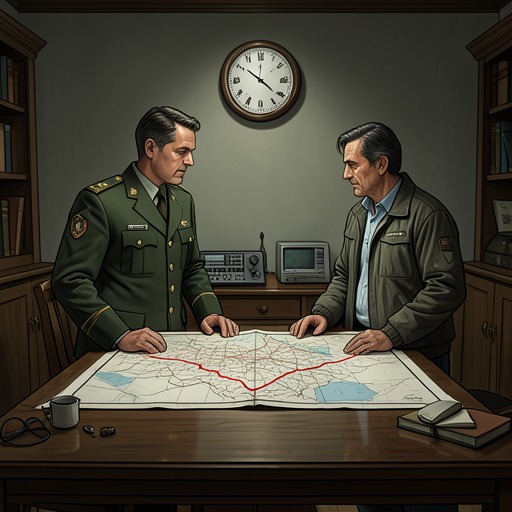
AfterburnCivilian Control of the U.S. Military is the principle that politicians determine policy and military officers, despite their professional advice or reservations, execute the decisions handed down to them. In the novel, that principle is tested not only by the decision to intervene in a Russian conflict but by the unusual delegation of operational authority to the United Nations: officers who question the arrangement are still expected to obey it.
The constitutional and political boundary
The dispute begins with a question that has been debated for years: whether American forces should serve under United Nations commanders. The stakes are presented as both strategic and constitutional. The intervention is intended to help create conditions for a United Nations-brokered peace across the Russian Federation, and the Thomas Jefferson and its battle group sail toward the region to add the carrier air wing to the United Nations effort. A Marine Expeditionary Unit has already been moved to the waters off Poti, Georgia.
That purpose does not erase the limits set by national policy. The National Command Authority’s directive rules out U.S. involvement in fighting between the Reds and the Blues; the Marines are to go ashore at Poti. The distinction between contributing to an international peace effort and entering the factional war is therefore a command constraint, not merely a difference in rhetoric. The mission depends on political leaders defining what the military may do, even as events threaten to draw it closer to combat.
Disagreement among civilian leaders
The novel gives the constitutional objection a forceful voice through Admiral Scott. He warns that extending United Nations power would surrender American sovereignty and argues that intervention can be detached from the national interest. When Robert Heideman rejects that view, Scott characterizes the proposal as a way of sidestepping the Constitution by placing troops under United Nations authority. Heideman counters that sovereignty should not become an excuse for avoiding intervention when intervention serves the national interest. The exchange makes the dispute more than a simple contest between military judgment and political ambition: both the scope of national authority and the purpose of using force are contested.
Scott also invokes a specific failure of responsibility: American personnel were killed in a firefight, and, in his account, were then left without support when they got into trouble. His objection is thus grounded in the consequences of intervention as well as in constitutional limits. The President, meanwhile, is described as taking a beating over foreign policy, with advisers seeing another overseas adventure as politically unwise. The competing pressures—past casualties, national interest, sovereignty, and the President’s political position—surround the decision without resolving the underlying institutional question.
Orders and operational authority
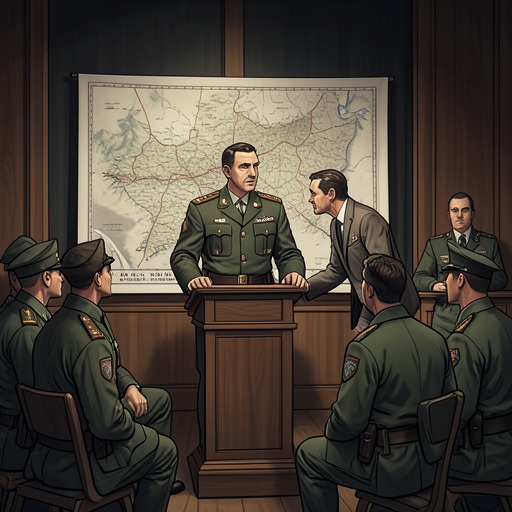
The principle becomes immediate when Rear Admiral Douglas E. Tarrant tells his people that Washington has granted the United Nations operational authority over U.S. forces in the Crimean Peacekeeping Operational Zone. The arrangement is explicitly temporary, lasting for the mission, but its practical meaning is direct: the force is to operate under United Nations command until the President says otherwise. Tarrant acknowledges the officers’ reaction and demands discipline at the briefing, insisting that their objections cannot turn it into a free-for-all.
His explanation joins obedience to the civilian chain of command with the military’s institutional duty. The President remains commander in chief; once the order is given, the officers are expected to obey, even if they regard the policy as mistaken. This does not establish that the international command arrangement is free of risk. Rather, it distinguishes professional advice from the authority to decide: military leaders may counsel against policy, but they do not acquire the right to replace it with their own.
Principle under pressure
The narrative’s account of the tradition is deliberately firm: policy belongs to politicians, while admirals and generals advise and then carry out the decision. Yet the weary exchange between Scott and Thomas Magruder, neither of whom speaks after the discussion, leaves room for apprehension. Thomas Magruder hopes the policy will not become one the United States bitterly regrets. The scene holds professional misgivings and institutional obedience together instead of treating one as proof that the other has disappeared.
Later questions about the chain of command show that authority remains a practical concern as the operation develops. In a discussion of the battle group’s options, Gordon West calls the strategic concept sound but its execution badly flawed, while describing the overall undertaking as a major failure. Those judgments do not cancel civilian control; they underline the distinction between who authorizes a mission and how well it is carried out. The principle’s significance lies in that tension: obedience preserves political accountability, but it cannot guarantee wise policy, sound execution, or freedom from consequences.