Rules of engagement
AfterburnRules of engagement determine when American forces may use force during the United Nations peacekeeping mission, where operational authority, national limits, and immediate battlefield decisions overlap. Their defining tension is between capacity and permission: American aircraft can be in range of a target without being authorized to fire, but confirmed hostile action can abruptly change that status.
Conditional Authority to Use Force
The rules are presented not as a general license to fight, but as constraints on particular actions in a volatile mission. American forces are sent toward Poti to add the carrier air wing to the United Nations’ position, yet the National Command Authority has expressly forbidden U.S. involvement in the fighting between the Red and Blue Russian factions. The deployment therefore does not itself authorize participation in every nearby conflict. The distinction matters: a force can be present, armed, and capable of intervening while remaining bound by a political limit on what it may do.
That limit sits within a longstanding dispute over whether American forces should serve under United Nations commanders. During the Crimean mission, Washington grants the United Nations operational authority over U.S. forces in the Crimean Peacekeeping Operational Zone. The arrangement is explicitly temporary: the forces are to operate under United Nations command until the President says otherwise. The order makes the chain of command consequential to the rules in practice, while preserving the President’s stated ability to end the arrangement. The resulting framework does not erase national authority; it places operational direction inside a broader command structure whose boundaries remain politically charged.
Identification Before Fire
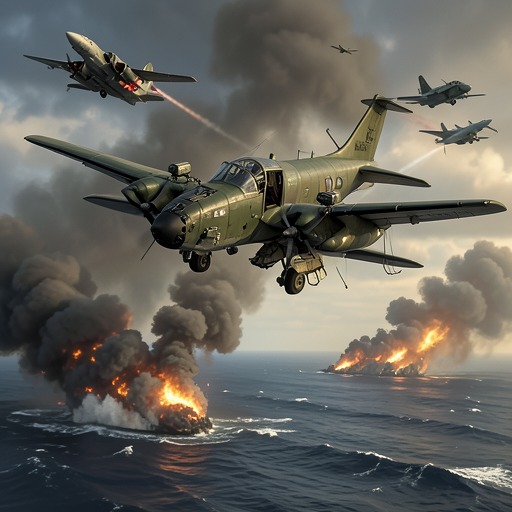
The air-combat scenes make the restraint concrete. During one encounter, American aircraft are comfortably within the range of their AIM-54 missiles, whose reach extends to 120 nautical miles. Yet the Americans have not been attacked or even threatened, and Operations has not granted weapons-free authority. The pilots must obtain visual identification first. Range and weapon capability establish what they could do; neither supplies the missing permission to do it.
This requirement gives identification a decisive role in the interval between detection and engagement. The pilots cannot treat an uncertain contact as a confirmed hostile target merely because their equipment makes an attack possible. The rule slows the movement from surveillance to lethal action, requiring a closer determination before weapons may be used. In a scene shaped by mounting tension, that pause is not indecision: it is the procedure that keeps military capability subordinate to authorization.
From Restraint to Weapons Free
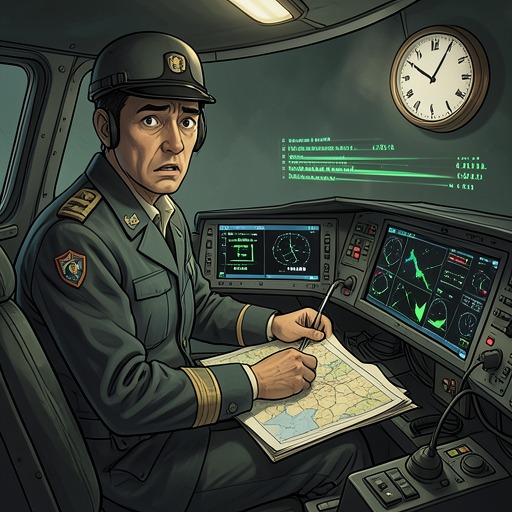
The later order changes the situation. After a missile launch is confirmed and hostile action is reported at 2140, Admiral Jeremy Brandt speaks from the Jefferson’s combat information center and declares weapons free, repeating the authorization. The sequence is sharply defined: the American side first confirms an attack, then its commander announces that weapons may be used. Where visual identification had been required in the earlier encounter because no attack or threat had occurred, confirmed hostile action now supplies the basis for a different response.
The contrast makes the rule’s conditional character visible. Authorization is not permanent simply because a force is deployed, nor does restraint mean that force can never be used. The change follows a specific development in the encounter, and the order communicates that change across the command. The pilots’ reaction conveys relief at being permitted to respond after being shot at; the command decision turns that permission into an operational fact. The scene thus distinguishes the experience of danger from the formal authority to answer it.
Command, Politics, and Consequence
The rules operate inside a political argument that predates the immediate crisis. Whether American forces should be placed under United Nations commanders has been debated for years, and the President is already taking heavy criticism over foreign policy. The novel connects those pressures to the practical problem of command: a mission may have international purposes, but its forces remain subject to limits set by national authorities, and commanders must translate those limits into decisions under pressure.
The temporary United Nations command arrangement is reinforced as an order to be obeyed until the President changes it. At the same time, the commander expects officers to maintain military decorum. These instructions show that command governs more than target selection: it also establishes the conduct expected of officers while they serve within a contested arrangement. The narrative does not resolve the larger debate by presenting the rules as a universal formula. Instead, it shows how authority is negotiated through a national prohibition on entering factional combat, a temporary grant of United Nations operational control, a requirement to identify before firing, and a clear authorization after hostile action is confirmed.
The rules’ significance lies in the boundary they draw between readiness and action. The aircraft’s reach, the mission’s political purpose, and the pilots’ exposure to danger do not by themselves settle whether they may fire. That decision depends on identification, the circumstances of the encounter, and a recognized command authorization. When the reported attack changes those circumstances, the order changes with them; the rule is both a restraint on premature force and the procedure by which force can be released.