U.S. Forces under UN Operational Command
AfterburnU.S. Forces under UN Operational Command was the arrangement by which Washington granted the UN operational authority over American forces in the Crimean Peacekeeping Operational Zone. It made the UN Special Envoy in Sevastopol the force’s immediate operational superior, while the President remained commander in chief and the authority who could end the arrangement. The resulting command structure turned a longstanding policy debate into a test of obedience, sovereignty, and military professionalism.
The Disputed Principle
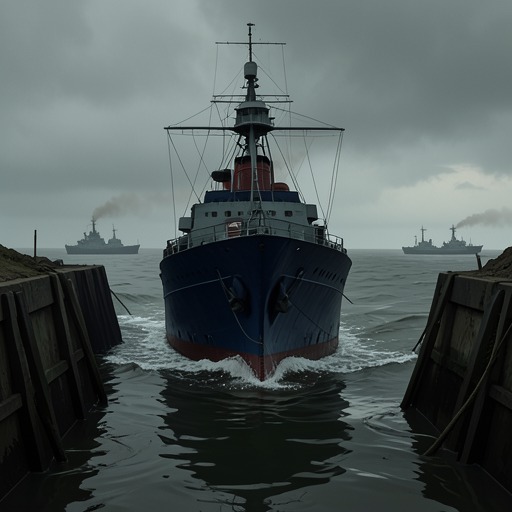
Whether American forces should serve under UN commanders had been debated for years. The issue was not merely theoretical: the Jefferson was heading into the waters off Poti to add its air wing to the UN’s arguments. The carrier was nuclear-powered, but that did not make its air wing independent of fuel; the ship required replenishment of expendables every two to three weeks, and its aircraft consumed fuel. The proposed international command therefore concerned a substantial military commitment, not simply a diplomatic gesture.
The dispute also touched the established American principle of civilian control. Determining policy belonged to politicians, not the armed forces, and the President’s authority as commander in chief remained the basis for the military’s obligation to obey. That principle did not resolve the practical question of whether operational authority should be delegated to an international organization; instead, it framed the dispute over how far such delegation could go without displacing the country’s own political command.
Limits Set Before Deployment
The National Command Authority had already imposed a specific restriction: American forces were not to become involved in the fighting between the Russian Reds and Blues. The Marines could go ashore at Poti, but their mission was bounded by that prohibition. The distinction between entering a conflict zone and joining the factional fighting was central to the limits placed on the deployment.
The policy debate carried memories of earlier UN-directed intervention. Operation Restore Hope in Somalia, described as an abortive and expensive Marine operation, served as a warning in the discussion. Admiral Scott objected that giving the UN more power amounted to surrendering American sovereignty. His concern was sharpened by the memory of an earlier firefight in which American personnel had been killed and then, in his view, inadequately supported when they encountered trouble. Heideman rejected the idea that national sovereignty could settle the question by itself, arguing that the country could not remain bound to the past. The disagreement was thus about both authority and responsibility: who would direct the forces, and who would answer for the consequences of their use.
Authority Granted and Orders Enforced
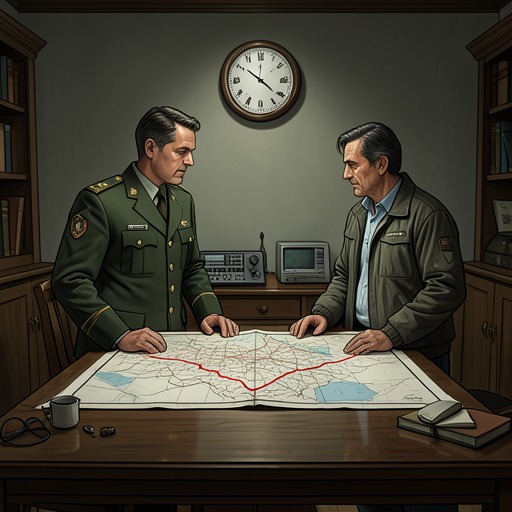
The UN requested operational authority, and Washington granted it for the duration of the mission. Admiral Tarrant told his personnel that the UN Special Envoy in Sevastopol would be his immediate boss and would determine exactly how, when, and where American forces were used in support of other UN personnel deployed in the region. This established the Envoy’s authority over operational employment, rather than merely assigning the UN a consultative role.
The announcement provoked immediate protests. Some personnel objected to UN control and invoked Somalia as a precedent. Tarrant stopped the outcry and acknowledged that the arrangement broke with military tradition and was not what his people had signed up for. He nevertheless made the chain of legitimacy explicit: the President had given the order, and the forces would operate under UN command until the President said otherwise. He required officers to maintain military decorum and to treat UN personnel, military and civilian, with the same respect as fellow American servicemembers. The room’s response remained muttered and distinctly unenthusiastic, but the order stood.
Friction and Command Continuity
The arrangement did not erase disagreement within the political leadership. Admiral Scott and Matthew Magruder exchanged a long, weary look after the debate, but neither spoke. Later, White House Chief of Staff Gordon West called the undertaking a colossal screw-up and doubted that the President would want to enter another major military operation. That criticism registered the continuing political cost of the mission, though it did not itself alter the command order described by Tarrant.
Operational command also depended on a functioning military chain beneath the international authority. After an admiral was wounded, the question of succession arose; Jeremy Brandt, Tarrant’s flag captain, received a brevet promotion to admiral, confirmed through Naples. The episode distinguishes two problems that the mission brought together: who held authority over the American forces at the international level, and how command continuity would be maintained within the force itself. The order to serve under the UN remained conditional on presidential direction, but its immediate demands were concrete: accept the Envoy’s operational decisions, obey the President’s command, and sustain professional relations with the UN personnel alongside whom the Americans were deployed.