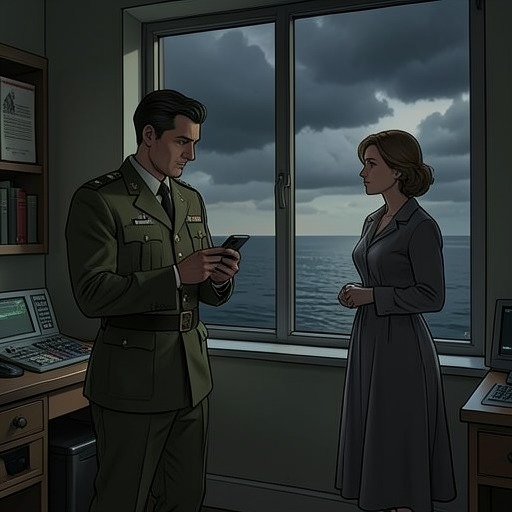
Strain of Deployment on Intimate Relationships
AfterburnStrain of Deployment on Intimate Relationships is the novel’s recurring conflict between the demands of military service and the time, presence, and shared life that intimate relationships require. It is not merely the sadness of parting: deployment repeats, its duration can be uncertain, and operational obligations are difficult to set aside for the sake of a relationship. Matthew “Tombstone” Magruder and Pamela Drake’s breakup makes that conflict explicit, while the shipboard prevalence of Dear John letters places their private crisis within a larger community of military separations.
A Relationship Measured in Absences
Pamela describes the pattern that has made a future with Matt seem unworkable: he is home for about six months, then away for six months, perhaps nine. Her account emphasizes the repeated rhythm, not a single exceptional separation. Just as she has begun to adjust to his presence, another deployment takes him away. The uncertainty in the longer estimate matters as much as the time apart; their shared life cannot be planned around a reliably fixed absence.
Pamela has also reconsidered what she has seen of families in which the men are away half the time or more. After Matt leaves, she recognizes that she cannot live that way. The decision comes from comparing the life military service entails with the life she can accept, rather than from a claim that she does not love him. That distinction gives the conflict its force: affection remains, but it does not erase the costs of the arrangement.
Love and Incompatibility
The conversation turns on a painful contradiction. Pamela tells Matt that he would not be the man she loves if he could easily give up the work that takes him away. Yet that same commitment makes them, in her judgment, completely incompatible. She does not treat his service as a disposable preference he could simply abandon without changing who he is; nor does she pretend that loving him makes repeated absence sustainable for her.
Matt hears the continued love in her explanation and responds with a glimmer of hope, asking whether she still loves him before beginning to draw an inference from her answer. But the exchange does not undo Pamela’s conclusion. The novel frames the separation as a collision between two truths—her love for him and her inability to accept the life his service entails—rather than as a simple failure of feeling. Their relationship ends in the setting of a romantic dinner, a sharp contrast between the intimacy the occasion promises and the incompatibility it exposes.
A Wider Military Pattern
Matt recognizes that the problem extends beyond his relationship. He thinks of Coyote’s marriage, which is rocky for the same reasons Pamela has raised, and of how painful it is to watch that marriage come apart. That comparison makes deployment strain more than a private disagreement between two people: it is a recurring pressure on couples connected to the service, visible even to a friend who has stood beside one of them at his wedding.
The novel also identifies Dear John letters as a common problem aboard the carrier, especially among younger enlisted personnel. The letters are familiar enough to figure among the concerns encountered by the ship’s chaplain’s department and by the executive officers of both the carrier and its squadrons. This institutional presence broadens the subject. Relationship breakdown is not presented only as a dramatic exception for a principal character; it is part of the ordinary human burdens that military units must encounter alongside their formal duties.
Operational Time and Private Cost
The book’s operational details give the separations a material backdrop. A modern carrier needs at-sea replenishment of expendable supplies every two to three weeks. Though nuclear-powered, it still depends on supplies for its aircraft, and the aircraft’s needs can become more pressing under a heavy flight schedule or sustained combat. The work of deployment therefore involves a continuing chain of operations and resupply, not simply a period away that can be treated as empty time between homecomings.
That dependence becomes especially consequential when a battle group faces isolation in the Black Sea. Under round-the-clock flight operations, an initially estimated ten-day margin could shrink to two to four days; if the Bosporus Strait closed, the carrier and its escorts risked becoming trapped without a route for replenishment. Later, the prospect of resupply is examined through estimates passed around a conference table, while a separate effort requires pumping nearly three million gallons of aviation fuel—about nine thousand tons—aboard. These details do not make the breakup a consequence of fuel calculations. They show the larger structure in which personal absence occurs: naval commitments are governed by operational needs, supply windows, and access to routes, rather than by the timetable a relationship might prefer.
The contrast between Matt and Pamela’s six-month intervals and the fleet’s shorter cycles of replenishment is significant. One measures absence in the span of a relationship; the other measures the resources required to keep a deployment functioning. Together they make clear that service imposes costs at different scales, from the logistics that sustain aircraft to the repeated homecomings and departures that Pamela cannot accept. The novel’s treatment of the subject rests on that tension: military duty can be inseparable from a person’s identity and obligations, while love alone cannot guarantee that another person can live with its consequences.