Political Expediency and Abandoning Frontline Personnel
AfterburnPolitical Expediency and Abandoning Frontline Personnel names the widening gap between the risks borne by deployed forces and the political calculations governing whether to sustain or rescue them. In the novel, that gap is not abstract: a carrier group is trapped in the Black Sea, its routes constrained, its supplies finite, and its personnel left waiting while leaders weigh escalation against the costs of intervention. The dilemma exposes competing duties rather than a simple division between courageous military officers and indifferent politicians: the forces at sea need help, but the decisions about war remain political.
The material conditions of abandonment
A carrier’s nuclear power does not make its air operations self-sustaining. The Jefferson requires replenishment of expendables every two or three weeks; its aircraft consume fuel, and the ship’s aviation supplies would last no more than ten days under ordinary conditions. A heavy flight schedule, a major strike, or a prolonged running battle could reduce that margin. Its only sources of resupply are the UNREP tankers following the battle group, leaving the force vulnerable if its access to them is blocked or the group is pinned in place.
The later crisis sharpens those logistical limits. With the Bosporus Strait closed, the carrier and its escorts risk becoming stranded inside the Black Sea. Continuous maneuvers and round-the-clock flights could cut the available leeway to two to four days, after which the ships would be trapped without the fuel needed to operate effectively. The description of them as expensive toys captures the reversal: a powerful force can remain physically present while losing the practical means to act.
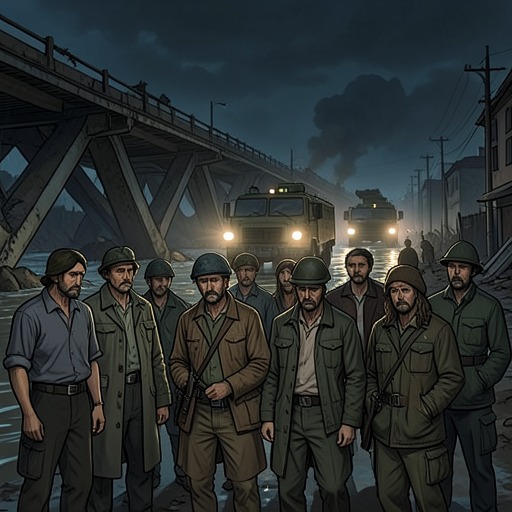
The danger is not only a matter of fuel. A report confirms that the group has been stranded after the bridge was knocked out; one of its aircraft has been fired upon, and the admiral has been wounded. Those events turn a strategic predicament into a personal one for the crews, while the attempt to determine how to get them out runs up against a problem of air superiority. In a later effort to address the fuel shortage, nearly three million gallons—about nine thousand tons—of aviation fuel must be pumped aboard the carrier. The scale of that requirement makes clear how much depends on access to supply, not simply on the ship’s ability to fight.
A divided argument over sovereignty and intervention
The policy dispute predates the immediate rescue question. Admiral Scott objects to giving the UN greater power, seeing the proposal as a surrender of American sovereignty. His resistance is shaped by the recent firefight in which American personnel were killed and the failure to support them when they were in trouble. Robert Heideman rejects this appeal to the past: he argues that national sovereignty cannot remain an unquestioned principle when circumstances have changed. Their disagreement sets two kinds of institutional memory against each other—Scott’s insistence that previous failures should caution against entrusting more authority, and Heideman’s insistence that those failures cannot dictate the future.
The novel also marks a limit to military autonomy. A long-standing American tradition of political control over the armed forces remains firm: policy belongs to politicians, not to military commanders. That principle does not settle whether a particular policy is wise, but it explains why officers’ judgments about danger do not themselves authorize an operation. During a heated briefing, Tarrant restores order and acknowledges that the proposal under discussion breaks with established practice. The scene presents the strain of the decision process without suggesting that disagreement can replace civilian authority.
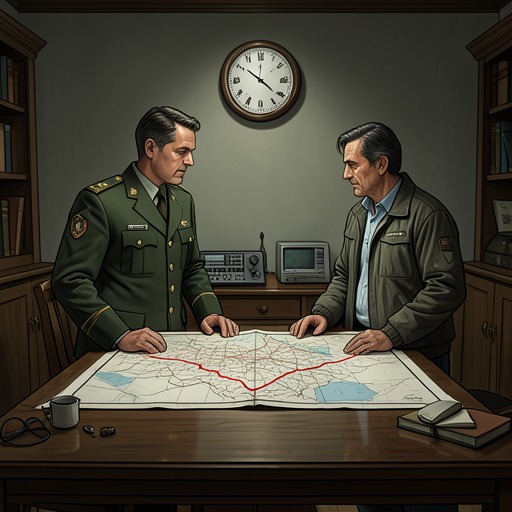
As the trapped group’s situation worsens, Admiral Scott argues that the United States cannot yield to Dmitriev’s demands because doing so would amount to extortion. When Samantha Reed asks for an alternative she can present to the President, Scott proposes sending in the Marines to secure the Dardanelles Straits from the Aegean onward. His proposal would address the access problem through direct force, but it also carries the risk of enlarging the conflict. Gordon West distinguishes between the strategic idea and its execution, calling the concept sound while describing its implementation as a major failure; he also indicates that the President is reluctant to begin a major military operation.
Political expediency and the people left waiting
The personal meaning of abandonment surfaces in a conversation with Matt “Tombstone” Magruder. He is told that the people in Washington are abandoning him, while he refuses to accept that conclusion. The warning is tied to the political mood in the United States: the prevailing sentiment, according to the speaker, is to stay out of the Russian war. Magruder counters that the public usually supports military personnel in the field and would object if Washington left them stranded. His confidence meets an immediate operational answer rather than reassurance: efforts to get the group out are under way, but air superiority remains a problem.
At the policy table, Reed faces the same conflict in more formal terms. Admiral Thomas Magruder asks whether her position amounts to doing nothing and invokes the people at risk. Reed refuses to send in the Marines because she does not want the incident to escalate into a major war. She then makes clear that she expects agreement from her advisers, offering to accept the resignations of Admiral Magruder and Admiral Scott if they cannot support her approach. Rather than a military rescue, she recommends meaningful dialogue with Dmitriev and the possibility of negotiation. Political expediency here is not merely a private motive: it becomes an explicit governing rationale, backed by the authority to determine which options may proceed.
Consequence and narrative significance
The narrative leaves the conflict between responsibility and restraint unresolved at the level of principle. Military leaders are responsible for the people and ships exposed to danger, but the government must also consider the possibility that a rescue operation could trigger a larger war. At the same time, delay has material consequences: aviation fuel dwindles, routes are closed, and the force’s capacity to respond contracts. The book therefore makes political choices legible through operational limits and the waiting they impose on those at sea.
Magruder’s later shame at the course his country has taken gives the concept its moral weight. The narration associates that shame with political expediency and a crumbling presidency, while placing it after a document has been signed. The scene does not erase the constitutional distinction between civilian policy and military command; instead, it shows how that distinction can coexist with profound unease about what policy leaves frontline personnel to endure. The recurring contrast is between decisions made at a distance and consequences measured in days of fuel, inaccessible passages, and uncertain prospects of rescue.