Humanitarian Military Intervention and Mission Creep
AfterburnHumanitarian Military Intervention and Mission Creep is the novel’s debate over what happens when military forces are assigned to preserve peace or deliver humanitarian outcomes in a conflict whose boundaries and objectives remain uncertain. Intervention is defended as a way to stabilize a disintegrating region, yet the same commitment can make outside powers responsible for protecting territory, managing political disputes, and sustaining forces in a dangerous theater. The danger is not humanitarian purpose itself, but the widening distance between that purpose, the authority granted to the military, and the resources available to carry it out.
Political Stakes in Ukraine and Crimea
The argument begins with a conflict that cannot be reduced to a simple division between Russia and Ukraine. Ukraine had been one of the Union’s largest and most productive republics, but ethnic Ukrainians were not Russians; its political identity and its territorial claims persisted amid the Russian Civil War. Crimea sharpened the dispute. The peninsula had traditionally been regarded as part of Ukraine, while the Russian Federation bordered it to the east. As Russian authority weakened, Ukraine appeared poised to press its claim, and the unresolved contest over Crimea and the Black Sea Fleet threatened to turn internal collapse into a wider confrontation.
That prospect makes intervention appear both preventive and perilous. In the policy discussion, Admiral Scott objects that placing American troops under the UN would sidestep the Constitution. Samantha Reed answers that intervention could serve immediate American interests, while Matthew Magruder privately sees the short-term calculation as potentially penny-wise and pound-foolish. Their disagreement concerns more than whether intervention is desirable: it concerns who authorizes it, what interests it serves, and whether the immediate rationale can control the consequences that follow.
The political uncertainty is explicit in Scott’s challenge to the claim that intervention would maintain peace: the region, he argues, is already tearing itself apart. The response is that Ukraine has not yet attacked. That distinction frames intervention as action before a predicted escalation, not simply a response after violence begins. But a preventive rationale depends on judgments about what another state is likely to do. In the novel’s setting, Ukraine’s history, identity, and territorial claims make those judgments inseparable from the disputed status of Crimea.
A Humanitarian Commitment Becomes a Guarantee
The proposal to accept Boychenko’s surrender makes the scope of intervention concrete. The UN sees the offer as an opportunity for international peacekeeping, and control of Crimea is also described as a humanitarian effort in light of the threatened ethnic-cleansing operation. Yet accepting the surrender would entail more than providing aid: the UN would guarantee Crimea against outside attack. The shift is consequential. A mission framed as peacekeeping acquires responsibility for the territory’s security and for deterring forces beyond it.
That guarantee exposes the asymmetry between the language of limited intervention and the obligations it can create. A humanitarian purpose may explain why outside powers act, but it does not make the resulting military commitment small. Once protection against attack is promised, withdrawal or failure to defend the territory carries political and human consequences. The offer therefore presents the UN with both an opportunity and a burden: international peacekeeping can prevent harm, while also binding the organization to a more demanding role than the delivery of humanitarian assistance alone.
Mission Creep and Operational Risk
The novel makes mission creep legible through the distance between military training and assigned work. In a conversation about deployments to Georgia and Crimea, Matthew Magruder questions why naval forces are being sent on humanitarian programs when they are not trained for those tasks. He describes such deployments as a waste and misuse of resources, but also as dangerous. His concern is cumulative: each additional make-work mission extends resources farther and weakens readiness for other demands.
The risk grows when political aims produce vague parameters, jumbled or self-contradictory orders, and a chain of decisions shaped more by politics than by fighting. Under those conditions, Magruder argues, mistakes become more likely. The discussion gives the warning an immediate example: the downing of a helicopter. Earlier, he and his interlocutor refer to two kills, both mistakes, and question what the Navy is doing in the theater. The incidents do not establish that humanitarian work alone caused the errors; they show how a deployment whose purpose and operational boundaries are disputed can be experienced by those carrying it out as a dangerous mismatch between mission and capability.
Magruder’s further concern is about what such a mismatch prevents. If forces remain tied down in relief efforts, they may be less able to respond when a crisis arises that only the military can solve. The argument is not that relief is worthless: when asked what is wrong with humanitarian programs, he accepts that nothing is inherently wrong with them. His objection is to assigning scarce military capacity without clear parameters or regard for the costs to readiness. The distinction preserves the humanitarian aim while criticizing the institutional choice to use military forces for it in ways that may erode their ability to meet other obligations.
Logistics and the Limits of Commitment
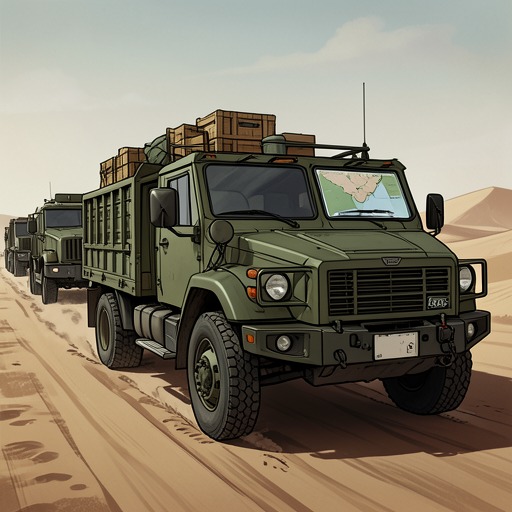
The carrier’s supply problem gives that concern a material scale. A modern carrier requires replenishment of expendables every two to three weeks. Though nuclear-powered and not dependent on fuel for propulsion, its aircraft consume aviation fuel, and the group’s supply of expendables would not last more than ten days under ordinary estimates—less during a heavy flight schedule, a major strike, or an extended battle. Its only sources of resupply are the UN replenishment tankers following the battle group.
The margin can contract sharply under sustained operations. With round-the-clock maneuvers and aircraft flying from the carrier, the nominal ten-day leeway could fall to two to four days. If the Bosporus Strait closes, the carrier and escorts risk being trapped in the Black Sea, where they would become, in the assessment described, expensive but useless assets. The strategic predicament is therefore not only about whether leaders are willing to intervene. It is also about whether the forces committed can be supplied and remain useful when a route closes or operational tempo consumes their stores faster than expected.
Later, the scale of aviation-fuel demand becomes physical: nearly three million gallons, about nine thousand tons, must be pumped aboard, with flight-deck operations suspended during the process. Matthew Magruder brings estimates to a policy meeting as officials confront whether the force can be resupplied. Such details connect political promises to the practical conditions of military presence. A guarantee of protection may be expressed in diplomatic terms, but carrying it out depends on tankers, fuel, open routes, and time.
The Concept’s Narrative Significance
The novel treats humanitarian intervention neither as an uncomplicated good nor as a disguise that can be dismissed outright. Its characters recognize the danger the mission is meant to address, including threatened ethnic cleansing and the prospect of Ukraine taking action while Russia is consumed by civil war. At the same time, they dispute whether the proposed response can preserve peace, whether its authority is constitutionally sound, and whether its obligations exceed the capacity of the forces assigned to it.
Mission creep emerges from the accumulation of those unresolved tensions: a peacekeeping rationale becomes a territorial security guarantee; a deployment expands beyond the work for which its personnel are trained; political ambiguity complicates orders; operational errors consume attention; and logistical demands narrow the force’s options. The carrier’s fuel calculations make the pattern especially clear. Good intentions cannot by themselves keep a force supplied or resolve who commands it. In this account, humanitarian intervention becomes dangerous when its moral purpose is allowed to stand in for a precise mandate, a coherent chain of authority, and a realistic plan for sustaining the commitment.