The Concept of a United Nations with Teeth
AfterburnThe Concept of a United Nations with Teeth is the argument that the United Nations must command real military power if it is to enforce peace and shape a New World Order. In the Georgian relief mission, the idea is not merely theoretical: United States forces serve under United Nations auspices, while the intended peacekeeping presence becomes entangled in regional conflict and the fragile logistics of a carrier group operating inside the Black Sea.
Political Ambition and International Command
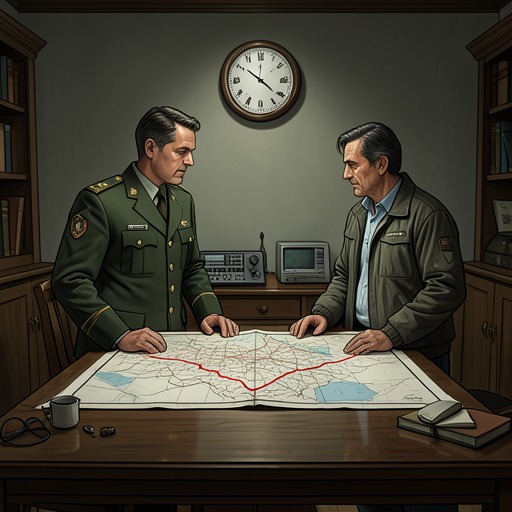
Whether American forces should serve under United Nations commanders has long been debated. Advisers close to the President, nicknamed the Internationalists, insist that the New World Order can emerge only when the United Nations possesses the military teeth of a world power and national armed forces are weakened. The proposal therefore contains a sharp exchange of authority: military strength is meant to make international peace enforceable, but achieving that strength entails subordinating national forces to foreign command.
Matthew “Tombstone” Magruder dislikes the direction this policy appears to be taking. His unease is attached to a specific prospect—a United States carrier battle group under a foreign commander—rather than to an abstract argument over institutional design. The scene places that political dispute amid Istanbul’s lived, strategic setting: the afternoon calls of muezzins from the city’s minarets mingle with horns and traffic, while the nearby straits give international command a concrete maritime dimension.
Operation Sustain Hope in Georgia
The United Nations puts the concept into practice through Operation Sustain Hope. Marine Expeditionary Unit 25 operates under United Nations auspices as part of the Georgian relief program, making the question of American forces serving under United Nations leadership immediate. The arrangement is already described as rapidly proving disastrous. The promise of an internationally backed military presence is thus tested not in a settled peace but in a mission where command, intervention, and local instability press against one another.
The hoped-for political result is conditional. If a fragile peace can be established among western Georgia’s warring tribes and factions around Poti and Kutaisi, United Nations sanctions could be extended across all of Georgia and into neighboring Armenia and Azerbaijan. A successfully enforced peace would, in turn, lend legitimacy to the claim that the United Nations can act with the force of a world power. The mission’s ambition is therefore broader than relief in one region: its success is meant to demonstrate that international sanctions and military backing can help contain several connected conflicts.
That same military presence is expected to defuse other dangers. Turkey has threatened more than once to invade Armenia to suppress unrest there, and the United Nations hopes a strong force in the region can reduce the risk. Yet relations with Ankara are strained, and no one counts on help from that quarter. The policy depends on an international presence to quiet regional crises even as the political and diplomatic conditions for assembling support remain uncertain.
Escalation and the Limits of Peacekeeping
As the situation deteriorates, the language of peace becomes contested. The northern Black Sea, from Odessa to Gagra, may become a war zone; the narrative warns that such a development could make the position of the United Nations and the United States difficult, perhaps impossible. In a policy discussion, Admiral Scott rejects the Secretary’s appeal to maintaining peace by pointing out that the whole area is tearing itself apart. The Secretary responds that Ukraine has not attacked yet. Their exchange exposes the problem at the heart of intervention: a force may be deployed to preserve peace before a particular attack occurs, while the surrounding conflict already makes the meaning and limits of that mandate uncertain.
Official statements likewise show how claims of accident and resolve can coexist. A government statement describes attacks as products of mistaken identity and the well-known fog of water, expresses regret, and at the same time insists on its determination not to let foreign powers hinder its purpose. The juxtaposition complicates the language of enforcement: a military presence intended to uphold peace operates amid competing accounts of responsibility, danger, and legitimate action.
Supply, Access, and the Test of Power
The concept’s military credibility depends on sustainment as well as command. A modern carrier such as the Thomas Jefferson requires replenishment of expendables every two to three weeks. Although nuclear-powered, it still relies on aviation fuel for its aircraft; under a heavy flight schedule, those supplies may not last more than ten days. A major strike or extended battle would consume them faster. The battle group’s replenishment tankers follow it at sea, making the force dependent on a supply chain that can become a strategic vulnerability when access is threatened.
The Bosporus Strait makes that vulnerability decisive. With continuous maneuvers and aircraft operations, the carrier’s ten-day margin can shrink to two to four days. After that, the Thomas Jefferson and its escorts risk becoming, in the book’s account, expensive but useless forces trapped in the Black Sea by closure of the strait. A later refueling effort underscores the scale of what military endurance requires: nearly three million gallons, about nine thousand tons, of highly flammable aviation fuel must be pumped aboard, after fuel has been judged acceptable for the carrier’s demanding standards and flight-deck operations have been suspended. The image of an immense fighting force awaiting fuel brings the political claim down to material terms. United Nations military power can deter or intervene only while ships, aircraft, and their supply routes remain usable; command authority alone cannot secure them.