Crimean Tatar Independence Movement
AfterburnThe Crimean Tatar Independence Movement represents a challenge to any simple account of Crimea as territory contested only between Ukraine and Russia. In the novel, the Tatars’ claim to the peninsula is rooted in a history of forced exile and return, and takes political form in calls for autonomy or an independent homeland. The possibility that radical groups acted violently in pursuit of that cause enters the story through speculation about an assassination attempt, but the evidence never establishes that the movement, or any particular Tatar group, was responsible.
Historical and Territorial Background
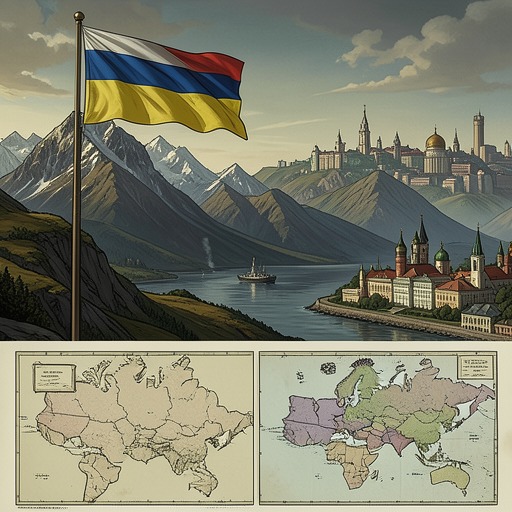
The peninsula’s competing claims are already part of a larger dispute. Ukraine had never been wholly comfortable with its position as a major republic of the Union, and ethnic Ukrainians were not Russians, despite what outsiders might assume. Crimea, meanwhile, was generally considered part of Ukraine geographically, with the Russian Federation bordering it to the east. During Russia’s civil war, Ukraine was taking steps to strengthen its position, especially in Crimea. The old dispute between the Ukrainian and Russian sides over the peninsula and the Black Sea Fleet remained unresolved as Russia’s crisis appeared to create an opportunity to settle it.
The Tatar claim adds another history to this territorial contest. Matt “Tombstone” Magruder, tending to Abdulhalik, recalls having read in a guidebook that Crimea was the Tatars’ homeland. The account he has learned describes occupation and liberation followed by persecution: Stalin accused the Tatars of collaborating with the Nazis and used that accusation to exile them to Central Asia. The ban on their return was lifted in the 1980s. They returned in growing numbers, so the movement’s demands arise not simply from a boundary dispute among states, but from the return of a population previously expelled from the place it regarded as home.
Demands and Political Form
The demands described in the novel are plural rather than a single settled program. Many Tatars were calling for Crimea to be returned to them either as an autonomous district or as a free homeland. Those alternatives imply different political outcomes: autonomy would give the Tatars a defined position within a larger political arrangement, while a free homeland would assert a more independent claim. The narrative does not specify a proposed institutional structure, boundaries, leadership, or agreed strategy, and it does not present every Tatar as sharing one political position.
Matt “Tombstone” Magruder thinks the demands would complicate an already unstable struggle but judges that they have little chance of being realized. That assessment is his, not a demonstrated resolution of the question. Its place in the scene nevertheless matters: the Tatar claim is acknowledged as a distinct interest, yet quickly measured against the power of the larger forces contesting Crimea. The movement therefore enters a conflict in which a people’s historical claim can be recognized without being treated as likely to determine the peninsula’s future.
Radical Groups and the Assassination Attempt
The movement becomes linked to immediate violence when Matt “Tombstone” Magruder asks whether the would-be assassins tried to kill General Boychenko to recover their homeland. Abdulhalik, in pain, responds that the explanation makes sense and that several radical Tatar independence groups could have carried out the attack to advance their cause. His statement identifies a possible connection between separatist politics and the attempted killing, but it does not identify a group or offer proof. The existence of several possible organizations also cautions against treating radical action as the action of a unified movement.
The exchange stops before that hypothesis can be tested. Abdulhalik loses consciousness before answering Matt “Tombstone” Magruder’s question about what the attackers would gain by killing General Boychenko. Matt “Tombstone” Magruder completes the bandaging and calls for a stretcher team as they approach the stage; Joyce joins him shortly afterward. Abdulhalik’s injury and loss of consciousness leave the proposed motive unresolved. The scene supplies a conjecture, not a confession or a settled account of responsibility.
Later, Matt “Tombstone” Magruder considers the attempted attack alongside a subsequent attack on a helicopter. He reasons that if Dmitriev had tried to remove General Boychenko, Dmitriev would by then know that he had failed; he also recalls Abdulhalik’s claim that Tatars were the would-be assassins. The Tatars’ alleged attempt could, in this reasoning, have been followed by another effort to kill the general. Matt “Tombstone” Magruder consequently warns that hostile forces may be coming to finish the job and urges that General Boychenko be told there is little time. This is an operational inference made under threat, not confirmation that the later attackers were Tatars or that the independence movement directed either assault.
Place in the Wider Crisis
The movement’s demands unfold amid a conflict over Ukraine, Russia, Crimea, and the Black Sea Fleet, with the surrounding violence also invoked in debate about intervention. In that debate, Admiral Scott challenges the claim that intervention is needed to preserve peace by pointing out that the area is already coming apart; the Secretary responds that Ukraine has not yet attacked. This exchange does not establish a direct link between the Tatar movement and the policy dispute. Instead, it shows the broader instability in which claims to territory, fears of escalation, and arguments for intervention are being weighed.
The movement’s narrative significance lies in the additional claim it brings into that instability. Crimea is not represented solely as an object to be secured by Ukraine or Russia: the return of the Tatars and their demands for autonomy or a free homeland expose a prior history of displacement. At the same time, the novel keeps the political claim and the suspected assassination distinct. It gives the possibility of radical action a place in the characters’ urgent calculations, while leaving responsibility unproven and the political future unresolved.