Mozart Improvises Variations on Salieri’s Welcome March
AmadeusWolfgang Amadeus Mozart’s improvisation on Antonio Salieri’s welcome march turns a courteous musical exchange into a display of unequal creative power. Mozart reshapes the march from memory, then builds on a small interval change until his performance resembles the celebrated march associated with Non più andrai. He treats the transformation as playful invention; Salieri watches with a smile that conceals his discomfort, and later casts the encounter as a possible beginning of his artistic war against Mozart.
The March Reconstructed from Memory
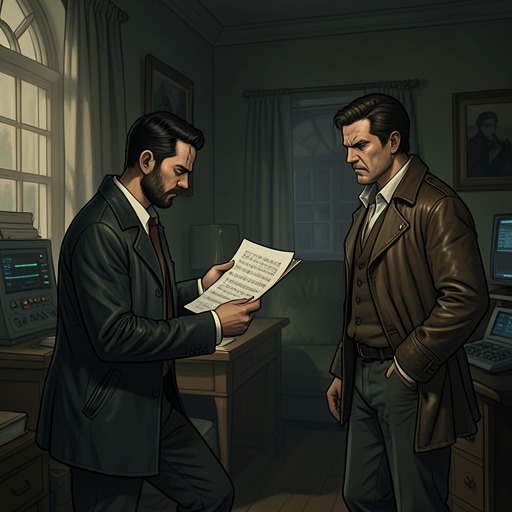
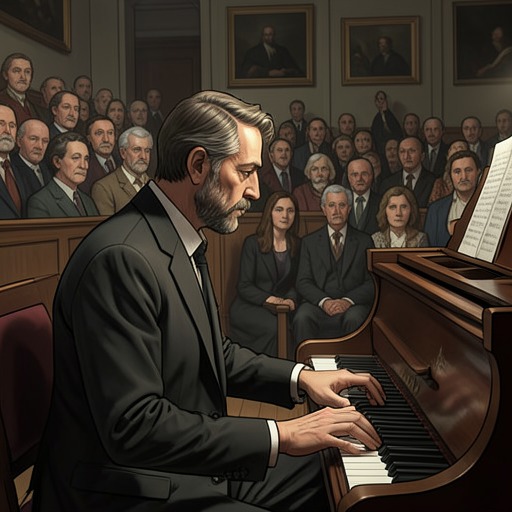
At Salieri’s invitation, Mozart sets aside the manuscript on the lid of the pianoforte, where it is out of his sight, and plays the welcome march from memory. He begins slowly, as if recalling it, then accelerates when the melody repeats. The performance establishes the particular pleasure of the scene: Mozart does not merely reproduce the music accurately but moves quickly from recollection to scrutiny and invention. Salieri acknowledges his remarkable memory, but the compliment does not capture what follows.
Mozart returns to the march’s first seven bars and pauses over the fourth interval, which he finds unsatisfactory. He tests a third above instead, recognizes the improvement, and smiles. This adjustment is modest in scale but decisive in the scene’s musical action: Mozart hears the march not as a finished object to be copied but as material that can be tested and changed. His spontaneous revision begins with a specific point of dissatisfaction rather than a plan to mock Salieri.
Improvisation and the Unintended Affront
From the revised interval, Mozart develops the music through the familiar military-trumpet arpeggio associated with Non più andrai. He proceeds delicately, note by note in the upper register, until the phrase becomes the famous melody in an emerging form. The stage directions emphasize the continuity of the process: Mozart keeps playing, tries out the change, and arrives at an extended improvisation that is virtually the march now known to the audience. His delight is visible in his laughter whenever he reaches the corrected interval.
The improvisation grows increasingly exhibitionistic, revealing Mozart as a formidable virtuoso before the audience. It ends in flourishes and triumphant chords, followed by an uncomfortable pause. The contrast is not simply between a poor performance and a good one: Salieri has supplied the occasion and the original march, while Mozart’s effortless command transforms that gift into a demonstration that overshadows its giver. Yet the scene explicitly makes Mozart unconscious of the affront he causes. His pleasure belongs to the musical discovery, not to a conscious attempt to humiliate Salieri.
Salieri maintains an appropriate smile while watching. After the pause, he excuses himself and says he must go. Mozart responds with surprise and, pointing to the keyboard, invites Salieri to try a variation as well. He then thanks him for the march, gathers the score from the pianoforte, and leaves cheerfully. The farewell sharpens the asymmetry: for Mozart, the exchange has been an enjoyable opportunity to play; for Salieri, its result is painful enough to make him leave.
Salieri’s Retrospective Interpretation
After Mozart’s departure, Salieri turns to the audience and asks whether this was when he began thinking about murder. His recollection immediately qualifies the question: he does not believe he was yet contemplating Mozart’s physical death. In art, however, he says the matter was different. The distinction keeps the scene’s consequences precise. The performance does not prompt an immediate physical threat, but Salieri retrospectively identifies artistic destruction as a possibility already taking shape.
Salieri resolves to compose a tremendous tragic opera that will astonish the world. He chooses the legend of Danaius, condemned for a monstrous crime to be chained to a rock for eternity while lightning repeatedly strikes his wounded head. In his mind, he maliciously imagines Mozart in that position, although he stresses that Mozart is not yet in any danger. The shift from a small alteration at the keyboard to an image of eternal punishment enlarges the scene into a turning point in Salieri’s private interpretation of his rivalry: Mozart’s unselfconscious brilliance becomes the provocation around which Salieri organizes an artistic counterattack.
Dramatic Significance
The episode gives the rivalry a concrete musical form. Mozart’s process is audible and visible—memory, hesitation over one interval, correction, development, and virtuoso display—while Salieri’s response remains largely concealed behind his smile until he leaves. That separation between Mozart’s innocent enjoyment and Salieri’s inward injury makes the performance’s effect more consequential than any explicit confrontation would be. Mozart offers Salieri the chance to vary the music, unaware that his own variation has already exposed the distance between them.
Salieri’s address to the audience also changes how the performance is read. It interrupts the cheerful ending with a retrospective account of resentment and a distinction between artistic and physical harm. The scene therefore joins creative freedom to rivalry without claiming that Mozart intends a contest: Mozart makes music spontaneously, while Salieri converts what he witnesses into a resolve to answer him through tragedy. His imagined Danaius supplies the punishment Mozart does not actually face here, foreshadowing the destructive direction Salieri’s response will take without pretending that this moment itself is a murder attempt.