Mozart Dies While Composing the Requiem
AmadeusWolfgang Amadeus Mozart dies while composing the Requiem, his attention held by the music even as Constanze Mozart tries to comfort him. The scene makes his death both intimate and public: a wife speaks to the husband she has returned to care for, while the music continues beyond his failing body and Antonio Salieri later describes the impoverished burial. Mozart’s final hand movements, Constanze’s words, and the persistent Amen chord make the event a collision between private loss, unfinished creation, and the harsh facts of his afterlife.
The final vigil
Constanze arranges two cushions at the left end of a table, which becomes Mozart’s bed. She helps her dying husband onto it and covers him with her shawl. Her return is framed as an act of care and a plea for reconciliation: she tells him she is sorry to have left and promises she is there to stay. Mozart, however, is absorbed by the thought that someone has done something; he repeats the accusation without explaining it, then calls out Salieri’s name and begins to sob. The scene leaves that distress present but does not make it the cause of his death.
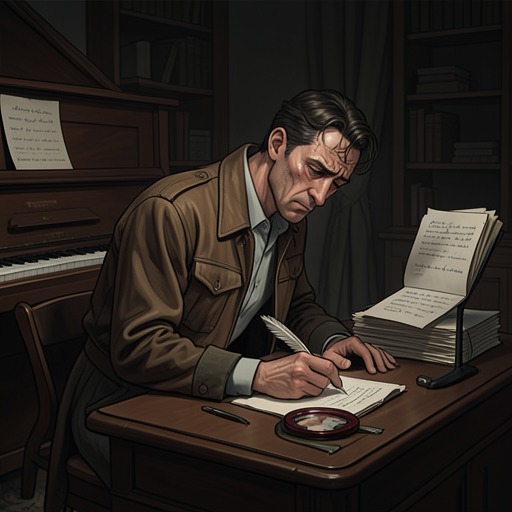
When Constanze assures him that no one has harmed him and that he will recover, the Requiem’s Lacrimosa begins faintly. Mozart raises himself against her shoulders to listen. His hand starts to mark the music’s beat, and the stage directions make clear that he is composing the Mass in his head rather than hearing his wife. The physical gesture is slight, but it gives the scene its central contrast: the body is being supported by Constanze, while the mind remains at work on music. Her spoken reassurance continues beside that inward concentration, without reaching him.
Constanze’s appeal and Mozart’s death
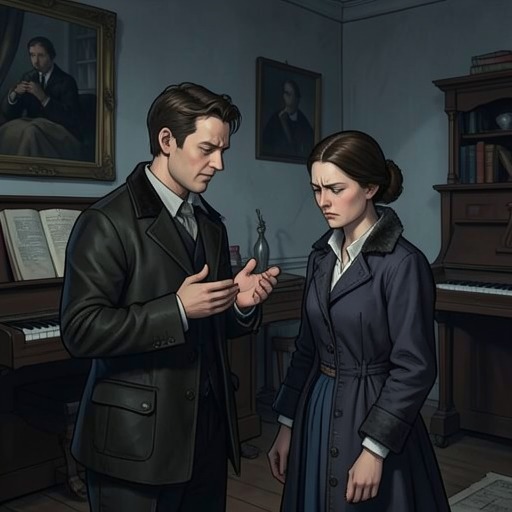
Constanze tries to draw Mozart back through the ordinary history of their marriage. She asks him to overlook her complaints about money, attributes them to being spoiled, and reminds him that she cared for and entertained him. She names their sons, Karl and the little Franz, and insists that the family needs him. Her appeal grows more personal as she recalls their wedding day as the happiest of her life and says she will always consider herself honored to have been his wife. These are not abstract farewells: they are attempts to keep him within the shared life of marriage, domestic dependence, and parenthood.
The hand that marks the music gradually slows and stops. Constanze realizes Mozart is dead; her mouth opens in a silent scream and her arm stiffens in a gesture of grief. At the same moment, the great Amen chord does not resolve but continues as an intense echo. The stage therefore gives the music a duration that the musician no longer has: the body’s rhythm ends, while the sound refuses an immediate ending. Constanze’s recognition is expressed first through her motionless cry, not through an explanation, and the lingering chord holds that recognition open.
The body, the burial, and its cost
Citizens of Vienna enter dressed in black. Constanze kneels, still in her posture of grief, as servants take positions at the four corners of the table bearing Mozart’s body. Gottfried van Swieten is among those who arrive. The formal arrangement briefly presents the death as a public ceremony, but Salieri’s account strips away any suggestion of an elaborate funeral. The death certificate gives kidney failure, accelerated by exposure to cold, as the cause of death. Salieri says that the generous Lord Fuga paid for a pauper’s funeral, in which Mozart was buried with twenty other bodies in an unmarked lime pit.
Van Swieten approaches Constanze and offers her the money saved by economizing on the burial so that it can go to the children. He rejects spending it on what he calls useless pomp. The exchange makes the funeral’s poverty immediate and practical: money withheld from ceremony is redirected toward Karl and Franz. The servants lift the table and carry the body toward the rear of the stage, to the central Light Box, followed by the citizens. They kneel in silence; then the servants throw Mozart’s body from the table into the space behind the stage. The public procession ends not with a marked grave but with this stark theatrical removal.
Salieri’s reckoning
After the others leave, only Salieri and Constanze remain. Constanze recovers movement and begins collecting the scattered scores from the floor. That action places the surviving music beside the absent composer, without suggesting that it can repair her loss. Salieri confesses that he felt relief, but also compassion for the man he helped destroy; he says this compassion for Mozart extended to God, a feeling he had never previously known. He describes himself as having weakened God’s flute to the utmost, only for God to continue blowing until the instrument cracked under its insatiable demand. His account turns Mozart’s death into the consequence of a struggle he understands as both personal guilt and conflict with God.
The scene closes on two different forms of aftermath. Constanze gathers tangible pages from the floor, while Salieri’s voice grows older and increasingly poisoned by his own hatred. His retrospect places an admission of complicity beside the stark medical explanation and the pauper burial, refusing to let either erase the other. Mozart’s final composition remains unfinished in the dramatic moment, but its musical echo persists after his hand has stopped; the funeral, by contrast, leaves no marker. That imbalance gives the death its decisive force: the music outlasts the body, while the social world gives the dead composer almost no public memorial.