Salieri Tears the Requiem Manuscript and Reveals Himself to Mozart
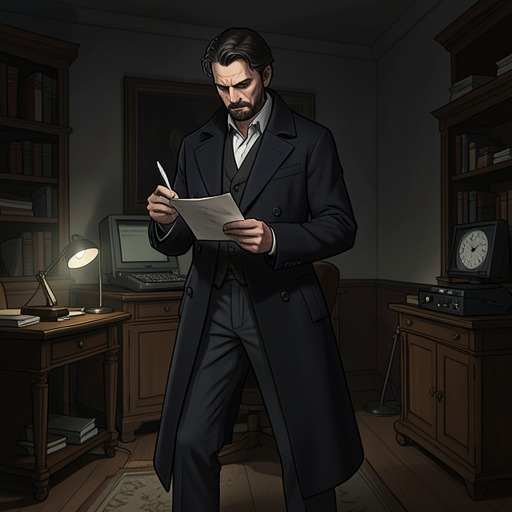
AmadeusSalieri Tears the Requiem Manuscript and Reveals Himself to Mozart is the scene in which Antonio Salieri turns a long-hidden rivalry into a direct confession. Faced with Wolfgang Amadeus Mozart’s unfinished Requiem, Salieri destroys part of the score, identifies himself as the gray-clad visitor, and tells Mozart that his hatred has helped poison him. The encounter’s decisive reversal is that the manuscript Salieri tears is, by his own admission, good; the destruction exposes not artistic judgment but the personal and spiritual conflict that has governed his actions.
The Unfinished Requiem and Mozart’s Plea
Mozart is already terrified when Salieri reaches him. He insists that the Requiem is not finished and begs the visitor to grant him another month. He recalls that he once could write a mass in a week, but now asks for time to complete this one, promising that the result will be perfect. His appeal makes the unfinished work more than a commission left incomplete: Mozart presents it as something whose completion might demonstrate that he is still worthy of divine regard.
Trying to persuade the visitor, Mozart points to the pages on his table and singles out the completed Kyrie. He explains that its two themes, Kyrie and Eleison, form a double fugue, and asks that the pages be taken to God as proof that the work is not unworthy. Salieri crosses the room reluctantly, takes the score, and sits in Mozart’s chair. The change of positions gives Salieri control of the pages while Mozart remains dependent on the judgment he hopes the stranger will carry back to God.
As the Requiem’s sombre overture sounds, Mozart remembers a childhood in which the world seemed perfect. He recalls journeys, carriages, smiling salons, the King at Schönbrunn, and the Princess at Versailles, where candles lit his way to the clavier. He remembers his father repeatedly bowing as he presented his son as miraculous. Against that remembered acclaim, Mozart asks why everything has ended and whether he has been wicked. His questions connect his present fear to a sense of lost favor: the child once displayed and celebrated now pleads for a reason his life has changed.
Destruction and Recognition
Salieri deliberately tears the pages in half. The music stops at once, leaving silence around the act. Mozart asks, timidly, whether the work is good. Salieri answers that it is, then tears a corner from the score, raises it like the Communion rite, places it on his tongue, and swallows it. The gesture makes the manuscript both the object of destruction and something Salieri consumes. He describes what he takes from God as poison and says that he and Mozart have poisoned one another.
Mozart moves behind Salieri and places a hand over his mouth. From behind, he slowly removes Salieri’s mask and hat, uncovering the identity concealed by the gray visitor’s disguise. Salieri then names himself and says that ten years of hatred have mortally poisoned Mozart. Mozart falls to his knees beside the table. The revelation collapses the distance between the supposed messenger and Mozart’s antagonist: the figure who had seemed to bring a demand from outside is Salieri, whose own hostility has shaped the encounter.
Salieri’s Accusation Against God
Mozart repeatedly cries out to God. Salieri answers with contempt, insisting that God will not help him. He argues that God neither loves nor cares for the people used or rejected, and that Mozart has become too weak and sick to be useful. In Salieri’s account, Mozart’s impending death is not a sign of divine punishment for wickedness but evidence that God has finished using him and will find another instrument.
The accusation gives the scene two intertwined conflicts. Salieri attacks Mozart while also indicting the God whom he believes has used Mozart’s genius and left him to suffer. Yet Salieri’s own behavior makes that indictment unstable: he destroys music he recognizes as good, consumes a fragment of it in a parody of sacred ritual, and confesses to hatred as a source of Mozart’s poisoning. His claim that divine use is indifferent to human beings therefore sounds alongside an intensely personal act of vengeance, not apart from it.
The Child’s Return and the Scene’s Ending
Mozart responds to Salieri’s command that he die by scrambling beneath the table, seeking shelter like a frightened child. Salieri kneels beside the table and begs him to die and leave him in peace, striking the table as he repeats his demand. Mozart suddenly cries for his father and becomes motionless, his head visible beneath the table. After a silence, he crawls out, sees Salieri, smiles, and calls him father.
Mozart then reenacts a childhood game: he holds out his arms, asks to be caught as he jumps, and sings a little song in a child’s voice. He climbs onto the table while Salieri watches in horror. Salieri interprets the change as the degradation of both man and God, declaring his oath fulfilled: the world’s deepest voice has been reduced to a childish tune. He leaves the room slowly as Mozart resumes singing. The ending offers no reconciliation or answer to Mozart’s plea; instead, the score’s destruction, Salieri’s confession, and Mozart’s regression converge in an image of artistic power and human vulnerability that neither man can undo.