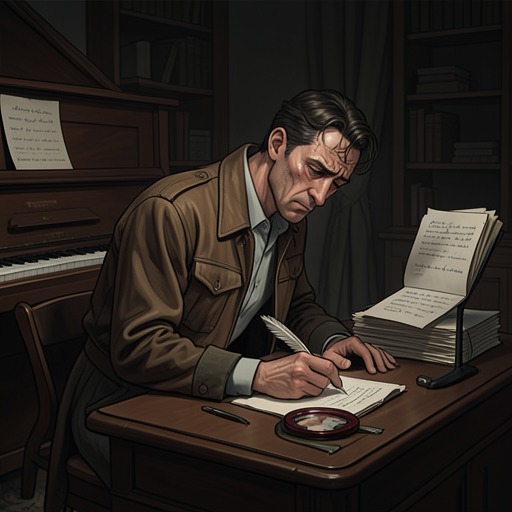
Salieri Appears at Mozart’s Window as the Gray Messenger for Seven Nights
AmadeusAntonio Salieri Appears at Mozart’s Window as the Gray Messenger for Seven Nights is the episode in which Antonio Salieri confesses that he transformed Wolfgang Amadeus Mozart’s frightening vision into a real, calculated intimidation. In November 1791, Salieri wore a gray cloak and mask, appeared beneath Mozart’s window at one o’clock for seven consecutive nights, and used each visit to make the composer feel that a mysterious messenger was counting down the time left to him. The disclosure turns an apparently supernatural threat into an act of human manipulation—and makes Salieri’s involvement in Mozart’s terror explicit.
The apparition and the commission
The episode is prepared by Wolfgang Amadeus Mozart’s account of a visitor he says appeared the previous night. The figure stood before his desk, dressed entirely in gray, its face still masked, and ordered him to write a Requiem Mass and begin at once. When Mozart asked who had died, the messenger gave no answer; instead, it required the work to be finished by their next meeting and left the room. Mozart cannot decide whether the encounter happened inside his head or outside it. Its force, he insists, was like that of something real.
The uncertainty affects more than Mozart’s understanding of the visitor. He connects the experience with Constanze Mozart’s departure, fears that he has frightened her, and laments that she will miss the vaudeville. The ominous commission has entered the ordinary pressures of his life, while the masked figure’s unexplained deadline hangs over the unfinished music. Antonio Salieri initially dismisses the account as unhealthy fantasy. His later confession reverses that reassurance: the threat felt real because Salieri had made it real.
The seven-night countdown
Speaking directly to the audience, Antonio Salieri declares that he understood what the gray figure had been seeking: Wolfgang Amadeus Mozart was alone in his poor room, writing a Requiem for himself. Salieri then identifies himself as the figure. He says that he obtained a gray cloak and a gray mask and, in November 1791, walked through Vienna’s deserted streets by moonlight on seven consecutive freezing nights. At the precise moment the city clocks struck one, he stopped beneath Mozart’s window.
The visits were arranged as a visible countdown. Each night, Salieri showed Mozart one fewer finger, then walked away with a majestic step. From the window, Mozart’s face appeared to Salieri to be that of a man slowly going mad. On the final night, rather than raising fingers, Salieri beckoned to him like the figure in his dreams. The repeated hour and diminishing count made the threat measurable: the encounter was not a single frightening glimpse but a sequence that made the approaching deadline harder to escape.
From the window to Mozart’s room
Wolfgang Amadeus Mozart answers the final summons with a line from Don Giovanni, inviting the statue to supper. For a long moment, the two men stare at one another in terror. Antonio Salieri then finds himself nodding as the statue does in the opera and crossing the street toward Mozart’s house. The passage from street to room follows the logic of the scene Mozart has invoked: Salieri describes himself as already inside Mozart’s dream, unable to stop what is unfolding.
At the door, Mozart begs for more time. He says the Requiem is unfinished, asks for another month, and fears that God will not allow the work to remain incomplete. He shows Salieri the pages and identifies the completed Kyrie, explaining that its two themes form a double fugue. Mozart pleads for the pages to be carried to God as evidence that the work is worthy. The appeal exposes how completely Salieri’s disguise has shaped the encounter: Mozart treats the intruder not as a rival or visitor but as an intermediary with access to divine judgment.
Confession, staging, and consequence
The disclosure is presented as Salieri’s recollection, but the play makes the confession theatrical and immediate. As he explains the scheme to the audience, his servant brings the clothes he describes; Salieri puts them on, turns away to take up the hat with its attached mask, and faces the audience disguised. Mozart and Salieri then stand looking forward as the earlier visits are reenacted. The stage directions turn a private confession into a visible demonstration of how the deception worked: the gray figure is no longer only Mozart’s feared image but Salieri himself, displayed before the spectators.
The episode’s final encounter links the intimidation to the fate of the music. After Wolfgang Amadeus Mozart begs for time and recalls a happier past, Antonio Salieri deliberately tears the pages in half; the Requiem music stops at once. The destruction follows the staged revelation of the messenger’s identity and gives the threat a material consequence. Salieri has not merely frightened Mozart with the prospect of death: he has entered the room as the figure Mozart feared, taken the unfinished work into his hands, and destroyed the pages Mozart offered as proof of his worth.