Mozart Shapes Don Giovanni’s Father Ghost after His Own Father’s Death
AmadeusWolfgang Amadeus Mozart’s response to Leopold Mozart’s death becomes, in Antonio Salieri’s account, the emotional source of Don Giovanni’s father-ghost. The scene does not show Mozart composing the opera; instead, it stages a passage from bereavement and self-reproach to an image of theatrical accusation. Salieri names the transformation as it happens, making the painful family moment both a personal crisis and an example of Mozart’s power to turn ordinary life into art.
The Announcement and Mozart’s Grief
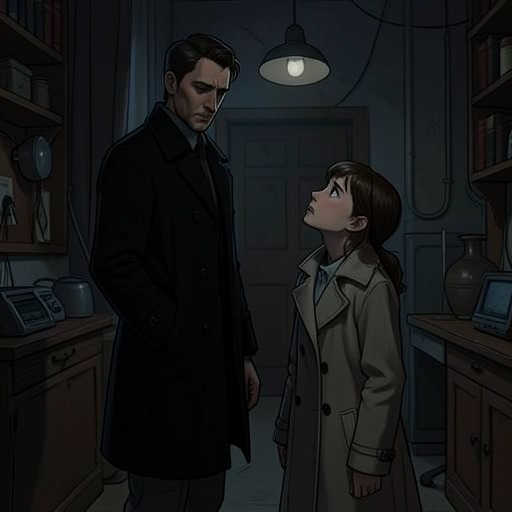
The news arrives through the Venticelli, who solemnly repeat Leopold Mozart’s name before announcing that he has died. The announcement interrupts a conversation in which Wolfgang Amadeus Mozart has been speaking bitterly about his father. He had asked Leopold to keep the child for a few months so that he could leave, explaining that he had a wife and son but no money; Leopold refused. Mozart describes him as embittered and jealous, and says that he resents him. The timing gives the news a sharp reversal: the harsh confidences of the living encounter the finality of the dead.
Antonio Salieri first responds with consolation, calling death inevitable and addressing Mozart as a friend. Mozart’s question about what he is to do now is not merely practical. He says he has no one else in the world to warn him about the evil around him, because he cannot perceive it himself. Leopold, he recognizes, had watched over him throughout his life. The revelation is not that their relationship had been harmonious, but that Mozart now understands his father’s vigilance as protection—and his own earlier rejection of it as betrayal.
From Resentment to Self-Accusation
Mozart turns from his former accusations to a catalogue of his own actions. He recalls speaking against Leopold, marrying against his wishes, leaving him, and spending his time dancing, playing billiards, and behaving foolishly while his father remained alone in an empty house, night after night, without a woman to care for him. The details make his remorse domestic and specific: the imagined solitude of the house gives his guilt a setting, while the contrast between his own activity and Leopold’s isolation sharpens the charge he brings against himself.
Salieri rises in concern and offers Mozart his support, opening his arms in a broad, paternal gesture. Mozart approaches and nearly accepts the embrace, but stops short, moves away, and falls to his knees. His cry for his father marks the scene’s emotional break. Salieri’s attempted comfort cannot undo the separation that death has made final; nor does the stage make reconciliation possible by substituting Salieri for Leopold. The near-embrace instead leaves visible the distance between the living man offering consolation and the father Mozart has lost.
The Father-Ghost Takes Shape
Salieri turns to the audience and declares that this is how the father’s ghost in Don Giovanni was born. The two severe opening chords of the opera’s overture sound through the theater. Mozart appears frightened by them and looks ahead; on the backcloth, a gigantic black figure in a cloak and three-cornered hat extends its arms threateningly toward its creator, as if to devour him. The staging gives outward form to the scene’s inward pressure: the dead father is not presented as a literal presence in the room, but as an accusing theatrical figure connected to Mozart’s grief and fear.
Salieri calls this the most accusing father seen in opera and links it to the guilty libertine cast into Hell. The sequence thus joins the father’s apparition to the opera’s moral world. The black figure’s gesture, the ominous chords, and Mozart’s recoil make the artistic transformation legible without showing a page of composition: the private cry is followed by an image and sound that belong to the theater. Salieri’s declaration supplies the causal interpretation, while the stage picture lets the audience witness how guilt can acquire an operatic body.
Salieri’s Interpretation of Mozart’s Art
The episode also advances Salieri’s account of the difference between Mozart’s genius and his own. Watching Mozart, he says, he saw a man turn ordinary life into art; both men were ordinary, but Mozart made legends from the commonplace, while Salieri made only commonplace things from legends. In this context, Mozart’s domestic remorse is not incidental background to the ghost: it is the ordinary human material that, in Salieri’s telling, becomes an operatic accusation.
The scene makes that interpretation dramatic rather than merely explanatory. Salieri speaks after Mozart’s cry and presents the ghost’s origin to the audience, while the overture’s chords and the looming figure translate his words into theatrical form. His explanation is also shaped by his own position: he sees Mozart’s ability with astonishment and describes himself as unable to achieve the same transformation. The event therefore reveals both the personal source Salieri assigns to Don Giovanni’s father-ghost and the contrast through which he measures Mozart’s artistry. It ends not with the grief resolved, but with the family loss made newly visible as art.