Goldonder
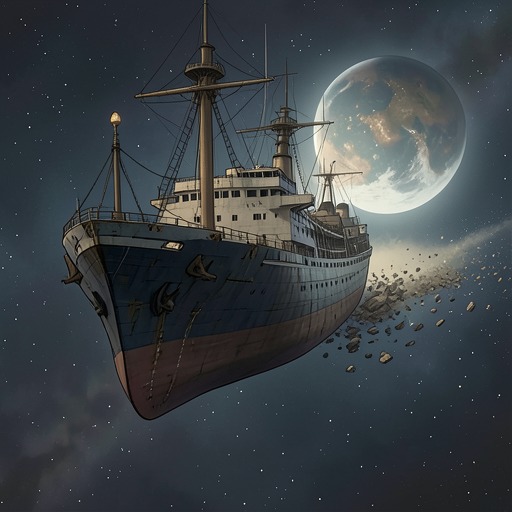
AniaraGoldonder is the name given to the spacecraft type represented by Aniara, the enormous vessel carrying refugees through space in Martinson’s poem. It is at once a means of evacuation and a confined world whose machinery cannot guarantee a way home. The craft’s scale, routines, and failing equipment turn technological passage into a condition of permanent uncertainty, while its name and conception connect the imagined ship to older forms of travel and to the real machines that captured attention in the 1950s.
Definition and Design
The name Goldonder is used for a type of spacecraft, rather than only for Aniara itself. Its likely derivation is the Swedish word gondol, meaning gondola; one possible derivation of Aniara’s name, by contrast, is the Greek aniaros, meaning “in distress.” The two names place a practical vessel alongside a suggestion of suffering, without reducing the ship to either function or symbol.
Aniara’s dimensions make its scale difficult to hold in mind: it is sixteen thousand feet long and three thousand feet wide, with a population of eight thousand souls in its vaults. The poem sets this numerical enormity against the ordinary motion of its passengers, who move through corridors toward Mima’s hall and may suddenly recall how large their craft is. The vessel is thus experienced in two registers: as a place traversed on foot and as a structure so immense that its human community seems gathered inside a moving city.
The ship’s operation is presented through specific procedures and specialized machinery. Aniara closes, a siren sounds for field-egression according to the established routine, and the gyrospinner begins towing. Elsewhere, the poem refers to gyrospin and gyromatic processes associated with Mima’s computer console, playing with scientific and quasi-scientific terminology. Such language gives the craft a technical vocabulary, but it does not make its systems invulnerable. The poem’s machines are instruments of travel and knowledge, not assurances of control.
Failure and Irreversible Passage
Damage to the ship’s apparatus divides what can still be repaired from what cannot. Some equipment is damaged, while other, less damaged parts can be mended; nevertheless, the narrator concludes that the passengers’ ill fate is irretrievable. The hope that Mima will hold until the end survives beside that judgment. This contrast makes the vessel’s predicament more than a simple breakdown: repair remains possible in limited respects, but the repairs do not restore a viable course or undo the larger loss.
The poem frames the disaster as part of a history of spacecraft failure rather than an unprecedented accident. A character explains that a large Goldonder carrying fourteen thousand people was lost sixty years earlier after instrument failure while heading toward Orion. The earlier vessel’s fate establishes a grim precedent: a ship can be lost not because space travel is wholly unfamiliar, but because the instruments on which it depends can fail. The comparison enlarges the present crisis while offering no practical escape from it. A previous disaster can be remembered, yet its knowledge does not prevent the passengers aboard Aniara from sharing the same essential vulnerability.
A Vessel and Its Passengers
Goldonder’s interior contains distinct spaces and groups, not merely one undifferentiated passenger population. The poem refers to the craft’s vaults, corridors, and Mima’s hall, and later to a holding-pen approached by people bound for Venus. Several hardened men going to Venus examine those brought before them and greet them with a formula that casts arrival as a return to a heavenly kingdom from Jerusalem. The scene places the ship’s enclosed social arrangements beside the language of welcome and destination. The craft carries people toward named worlds, but those destinations do not erase the restrictive and unsettling character of life aboard it.
The ship’s immense passenger count also sharpens the relation between individual movement and collective fate. Eight thousand people occupy a vessel that can be described through its dimensions, yet the poem’s repeated attention to corridors, halls, and compartments gives that scale a lived geography. The Goldonder is simultaneously transport, enclosure, and the shared setting in which the consequences of failed navigation become communal. Its routines continue even as the passengers’ larger prospects narrow.
Historical and Literary Conception
The Goldonder’s imaginative background includes the convergence of nuclear fear and new possibilities for flight in 1953. In the winter of 1939–40, Martinson had served among Swedish volunteers in the campaign on the Russian-Finnish border; the harsh conditions were followed by years of illness and silence. Later, he described the war’s material appetite as inaugurating a world of outsized objects. The poem’s great ship belongs to that wider apprehension of a world transformed by industrial scale, although the evidence does not make it a direct representation of any single historical machine.
In August 1953, news of the Soviet Union’s hydrogen-bomb announcement and detonation brought the prospect of catastrophic destruction into public discussion. At the same time, spaceflight and aviation were prominent in the news. Wernher von Braun described American advances in rocket propellants for orbital flight and the construction of a space station. Observations reported that the Andromeda Galaxy was about 1,500,000 light-years from the Milky Way, twice as distant and large as previously thought; Martinson later turned his telescope toward the unusually clear sky and saw Andromeda shining with striking intensity. These reports offered both the threat of annihilation and a newly enlarged sense of cosmic distance.
Aircraft and ocean liners supplied another scale for imagining passage. The first nonstop jet flight across the Pacific, from Alaska to Japan, had been made in 1952, and the United States Air Force’s six-engine XC-99 made its first transatlantic flight in August 1953. The Swedish superliner Kungsholm was also being prepared for service from Gothenburg that October. Martinson explicitly connected the ill-fated Titanic with his conception of Aniara, describing the imagined spacecraft as a Titanic of outer space. The Goldonder consequently carries a maritime echo into the cosmic setting: like a liner, it transports a large population across an immense expanse, but its passage is shadowed by the possibility of disaster.
The first poems that became Aniara appeared in 1953 as “The Song of Doris and Mima,” whose account of nuclear destruction and refugees at sea was later expanded by seventy-four additional poems in the 1956 work. The Goldonder’s significance lies in how it joins these lines of imagination. It is a speculative spacecraft, shaped by contemporary aerospace news, but it also inherits the older image of the doomed passenger vessel. Its impressive size and technical routines promise organized passage; instrument failure and irretrievable misfortune expose the limits of that promise.