Yurg
AniaraYurg is a dance that carries an echo of life on Earth into the Aniara’s enclosed, drifting world. It appears first as a shared pleasure and a deliberate diversion: music fills the ballroom, couples take the floor, and the dance draws passengers’ attention away from their trajectory. Later, as the ship’s social world changes, yurghing is described as long forgotten. Its path from familiar amusement to lost custom gives the dance a small but revealing history within the passengers’ larger exile.
A dance carried from Dorisburg
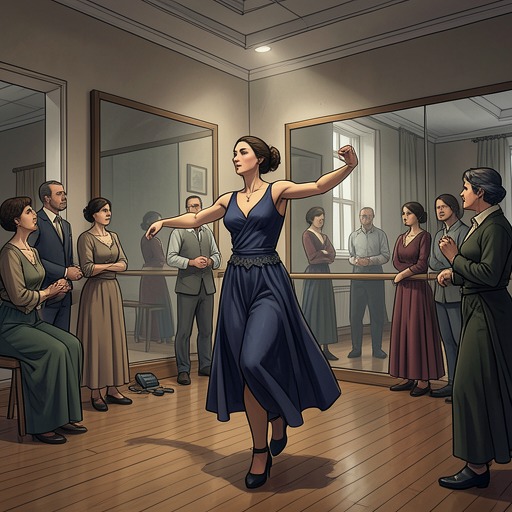
The ballroom scene places Yurg between two worlds. An orchestra plays and the speaker leads a girl around the floor; she is from Dorisburg, and insists that the Yurg danced aboard the Aniara is no different from the one danced there. Her comparison supplies a concrete link between the ship and the world its passengers have left behind. The dance may take place in the spacecraft, but for her it remains recognizable across that change of setting.
That continuity matters in a voyage whose passengers are refugees being evacuated from a radiation-damaged Earth. They are meant to travel to labor camps on Mars or Venus while the planet is detoxified, but the Aniara is knocked off course and becomes a ghost ship, unable to return. Against that immense rupture, Yurg offers no rescue and cannot restore the lost home. Its modest promise is recognizability: a step or turn aboard the ship can still be understood as the same dance a passenger knew in Dorisburg.
The scene does not present that familiarity as uncomplicated comfort. The speaker is nursing grief, yet the energetic swing of the dance threatens to make that grief recede as he moves with a young woman absorbed in Yurg. The ballroom’s pleasure interrupts sorrow without resolving its cause. That tension gives the dance its particular force: for a moment, bodily movement and music occupy the attention that might otherwise remain fixed on loss.
Carouse against the trajectory
In another ballroom episode, the speaker describes using a multi-mirrored space to redirect people’s attention from the Aniara’s trajectory toward a world of gaiety. He succeeds in turning many minds toward the carouse offered by the mirrors; even he takes time to dance. The scene makes Yurg part of an organized diversion, not only a private amusement. The dance helps populate an alternative field of attention within the ship: reflected images, movement, and company temporarily displace the course that carries everyone farther from Earth.
The gathering grows beyond the speaker’s own participation. He sees people arriving in groups and waking to Yurgs and cults among the mirrors, and he watches them with admiration. The plural suggests repeated dancing or forms of the dance shared among the crowd, while the mirrors enlarge the social scene by multiplying its images. Yet the passage does not say that the passengers forget their actual danger permanently. The diversion works in the immediate terms the speaker gives it: it turns minds away from the trajectory and toward gaiety. Its brightness is therefore real, but bounded.
This use of Yurg also connects the dance’s personal and collective meanings. In the earlier scene, its swing threatens to loosen one speaker’s hold on grief; in the mirror-house, the carouse draws many passengers into a shared occupation. In both cases, the dance changes what fills the moment without changing the underlying voyage. It provides movement and company inside a situation defined by involuntary movement through space.
Changing manners and disappearance
The dance’s later mention reverses the ballroom’s animation. The narrative says that changing times bring changing manners and that yurghing has long been forgotten. Daisy Doody, identified with dancing to the point of being dance-besotted, is said to sleep forever in her helix. The account places this image alongside ballroom floors that have become increasingly worn, pitted, and rough. Rather than preserving Yurg as a stable custom, these details show a social world in which both the dancer and the places of dancing have altered.
The passage does not specify precisely when Yurg disappeared, why the floors deteriorated, or what happened to Daisy Doody beyond the image of her enduring sleep. Its restraint makes the contrast do the work: earlier, an orchestra plays and a crowd takes the floor; later, the dance is named as forgotten, and the ballroom bears the mark of prolonged use and change. The custom has not simply been declared obsolete in the abstract. Its loss is framed through a remembered dancer and the material surface on which people once moved.
Yurg’s brief arc thus joins continuity to erosion. A girl from Dorisburg recognizes it aboard the Aniara, and the mirror-house speaker uses dancing to gather attention and animate a crowd. But neither recognition nor collective pleasure can secure the practice against changing circumstances. By the time yurghing is recalled as forgotten, the dance records a vanished mode of sociability: an earthly custom carried into exile, used to make the present moment bearable, and eventually lost along with the habits and settings that sustained it.