Cosmic Way (the Way of the cosmos)
AniaraThe Cosmic Way (the Way of the cosmos) is the name for an order that exceeds human explanation rather than a doctrine the passengers can master. In Aniara, its force lies in the contrast between that vast, indeterminate mystery and the human efforts to turn it into a rule, a spectacle, or a consoling account of fate. The ship’s anniversary fête makes that contrast especially visible: Chefone presents himself as its interpreter, but the ceremony instead exposes the limits of his authority and the passengers’ uncertainty.
A Mystery Beyond Human Categories
The Cosmic Way is described as Tao-like and as transcending divisions such as mind and matter, life and death. It therefore cannot be reduced to a scientific account or a political program. The poem’s image of “the clarity of cosmic soul” seems, at first, to offer a clear view; the accompanying interpretation complicates that promise. This clarity is like a mirror: it reflects the puzzled face looking into it, without explaining what lies beyond the reflection. What appears lucid may be only the surface of the Mystery.
The warning attributed to Kwang-Tse, “The Tao that is displayed is not the Tao,” gives this problem a concise form. To display or name the Way is not to possess it. The phrase helps distinguish the Cosmic Way from the claims made in its name: the Mystery remains beyond whatever human representation is offered as its definitive expression. In this sense, the mirror does not reveal a hidden answer so much as make the searcher’s own bewilderment visible.
Chefone’s Political Parody
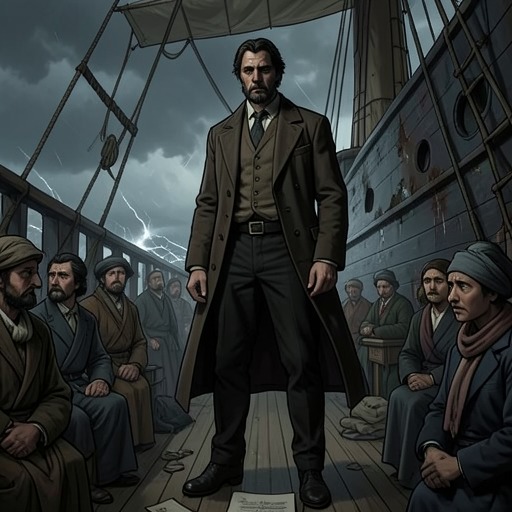
Chefone is presented as a parody of the impenetrable fact represented by the Cosmic Way, not as its genuine embodiment. Called “the fierce lord of our craft” and “that bullet-headed breaker of mankind,” he draws power by instilling fear in the Aniara passengers. He claims that without him they would fare terribly in the Hell they are approaching, but the account pointedly questions whether his rule makes their prospects better. His authoritarian certainty is thus set against a cosmic order that cannot be made certain by force.
The contrast also shapes the persecution that follows Mima’s breakdown. Enraged by it, Chefone unjustly accuses Mimarobe and other technicians of malfeasance. They are released on a technicality, but the outcome does not restore the authority of scientific reasoning: the poem treats their vindication as another instance of argument having lost its former force. Chefone’s appeal to law consequently appears less like a search for truth than a means of satisfying his own sadism. Set beside the Cosmic Way, his rule is a human performance of certainty—coercive, self-serving, and unable to resolve the passengers’ actual predicament.
The Fête and Its Reversal
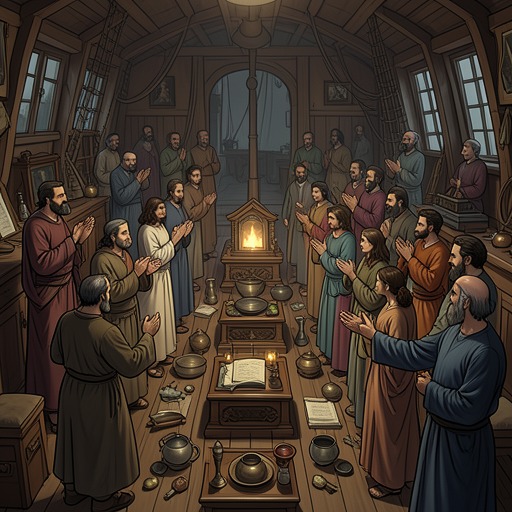
Chefone stages a Fête for the Cosmic Way to mark the twentieth anniversary of Aniara’s lift-off. The event is heralded and celebrated in space as something “outré,” language that gives the occasion an air of deliberate extravagance. Yet the celebration becomes a fiasco and foreshadows the breakdown of Chefone’s rule. The ritual meant to place the Cosmic Way under public, ceremonial display instead reveals how little the display can contain.
The crowd’s response sharpens that reversal. Many thousands weep, while several hundreds speak of what is happening as Fate’s way. The difference between the weeping multitude and those who give the event a name matters: the scene offers no shared, settled explanation, only grief alongside an attempt to interpret it. Calling the moment Fate’s way does not establish that the crowd has understood the Cosmic Way; it shows how people reach for language at the edge of what they can comprehend. The fête’s public scale cannot turn that uncertainty into knowledge.
The Way, Mima, and the Unresolved Ending
The Cosmic Way also stands in the poem’s wider field of loss and possible transformation. After the divine Mima dies, Aniara moves deeper into its woes and is left to the imperious mystery of the Way. The juxtaposition does not make the Way a replacement for Mima or explain her death. Rather, it places the ship’s continuing passage under an order that offers no humanly secure consolation. Mima’s absence makes the limits of control—and of explanation—more acute.
A later passage imagines Aniara’s legions lying deep asleep and being swiftly changed in Mima’s hold at the end of the journey through those regions. This prospect gives the poem an image of transformation, but not a practical escape or a demonstrated account of what awaits the passengers. The Cosmic Way’s significance rests partly in that unresolved relation between death and change: the poem can place both within its horizon without making them intelligible. Against Chefone’s false mastery, the Way remains something approached through images, ritual, grief, and silence, never reduced to a rule that can govern the cosmos.