Gopta
AniaraGopta is a technical and mystical discipline in Aniara, presented through specialized workrooms, mathematical equipment, and practices for investigating complex systems. The novel associates it both with the study of Mima and with an aleph-number school of philosophy. Its importance lies in that conjunction: knowledge appears as something pursued through calculation and skilled labor, yet its vocabulary and intellectual setting retain an occult, initiatory character.
Definition and Equipment
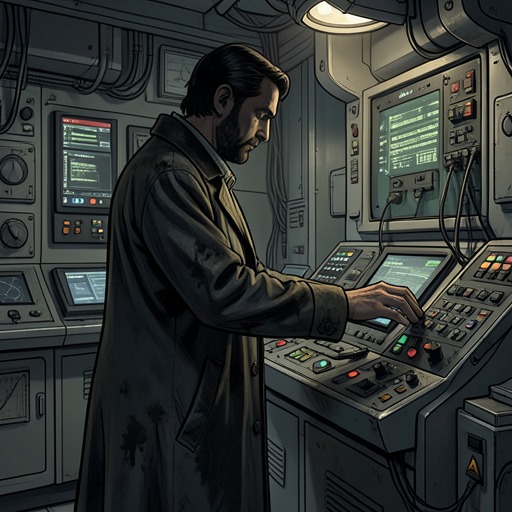
An explanatory note describes gopta as Sanskrit for occult and characterizes the gopta as a mystagogy for which Martinson invents the equipment of an applied science. This account gives the concept two registers at once. Gopta belongs to hidden or esoteric knowledge, but it is not represented only as doctrine or belief: it has instruments, technical procedures, and a place within the ship’s organized work. The description supports a connection between mystagogy and applied science, without specifying a single comprehensive theory or set of rules.
The Gopta room provides a concrete setting for that work. One morning, Isagel sits there in silence, occupied with Jender curves. She then calls the narrator to the Jenderboard, where she has rapidly stabilized a breakthrough in a provisional final form. The passage makes the board more than a decorative emblem of abstruse learning: it is the working surface on which a difficult result takes shape. At the same time, the result is provisional, so the scene presents discovery as a stage in an ongoing process rather than as a final, unquestionable revelation.
Analysis of Mima
Another technical practice in the novel is the systematic sounding of Mima’s language cycles, phase by phase. Over two years of such work, the narrator gains a substantial grounding in the cycles. This long duration distinguishes the process from a sudden act of inspiration: understanding accumulates through repeated, ordered examination. The language of sounding and phases also suggests that the work attends to structure and sequence, although the passage does not provide a complete account of the method or its results.
This inquiry gives Gopta’s technical world a consequential object of study. Mima is not simply encountered as a mysterious presence; her language cycles can be approached through sustained analysis. The evidence does not explicitly identify every technique used on those cycles as Gopta, so the connection is best understood as part of the same wider environment of specialized knowledge rather than as proof that all analysis of Mima belongs to one formal Gopta procedure. The contrast is significant: the novel shows a measurable, phased practice, while withholding enough detail to make the system wholly transparent.
Number Philosophy and Collaborative Work
Gopta also receives visitors from an aleph-number school. A philosopher and mystic associated with that school comes often with a completed query-card to feed the Gopta-works. The combination of a query-card and a dedicated system suggests a regularized exchange: a question is prepared and submitted through an established means, rather than raised only as informal conversation. Yet the passage does not disclose the particular questions or answers, and it does not explain the operation of the Gopta-works in detail.
This work depends on more than abstract intellect. Robert serves as the space assistant attached to the philosopher, described as the brains trust’s loyal dray for number-loads. The comparison emphasizes the physical or logistical labor that accompanies numerical inquiry: difficult calculations or quantities have to be carried through a working process, and a specialist assistant helps sustain it. When the philosopher returns, Isagel is to tell him how the situation stands, despite Robert’s unremitting attempts. The passage establishes a division of effort among the philosopher, Robert, and Isagel, but does not say what those attempts achieve or what report Isagel ultimately gives.
Scope and Significance
The references to Gopta do not resolve its full place among the ship’s sciences, its exact mathematical foundations, or the relation between its several applications. Instead, they show a practice in fragments: an applied science with occult associations, a Gopta room and Jenderboard, sustained analysis of Mima’s language cycles, and query-driven work linked to aleph-number philosophy. These scenes make the discipline concrete without turning it into a fully explained system.
That incompleteness preserves a productive tension in the concept. Gopta is organized enough to have equipment, recurring users, and procedures, yet its mystical associations keep it from appearing as ordinary, fully disclosed engineering. Its practice also rests on collaboration: Isagel stabilizes a breakthrough, the narrator develops knowledge through two years of analysis, and Robert supports the philosopher’s numerical work. Gopta therefore signifies not merely a body of occult ideas but a labor-intensive way of producing and handling knowledge aboard Aniara.