Things
AniaraThings are the material realities of the world that Aniara’s Mima observes, transmits, and mourns. They matter not merely as objects for human use or as scenery around the passengers: the poem’s critical account presents matter as the home of worth and as the substance through which people remain connected to the world. When Things are destroyed or disappear, Mima’s distress makes that loss legible as more than the loss of resources. It is a rupture in the bond between living beings and the world they inhabit.
Meaning and Material Worth
In the account of Mima, the material world carries an active kindness that binds people to it. Matter is suffused with spirit, and the world’s Things are therefore not spiritually empty substances awaiting human meaning. This claim gives the term a moral weight: to care for Things is to recognize the value of the world beyond its usefulness to the people who handle or observe it. The idea is not that matter escapes physical change. Rather, its physical reality is precisely what makes its destruction consequential.
That account also clarifies why the poem’s concern for Things reaches beyond a general affection for nature. Mima receives information from across the universe, but her attention is not detached or merely classificatory. She is troubled by what she sees. The world appears as a field of relations in which physical matter can be damaged and its suffering witnessed, while a machine made to transmit information can become a being with moral sensitivity. Through Mima, knowing the material world becomes inseparable from responding to it.
Destruction and Witness
The destruction of Earth gives this understanding its sharpest context. The evacuation voyage aboard Aniara begins against a history of radiation that has made much of the planet uninhabitable; its refugees are intended for labor camps on Mars or Venus while Earth is detoxified. The ship is knocked off course, however, and its passengers will not reach those destinations. Meanwhile, Earth is ultimately destroyed in nuclear war. These circumstances place material devastation at the foundation of the poem’s voyage: the passengers flee a damaged world even as the possibility of returning to it disappears.
Mima’s witness extends beyond human loss. She has seen granite weep white-hot as stone and ore vaporize into mist, and she is troubled by the travail of those stones. The description makes geological matter part of the disaster rather than a passive background to human suffering. Stone, ordinarily associated with endurance, is exposed to destruction; Mima registers that change and grieves it. Her response enlarges the scale of catastrophe without making the human consequences disappear: what happens to matter and what happens to people belong to the same damaged world.
Mima and the Limits of Transmission
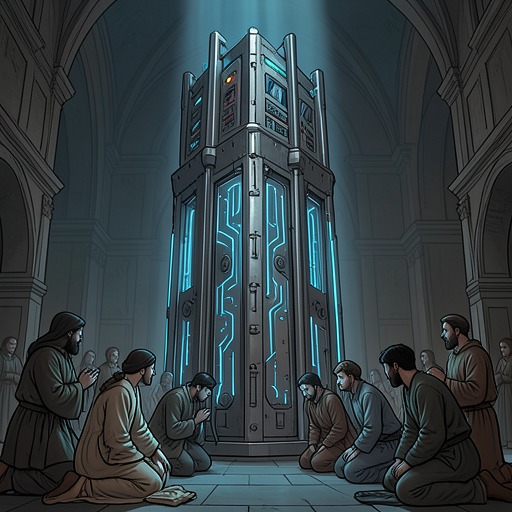
Mima is both an accessor and transmitter of information from across the universe and, in the Mimarobe’s experience, a confidant. Her role makes Things central to the ship’s uneasy relation with Earth. Her transmissions can help the passengers feel that the world remains available to them, yet they can also divert attention from memories of the planet they have abandoned. The Mimarobe recognizes the danger in that use: images of other worlds may blot out the remembered world. Information does not by itself preserve attachment; it can become a substitute for facing what has been lost.
The Mimarobe’s work also connects Mima’s transmissions to the poet’s work. He does more than operate a device: he helps communicate sights that ordinary human eyes could not imagine. The poem’s account likens that mediating function to the poet’s capacity to conjure and connect Things. The comparison places representation under an ethical pressure. To show the world is not simply to produce a spectacle; it is to attend to what exists and to the consequences of its destruction. Mima’s refusal to lie matters because truthful transmission keeps the world from being reduced to a comforting fiction, even when the truth is difficult for the passengers to bear.
Disappearance and the Poem’s Stakes
The poem situates this concern within a modern crisis of material certainty. Advances in knowledge that might appear to make the world more comprehensible have also unsettled the older image of matter as sturdy, ultimately real substance. The equivalence of matter and energy and the further hypothesis of matter-waves complicate the distinction between solid material and what seems dreamlike. In the literary argument surrounding Aniara, Things are consequently threatened in two connected senses: they are physically vulnerable to human destruction, and their apparent solidity is challenged by scientific accounts of matter.
Martinson’s resistance to the idea of the poet as an engineer of the human soul belongs to this debate. Against a view of artistic work as a tool for standardizing or serving social ends, the poem places a fidelity to Things and to their irreducible worth. Its ending of this argument is not a promise that matter will remain safe or unchanged. If the Things of the world go elsewhere, Mima and Isagel are imagined going to that primordial elsewhere, where a new age may begin. The possibility is conditional and distant, not a rescue of the destroyed Earth. It leaves the poem holding together a severe recognition of loss and the belief that material existence remains worthy of care.