Anxiety, possibility, and agency
AnimalsAnxiety, possibility, and agency is the tension Laura Joyce’s reflections repeatedly circle: a life may contain many possible selves and choices, yet those possibilities can feel less like freedom than a force that carries a person along. Across scenes of self-examination, intoxication, and care, the narrative tests whether action is chosen, shaped by earlier decisions, or only understood after it has happened.
A self made through choices
On a delayed flight, Laura Joyce turns over the question of how her life fits together. Clarity, when it arrives, seems to have been obvious all along, but rarely lasts. She wonders whether her detachment from Jim began gradually, rather than in a single decisive break, and whether she had been too compliant with him. The uncertainty is not merely about what to do next: it reaches backward, making her reconsider how a relationship and a version of herself took shape.
Her reflections make agency difficult to separate from desire. Laura Joyce considers how embodying what another person wants can feel powerful: she knows how to provide the desired version of herself. But that apparent power has a cost. When she recognizes herself as something she has helped create for someone else, the result is emptiness rather than security. The account refuses a simple division between an authentic self and an imposed one; she says she allowed herself to become what she became. Choice is present, but it does not guarantee that its consequences will feel freely chosen.
Writing offers another way to apprehend this pattern. Laura Joyce sees herself as good at beginnings and wonders whether her work has shown her the same quality through its false starts. The possibility of a life made up of successive beginnings is at once a limitation and a tentative alternative: if continuity cannot be trusted, starting again might still be acceptable. Her repeated thoughts on the flight move toward that possibility without resolving whether it represents freedom, retreat, or both.
Possibility as paradox
During an encounter with Marty, Laura Joyce’s thinking turns from immediate experience to the quantum multiverse. If every eventuality is possible, she reasons, then every eventuality may also be inevitable; perhaps they have already happened. She extends the paradox through memory and a sense of foreknowledge, imagining consciousness as an accumulation of memory in which events do not line up neatly as cause followed by effect. In this formulation, living in the moment is not a triumphant exercise of choice. It may not even be a choice at all.
The surrounding movement through streets gives the abstraction a concrete counterpart. Laura Joyce holds Marty’s hand as they walk through a graveyard, step over a small fence, and continue toward his hotel. She reflects on how thin and elastic the boundaries between life and death, reality and unreality, and right and wrong can seem. The scene makes crossing a line feel both ordinary and consequential: one foot lands on the other side, then the rest follows. Its sequence gives physical form to her question about how a person passes from possibility into action, while her reflections resist claiming that the boundary was ever firm.
The imagined alternative self
Later, at Jim’s house, Laura Joyce tells herself not to open a bottle of wine, then does. The thought of a parallel-universe Laura Joyce who is constantly able to refuse comforts her for two linked reasons: such a self might exist, and Laura Joyce does not have to become her. This imagined double makes willpower a possibility without turning it into a standard she must meet. The scene retains the gap between knowing what she intends and acting accordingly, without presenting the alternative self as a cure or a moral verdict.
Tyler’s response, recalled parenthetically, complicates the fantasy of refusal: she says she did refuse, but the drugs did not respond to that refusal. The contrast sets an imagined individual power of choice beside an experience in which a decision may fail to control what follows. Neither statement erases agency altogether; together, they show why Laura Joyce’s consoling parallel self is useful precisely because it does not have to settle what anyone could have done in another circumstance.
Anxiety and small decisions
While caring for Tyler, Laura Joyce reflects on anxiety as an overwhelming sense of possibility, recalling Kierkegaard. She describes possibility as intoxicating and anxiety as a kind of privilege when lived alongside a taste for mayhem. This is not a claim that anxiety is harmless: the same reflection acknowledges her habits, panics, and capacity to be flung about by them. Possibility can exhilarate and destabilize at once, giving her life a sense of fullness that remains shadowed by something rotten within it.
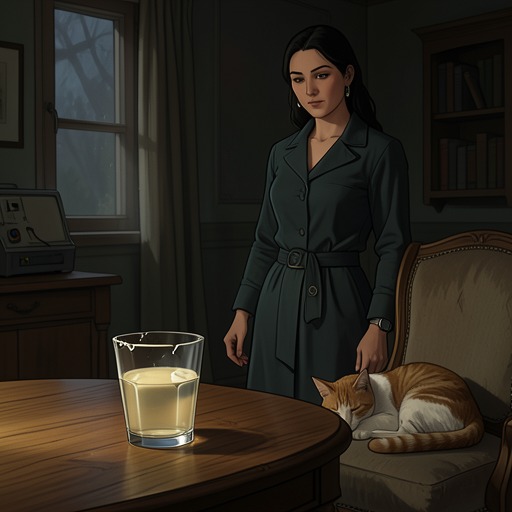
Against that expansive, shifting account, Laura Joyce identifies a small decision made at the kitchen window. She drinks water and takes small, primrose-yellow pills at the same time each night, describing the decision as absolute and connecting it to not passing on her greed and ingratitude. The scene does not explain the pills or promise a transformation; its emphasis falls on repetition and resolve. In a narrative where choices can look retrospective, compromised, or overwhelmed, this nightly act offers a limited but tangible form of agency.
An unresolved account of freedom
The concept’s force comes from the friction between these examples, not from a final theory of free will. Laura Joyce can trace how she participated in becoming someone shaped by another’s desire, imagine a self with perpetual willpower, and name a decision she intends to keep. At the same time, her multiverse reflections unsettle the boundary between what might happen and what has already happened, while her account of anxiety treats possibility as both privilege and danger.
The narrative therefore presents agency as partial and situated rather than absolute. Reflection can expose habits and make alternatives imaginable, but it does not automatically undo the past or secure a different action. Laura Joyce’s repeated returns to beginnings, parallel selves, and small decisions preserve that uncertainty. Possibility matters not because it guarantees freedom, but because it remains present even when freedom feels difficult to claim.