Baby Club and the pressure of parenthood
AnimalsBaby Club and the pressure of parenthood describes the pull between the public expectation that having children is a natural shared milestone and the private uncertainty of whether, when, or how to become a parent. Its central image is Tyler’s imagined club: a place people may feel trapped inside, yet greet newcomers with relief. Around that satire, age, marriage, and the fear of missing out turn parenthood from an abstract social script into a series of intimate decisions.
The Baby Club as social pressure
Tyler describes the Baby Club as a disco in Leicester Square: starkly lit, tacky, full of tourists, and dated in both décor and its inability to provide a decent drink. People have paid twenty pounds to enter and cannot leave; when someone new arrives, those already inside smile with relief. The image makes a supposedly joyful life stage resemble an unpleasant venue whose members reassure themselves by recruiting company. The pressure lies not only in entering the club, but in presenting entry as an exclusive event worth celebrating.
Tyler says she would not tell new parents to reject their club and find somewhere better. Her joke is therefore also a boundary: she can recognize the social script without joining its celebration or turning her refusal into a campaign against people who have chosen parenthood. The metaphor gives shape to the difference between being surrounded by a norm and personally accepting it. Its comic details—the entrance fee, the inability to leave, the performative welcome—make the welcome itself feel less like proof of contentment than evidence of how badly the members want company.
Age, friendship, and the life-stage clock
Age makes the pressure concrete when the narrator asks Tyler whether she is worried about becoming too old to have a baby. Tyler answers that she has at least fifteen years before she needs to panic. She rejects the suggestion that her feelings are simply resentment at not having received an invitation to the baby party, and says that if she chooses to have a child, she will do so as a personal decision rather than sell it as an exclusive occasion. At the same time, she acknowledges a continuing, lonely longing in her soul. Her defiance does not settle the question of desire; it keeps that desire from being mistaken for submission to a timetable.
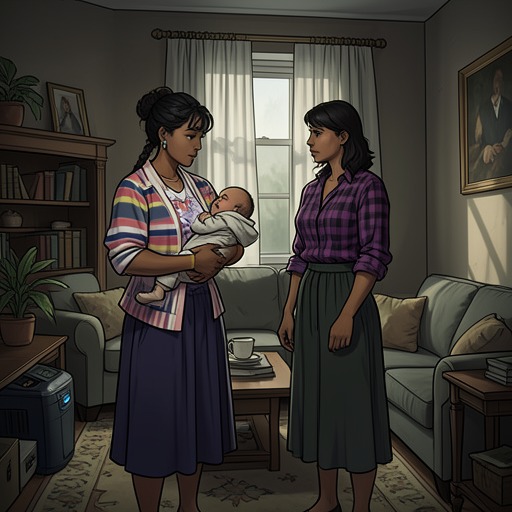
Jean’s pregnancy shows how parenthood can register as a change in a close friendship as well as a milestone in Jean’s life. Tyler and Jean are described as very close. Jean is twenty-seven, a year younger than twenty-eight-year-old Tyler, and Tyler experiences the pregnancy as a compounded betrayal: another friend, in her view, has been lost for a decade. Her response is theatrically delivered with a sweep of her kimono sleeve, like a Roman emperor declaring the games closed. The gesture makes the reaction comic, but the underlying sense of loss is direct. Jean’s transition into motherhood appears to Tyler as a possible removal from their shared life, even though the evidence does not establish that their friendship actually ends.
Different routes to wanting a child
A conversation with Jacqueline offers a less satirical account of the same uncertainty. When the narrator asks how she knew she wanted a baby, Jacqueline answers that she thought she might be missing out on something. Her explanation does not present certainty as a revelation or a settled theory; it frames desire partly through the possibility of being excluded from an experience. Set beside Tyler’s suspicion of the Baby Club, Jacqueline’s answer shows how the fear of missing out can be both a pressure imposed by a norm and a genuine element in an individual’s decision.
Jacqueline also describes disagreement with Neil about timing. He thinks they should wait a while before having another child, while she feels the force of a biological window and wants another baby before she turns thirty-five. She has tried discussing it with him, but feels he looks at her as though she were a stupid dog. The exchange gives the pressure a relational consequence: a question of timing becomes a conflict over whether her concern is taken seriously. The evidence records her wish and their disagreement, not the outcome of that disagreement.
Marriage, choice, and unsettled futures
The pressure surrounding children sits alongside the narrator’s uncertainty about marriage. Marriage has existed for her as a word and an abstract future—something she could imagine saying, without having considered what it would mean. Once it begins to take shape, she pictures it as a huge, heavy, expensive white Fifties American fridge appearing at the foot of the bed. The image gives physical weight to a convention that had previously seemed weightless. It does not make marriage and parenthood identical, but places both among the life-stage expectations that can become daunting when an abstraction turns into a decision with material consequences.
The narrator’s exchange about contraception and abortion makes that distinction between possibility and decision especially important. She says that she and Jim have not been using protection, then states that she would have an abortion. The evidence does not say that she is pregnant or that an abortion takes place; it records what she says she would choose. Beside Tyler’s acknowledged longing, Jean’s pregnancy, and Jacqueline’s fear of missing out, the statement presents another position: an immediate declaration of what the narrator would do, rather than evidence that every possibility has already become a settled future. Together, these episodes resist a single account of parenthood as either uncomplicated fulfillment or mere social conformity. They show people measuring desire against friendship, age, partnership, and the consequences of letting an expected milestone define their choices.