Belonging and a Place to Call Home
AnimalsBelonging and a Place to Call Home takes shape in Laura Joyce’s return to her small house in Blackley with Zuzu. After the fear and disorder of finding the cat in a ransacked house, Laura reaches a place arranged around her own habits and possessions; its quiet familiarity gives her a fragile but concrete sense of being present and belonging.
The return to Blackley
Laura makes her way northeast from Deansgate, through Ancoats and the old newspaper quarter, then past the Green Quarter, where To Let signs punctuate the fronts of tower blocks. The journey carries an inward charge: she feels the old rush of possibility and imagines something waiting in her unchanged room and on her laptop. The destination is not presented as a grand refuge. It is a small, ordinary place reached on foot after she gets out of the cab early and buys wine at an off licence.
At the Victorian semi-detached house, Laura recognizes the slightly open skylight. Before she can use her keys, a woman leaving the building holds the front door ajar for her. Inside, motion detectors illuminate two flights of stairs one bulb at a time, leading to a freshly painted blue door. These small thresholds and recognitions make her return feel physical: home is a specific route, a door, and a room she can enter.
A home assembled through care
Laura’s attachment to the house is bound up with Zuzu’s rescue. She had gone to Marie’s house intending to retrieve the cat, carrying kitchen scissors in her satchel after drinking three margaritas. Nobody answered. A passerby told her that no one had been there since the previous week, and the unlocked door revealed a ransacked interior, with clothes, CDs, and broken furniture scattered through the house. Laura followed Zuzu’s faint cries past an empty dog bowl and found her hiding behind a sideboard; an isolated Granny Smith apple stood out amid the wreckage. The rescue gives the return a consequential companion: Zuzu comes home with Laura and emerges from her box beneath the bed, yawning and stretching.
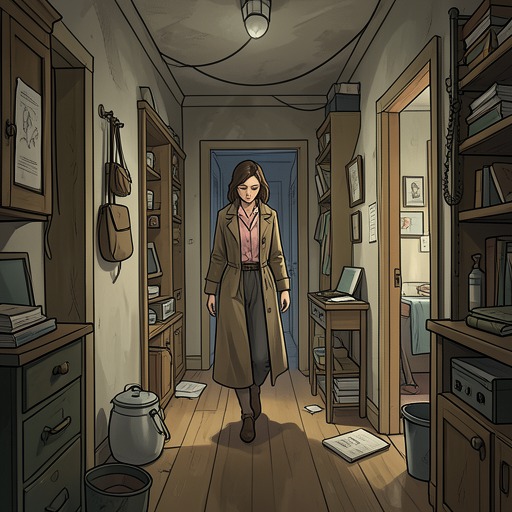
Laura settles into familiar routines. She hangs up her coat, turns on the light, goes into the bathroom she has made nautical but not sentimental, removes her boots and clothes, loosens her hair, and unpacks her bags. The room’s arrangements register a life being maintained rather than staged: books fill the shelves, favorite volumes lie open on the carpet near the desk, and the desk sits beneath the window. Zuzu’s presence makes the house company for Laura’s long nights in.
Belonging as a provisional state
The house is intimate but not socially full. There is only one tumbler on the draining board; guests drink wine from mugs, and some soon forget having been there. There are no pictures on the walls. Instead, Laura’s sense of continuity rests in the books, the desk, the room’s familiar objects, and the cat who now shares her nights. These details make belonging less a claim of permanence than a practice of returning, arranging, reading, and caring.
At the desk, Laura pours wine and looks into the dark sky, imagining it as a great hole to fall into. She is light-headed and contemplating gravity, yet the passage closes on a sense of location: she is here, with everything in its place, and everything something like belonging. The qualification matters. Home does not erase uncertainty or loneliness, but after the disordered house at Marie’s, Laura’s own room offers a small, self-fashioned ground on which she and Zuzu can stay.