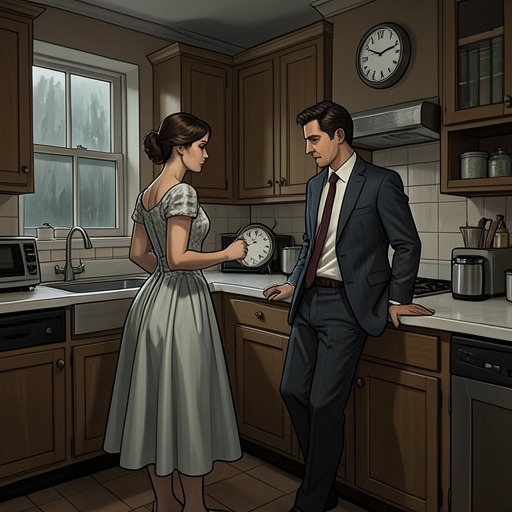
Bill tells his daughters about his cancer
AnimalsBill Joyce’s disclosure of his cancer to his daughters comes after months of silence and just before an operation, making the event less a single announcement than a belated entry into a family crisis already underway. Laura Joyce and Melanie learn the news five months after Bill himself receives it, on Jean Johnson’s insistence and only two days before his operation. The account connects that delayed telling to the family’s shock, Laura’s glimpse of Bill’s private anger, and the stark request for more time that she hears him make.
Background and Delay
Bill had known about the cancer for six months by the time Laura recounts the family’s response. He had told Laura and Melanie five months earlier, but only after Jean insisted; the disclosure occurred two days before his operation. The sequence establishes that the diagnosis was not shared with the daughters immediately. It also fixes the announcement against an approaching medical intervention, leaving little time between their learning the news and Bill’s operation.
The narrative gives no explanation for why Bill waited, and it does not describe the diagnosis conversation itself in detail. Instead, its chronology makes the delay legible: the family’s knowledge arrives after Bill has already lived with the news for months, and the operation is close enough to shape the timing of what can be said. Jean’s insistence is the stated cause of his telling Laura and Melanie; the account does not attribute a motive to her beyond that intervention.
The Family Learns
Laura recalls the day as grey and registers the surroundings in unusually precise fragments: stones in the driveway, dust in the house, and Jean and Melanie sitting downstairs with matching floral mugs, not drinking their tea. Melanie repeatedly says that she cannot believe they had failed to notice. Her response turns the family’s earlier unawareness into part of the shock: the fact that they did not recognize what was happening troubles her alongside the cancer itself.
Laura goes upstairs to use the bathroom while Jean and Melanie remain downstairs. The arrangement separates the daughters’ visible response from what Laura then hears elsewhere in the house. The disclosure is therefore represented less through a complete family conversation than through aftermath, fragments, and a division between the people sitting together and the father alone upstairs. The narrative offers no account of what Jean or Melanie says to Bill in the room where he is resting, or of how the operation proceeds.
Laura as Witness
As Laura approaches the bathroom, she hears Bill speaking. At first she assumes he is on the phone; as his voice rises, she creeps closer and realizes that he is expressing anger at the cancer and at its timing. He resents its arrival after retirement and pleads for ten more years before it can claim him. Laura stands rigid on the landing, aware that he would be mortified to know she has overheard him.
This private outburst gives the disclosure an intimate but incomplete second scene. Bill’s formal telling has made the daughters aware of his illness; Laura’s accidental listening exposes the anger and fear that the family announcement does not contain. Yet she does not enter or interrupt. Her position on the landing makes her a witness rather than a participant, and her knowledge carries its own constraint: she hears what Bill has not chosen to share with her in that moment and recognizes that he would not want an audience.
Significance and Limits
The event’s force lies in the contrast between delayed information and the immediacy of Bill’s need for time. The family has only recently been told, but the diagnosis has already occupied months of his life; the operation is two days away, while his plea reaches toward a future measured in years. The account does not turn this request into a promise or suggest that the time he asks for will be granted. It preserves the difference between wanting more life and knowing what the illness will allow.
Laura’s recollection also keeps the family’s responses distinct. Melanie voices disbelief that they did not know; Jean has pressed Bill to tell them; Laura hears an unguarded expression of anger and remains silent. These separate details show how the diagnosis enters their shared life unevenly, through insistence, belated recognition, and overheard speech. The scene is consequently not only the moment when Bill’s daughters learn about the cancer, but a record of what disclosure can and cannot make available: the fact of the illness becomes shared, while Bill’s most private words reach Laura by accident.