Laura sleeps under a bush after the lecture
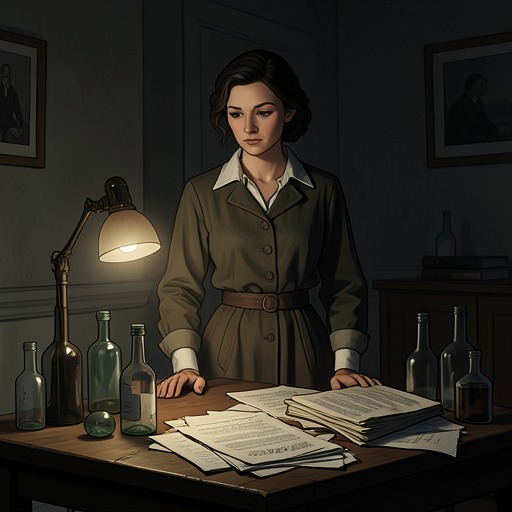
AnimalsLaura sleeps under a bush after the lecture during a night of severe intoxication and disorientation. Unable to navigate the streets safely or find the companionship she longs for, she climbs a steep embankment beside a viaduct and curls up out of sight beneath a bush. The episode turns an ordinary journey home into an exposed interval between public danger and private refuge, then lets its missing hours return in fragments the next morning.
Leaving the Library
After a phone call ends, the room seems to bulge at the edges of Laura’s vision. She puts on her jacket one arm at a time and makes her way through the library, smiling at the woman at the desk, who does not smile back. The stairs require a toddler’s method: one foot down, both feet together, then the next step, with Laura holding the wall and handrail. Her careful descent makes clear how little control she has over her body.
Rush hour meets her outside. She is startled that four hours have passed and weaves along Portland Street, past an all-you-can-eat Chinese buffet, to a crossing where the traffic lights seem to take too long. She crosses anyway and gestures angrily at a honking hackney cab. The city is not presented as a route she can master: it is a crowd, noise and movement to be endured while she tries to keep walking.
When a passer-by’s arm or briefcase strikes her, Laura veers towards the wall beside the former Odeon cinema. She presses her palm against its peeling blue paint and breathes until the nausea subsides. The contact with the wall is a small act of self-stabilisation, but it cannot make her well. She does not want to vomit in the rush-hour crowd, and knows she cannot manage the kind of public composure Tyler once displayed by carrying on after vomiting at a music festival. Their old joke about the walk and puke marks the contrast: Tyler could turn an embarrassing bodily episode into a performance of control; Laura only wants to lie down.
A Route Without a Destination
Laura continues through St Peter’s Square, past the Midland Hotel, and along Peter Street towards Deansgate. Only at the Free Trade Hall does she recognise that she is heading towards Jim’s home—and that Jim is not there. The route has brought her close to a person who might have mattered to her, but the recognition offers no reunion or help; it only exposes the gap between where her body is going and what the situation can provide.
The journey also loosens into a chain of associations. At Lion Bar, built beneath an old Methodist church, Laura remembers that the venue had once been the Red Room, where she worked for several months in her early twenties. She recalls Jacqueline, another waitress, and the club’s regular fetish nights: a dungeon assembled downstairs with nets, chains and a corrugated-cardboard rock wall fixed up with a staple gun. The memory of sweeping after one of those nights leads to a startling encounter with a crouching figure in a full-body gimp suit, who fled down the stairs and found the locked glass door before Jacqueline let the person out.
That comic, grotesque recollection opens into thoughts about the people who have disappeared from Laura’s life. She wonders what became of Jacqueline and remembers scrolling past her number while drunk. The thought that social media might answer such questions turns back on itself: if she had Facebook, she would not have to wonder. The digression gives the walk a second, inward route, through old work, old acquaintances and the uncomfortable persistence of uncertainty.
Climbing into Hiding
Where a dual carriageway begins, a viaduct divides the sky above a series of roundabouts. Green growth clings to the raised brick embankments: fast-growing trees, spiky bushes caught with litter, and grass growing out of the slope. Laura sees a way up where the wall looks almost impossible to climb. She jumps, grips its top and tries to work her trainers into cracks in the brick and gaps in the mortar.
The attempt is precarious and painful. The wall is slippery; Laura loses her balance, scrapes her knee, ladders her tights and nicks her shin before hauling herself over. At the top she lies on her back, panting, with leaves above her. Then she crawls on all fours beneath a bush, away from the pavement and passing traffic. Ivy spreads across the ground, with pale sycamore seeds lying between its leaves like brittle moth wings. Footsteps approach, and Laura hears a man’s low laughter. She turns onto her side and folds into the foetal position, her eyes closed, listening to the ebb and flow of traffic.
The bush is not a planned destination or a lasting refuge. It is a place Laura reaches by climbing out of the ordinary path, and her posture recalls the way she lies in bed—even as the position presses on a shoulder already slowly eroding. Her hiding place offers concealment from the road, not company or reassurance. The sensory scene narrows to leaves, footsteps, laughter and traffic, while Laura’s question about where her allies have gone gives the episode its emotional centre. She remembers the girls she drank with during long winters behind the bowling alley, when they were strangers in cars they did not know and seemed to have only to run towards whatever lay ahead. Now she feels she has not travelled far from that old restlessness: she is still running, except when she is lying down.
The Missing Hours Return
The narrative does not immediately explain how Laura gets from the bush to her bed. The next morning begins with the sight of a chicken carcass on a plate beneath the duvet and the discovery of chicken jelly around it. Only after asking whether it is morning or night does Laura recover the preceding hours in shards: waking beneath the bush, walking to buy a hot roast chicken, returning to the flat, and getting into bed with it. The account thus makes the domestic aftermath a belated key to the night’s missing stretch, without turning that recollection into a tidy or continuous record.
The episode’s structure echoes Laura’s impaired experience. First comes the difficult movement through the city and the stillness under the leaves; later comes the explanation, assembled after waking from scattered memories. The chicken, brought home after the roadside sleep, carries the night from public space into the bedroom and makes the lost time visible. Yet the recovery of these facts does not undo the solitude registered beneath the bush. Laura can reconstruct what she did, but the question of where her allies are remains unanswered.