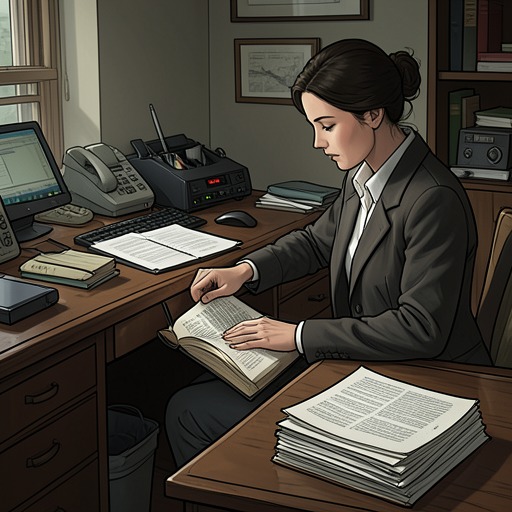
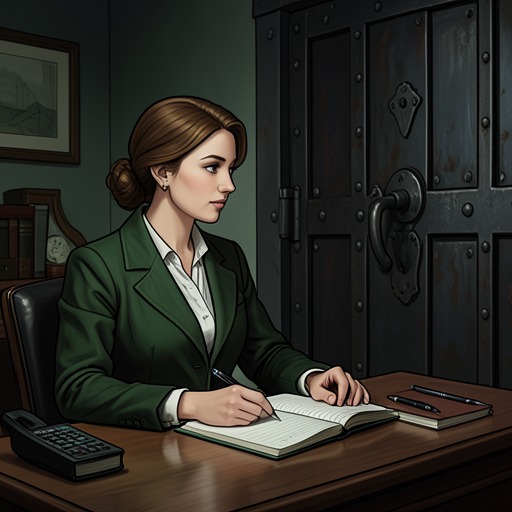
Laura meets Marty Grane at the Yeats lecture
AnimalsLaura meets Marty Grane at a Yeats lecture on 4 May, in an encounter that begins with a cancelled plan and the small relief of finding an unexpected intellectual connection, then turns into a charged negotiation of attraction and boundaries. The professor’s attention offers Laura the recognition she craves as a writer, but his declared preference for women who are already committed makes that attention dangerous from the outset. She leaves without giving him her number; the encounter nevertheless becomes the beginning of a night that ends with Laura sleeping under a bush.
The lecture begins with an absence
At lunchtime, Laura waits outside the Georgian Library for Tyler. It is raining lightly, but enough to make smoking unpleasant. She repeatedly has to relight her cigarette after knocking its burning end onto the wet pavement. Trams pass with condensation beading their windows; across the road, students queue at a Sainsbury’s cashpoint with packet sandwiches. Laura has come straight from a nightshift and is already wet through when, after waiting twenty-five minutes, she calls Tyler.
Tyler has forgotten the Yeats talk Laura reminded her about the day before. She tells Laura that she got blackout-drunk the previous night and feels so ill that even moving might make her vomit electricity; she asks to take a raincheck. Laura says, “Course.” The brief exchange leaves her to attend by herself, with wet shoes and no expectation of the evening that will follow. The ordinary disappointment matters: the lecture is not a planned meeting with Marty, but a destination Laura reaches because her friend cannot come.
The event’s framing gives this cancelled plan a further consequence. The lecture is identified as an inspiring encounter that causes Laura to sleep under a bush. The contrast is already present in its beginning: she arrives tired, damp, and alone, while the talk will draw her into a lively intimacy with a stranger and away from the routine she expected.
Yeats and the pleasure of recognition
The lecture is short enough that Laura wishes it had lasted longer. The professor explains how Yeats first entered his life through his thesis and later became a complement to his teaching. He describes being repeatedly drawn back to the later poems, which are at once personal and evasive, desperate and defiant. Laura recognizes the combination immediately. The talk feels like an ambush—not an unwelcome one, but a sudden encounter with ideas and feelings she already cares about. She looks down and finds wine to drink; an hour passes without her noticing.
When the talk ends, Laura applauds while checking that wine remains on the table. She considers going to thank the professor, partly because he has reminded her of so many things and partly because approaching him will make her look less like a freeloader. She drinks one glass beside the table, takes another to the front, and waits near the professor and the woman from the library. Her self-consciousness grows until her presence feels almost oppressive; just as she is close to leaving, they turn toward her. The awkward approach is also a choice to extend the encounter: Laura could depart, but instead offers the professor an opening to speak with her.
The professor introduces himself by holding out his hand: Marty. Laura gives her own name. When he asks whether she writes poetry, she steers away from poetry and, when he asks what she is writing, says that it is a novel. Its title is Bacon. This exchange establishes a shared literary subject while also marking Laura’s seriousness about work still in progress. Marty’s interest is not limited to the lecture: he asks why she wants to write, and Laura answers with an image of raging around a dark mansion. She has dismissed a question about the purpose of life in order to answer him, but the answer is still a declaration of imaginative ambition.
Wine, writing, and an explicit advance
Marty invites Laura to talk over wine in the anteroom. Heavy-legged tables and standing lamps with emerald, crimson, and gold shades give the room a cosy, clever atmosphere; dishevelled bookshelves line its walls. Seated opposite each other at a table for four, they drink two bottles of wine. Marty talks about his teaching job, which he enjoys well enough, and his life in Islington. His book, Widening Gyres, was published ten years earlier to little effect. The detail gives Laura’s writing conversation a particular context: she is speaking with a working teacher and published author, though his own book did not make much impact.
Marty asks whether Laura is engaged. She asks how he knows; he explains that she is not wearing a wedding ring and that he is only ever attracted to women who are irreversibly attached. The answer makes his attention legible in a way that Laura cannot easily treat as incidental. Her engagement is not merely background information to him; it is the condition he names as part of his attraction. Yet she continues the conversation, glad to have the subject of writing to return to when the exchange becomes uncomfortable.
When Marty asks why she wants to write, Laura answers with the dark-mansion image. He responds, “You know I’m going to kiss you if you keep talking like that. What does your fiancé do?” Laura recognizes that she should sit back or object, and that ignoring the remark amounts to acquiescence. She does neither. She says that her fiancé is a pianist. The scene holds together the attraction and the warning: Marty makes his intention explicit, Laura understands the significance of his words, and the conversation continues rather than resolving into a clear refusal or acceptance.
Recognition, refusal, and aftermath
Asked whether he has a girlfriend, Marty says that he has no one that regular. Laura describes feeling a tremor run down her spine and a cold spot at the back of the courtyard. Her mind supplies the image of a cat in the shade, repeatedly flicking a caught bird with its claw. The image makes the encounter feel predatory without turning that feeling into a spoken accusation. She senses that Marty has sensed her response: recognition passes between them without either having to name it.
Marty drains his glass and says he should get to the station, without looking at his watch. Before leaving, he asks whether he can have Laura’s number. She shakes her head. He smiles, salutes, and goes. That refusal is the scene’s clearest boundary, arriving after she has stayed through the drinks and continued a conversation that included his threat of a kiss. The refusal does not erase the intimacy of the exchange; it ends the possibility of extending it on his terms.
After Marty leaves, an undrunk blob of wine remains in the hollow where the bowl meets the stem, resembling a glass eye. Laura feels she needs to talk to Jim and calls him. The shift from Marty’s attention to the need to reach her fiancé makes the encounter’s emotional pressure visible without supplying a simple explanation for it. The episode has offered Laura a professor who understands her response to Yeats and takes her writing seriously, but that recognition arrives entangled with alcohol, his stated attraction to attached women, and her own failure to challenge his advance. The wet arrival outside the library and the wine-lit anteroom belong to the same chain of events: an ordinary plan collapses, a literary conversation opens, and the inspiring encounter leads into a night whose endpoint is Laura under a bush.