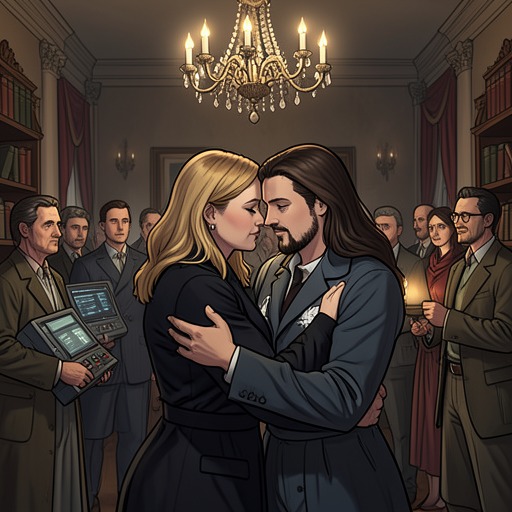
Laura meets Jim at the bar
AnimalsLaura meets Jim in a bar in Manchester’s Northern Quarter after drinking with Tyler on a Friday in October. What begins as a watchful exchange over drinks becomes a first introduction, an overnight intimacy, and, in Laura’s retrospective account, the start of a love that gives her life a new sense of purpose. The meeting is significant not because either person makes a grand declaration, but because Laura experiences attraction as an immediate recognition that turns an ordinary night out into the beginning of a relationship.
Setting and Circumstances
Laura and Tyler have gone drinking after their shifts. By 8 p.m. they have had ten drinks, and Laura describes their state as wedding-drunk: the wedding is already a presence in the evening, even as the scene moves toward a new attachment. At the bar, Laura notices a man stirring his drink. Because the bar’s drinks do not call for ice, fruit, or the usual reasons to stir, the gesture strikes her as unusual. She watches him, and he looks back at her and then at his glass. Their repeated glances turn the observation into an unspoken invitation for Laura to approach.
Tyler is beside Laura, looking down at her phone, while music sounds from a bass speaker and dancing bodies periodically muffle it. Laura asks whether Tyler wants a shot. Tyler chooses tequila, explains that sambuca from Tuesday still seems to linger, and tells Laura that the man is gay but that she should proceed if she wants to. The remark establishes Tyler as both companion and commentator: she is present for the opening of Laura’s approach, but does not prevent it. Laura goes to the bar, orders two shots, and offers one to the man, who initially declines without speaking.
The Approach and First Exchange
Laura reads Jim through small details before she knows his name. He appears to be drinking something with tonic, which Laura regards as promising because it is a drink she associates with going the distance. She watches him set down the straw he has used to stir his drink, then waits through his silence and repeated smiles. Her attention turns the quiet interval into a test of interpretation: she wonders whether he might be mute, and even imagines that communicating by notes could be romantic. These are Laura’s projections, not facts about Jim; the scene makes clear how quickly she begins building possibilities around someone she has not yet met.
When Laura offers him a shot, Jim smiles but does not speak. She eventually gives him a tequila, and they drink together. The first shared gesture is awkward for a moment, then passes without incident. Laura tries to begin a conversation by asking what he does when he is not standing in bars being enigmatic. Jim asks whether she really wants to discuss that. Laura admits, in effect, that she does not, and explains her discomfort with conversational silences as a habit of her generation. Her nervous attempt to fill the pause gives way to a brief account of how she alternates between wanting to be the centre of attention and wanting to remain mysterious.
Jim then says that he is a pianist. Laura asks whether he plays classical music or jazz, revealing that she has run out of categories to offer. Their exchange is not presented as polished courtship. Its pauses, misfires, and teasing make the meeting contingent: attraction develops alongside Laura’s self-consciousness rather than through effortless verbal rapport.
Introduction and Immediate Attraction
The two eventually exchange names: he introduces himself as Jim, and she gives her name as Laura. The handshake becomes the encounter’s decisive point of contact. Laura notices his hand and experiences a sudden, powerful attraction, coupled with a sense of gentleness in him. She associates that feeling with Yeats and with a loveliness she believes has largely disappeared from the world. The meeting’s emotional scale is therefore established through Laura’s response, not through any claim that Jim has already disclosed his character or intentions. He is still largely unknown to her, while her sense of possibility is already expansive.
Before the introduction, Laura has been trying to decide how to approach a silent stranger; after it, the connection acquires a name and a bodily immediacy. The narrative marks this shift without making Jim explain himself at length. His occupation as a pianist and his question about whether Laura has published anything are among the few concrete facts they exchange. Laura says that a few of her things have appeared in a small way. The conversation thus gives each a limited glimpse of the other’s work, while leaving most of their histories and differences undisclosed.
The Night Together and Its Meaning
Laura wakes in a rented room beside Jim, not in her own bed and not beside Tyler. She remembers that they stayed at the bar until two and then took a taxi to his place. Her recollections of the night include kissing, closeness, and the practical details of the room: magnolia paint and sloe gin made by Jim’s niece. The account moves from the bar’s hesitant first contact to an intimacy that has already occurred, then slows over the quiet recognition of waking beside him. Laura reaches toward Jim; he murmurs and turns to face her. The morning confirms that the encounter has become more than an exchange of glances and drinks, without resolving what their future will be.
Tyler’s night has taken a separate course. Laura later calls her, and Tyler reports that she has ended up at a party in Salford. This parallel outcome keeps the first meeting within the texture of an evening out with a friend: Laura and Tyler begin together, then move into different encounters. It also makes clear that Jim’s arrival in Laura’s life does not erase the social circumstances from which the meeting emerged.
Laura’s retrospective conclusion is that she has fallen in love. She describes the relationship that begins here as a source of communion and renewed purpose, and recalls making love to Jim as a repeated ritual through which each could explore the other’s responses. Her account also gives the first meeting a particular temporal quality: at the beginning, the other person has not yet discovered one’s limitations, and many futures still seem possible. The scene’s importance lies in that combination of immediate attachment and untested possibility. Laura’s confidence belongs to the beginning itself; the later knowledge of a relationship’s imperfections has not yet entered it.