“I am here to say no to you, and then to die”
Antigone“I am here to say no to you, and then to die” is Antigone’s stark description of her purpose in confronting Creon: she will not assent to the political and personal terms he offers, even though she knows that refusal leads to her death. The line condenses the play’s conflict between Creon’s claim that rule requires practical consent and Antigone’s insistence that she must act according to what she can still do and choose for herself.
The Choice Behind the Expression
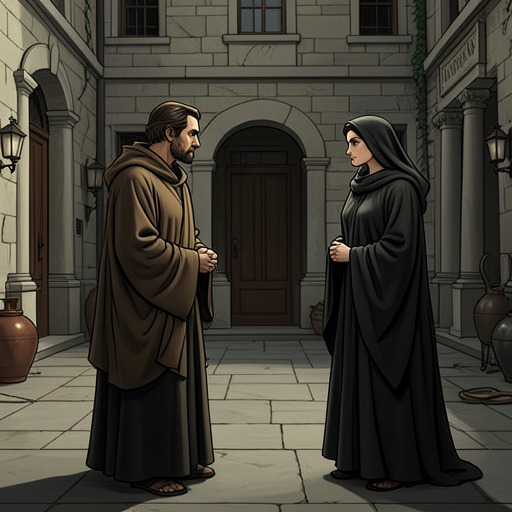
The declaration comes from an argument in which Creon presents his decision to govern as an act of necessity. He says that he considered refusing the role but felt like a workman refusing work, and so said yes. Antigone answers that she did not say yes: his crown and guards give him the power to put her to death, but, in her view, that power follows from his own assent to the responsibilities he has taken on. She rejects his politics, obligations, and personal explanations as reasons she must accept his decision.
The opposition is not simply between action and inaction. Creon claims that saying yes means taking hold of life and entering into its work, while saying no means waiting—even when death is the price. Antigone does not dispute that the cost is severe. She defines her purpose through the refusal itself, treating the choice as hers even when she cannot control the punishment that follows.
Creon’s Case for Saying Yes
Creon’s metaphor of the ship gives his position its most forceful form. He describes a vessel taking on water amid crime, poverty, and misery; its crew will not work, its officers look after themselves, and the ship risks going down unless someone takes the wheel. In this emergency, he argues, the person steering cannot pause to make fine distinctions about each decision. The image makes political responsibility a demand to act under pressure, with the survival of the whole vessel taking priority over the individual’s name or scruples.
His account also carries a cost. In the crisis he describes, the person at the wheel may lose his name just as the people caught in the storm lose theirs: only the ship and storm remain. Creon’s defense of authority thus acknowledges that political action can erase personal distinctions, even as he treats that erasure as part of the burden of governing. The shipwreck image explains why he believes someone must say yes, but it does not persuade Antigone to make that choice.
Antigone’s Refusal and Its Stakes
Antigone answers the ship metaphor directly: she does not want to understand. She says she is there for other things than understanding, then names the purpose captured by the expression: to say no to Creon and then to die. Her answer rejects the idea that grasping the administrator’s reasons must lead to agreement. Understanding, in this exchange, is not the same as accepting the terms of political necessity.
The declaration also connects her refusal to a concrete obligation. Earlier, Antigone describes the roles as already cast: Creon must have her put to death, while she and Ismene must bury their brother. She presents the conflict as one in which each party has a part to play, not as a choice that can be resolved by simply avoiding consequences. Later, she says that she knows she can do little, but that she can do this much and must do what she can. The expression gives that limited capacity its most uncompromising form: she may not control the outcome, but she will not give up the act she has chosen.
A Refusal of Compromise
Antigone’s later statement that she wants everything, here and now, whole and complete, or else nothing, broadens the logic of the line. She rejects a modest share of happiness when obtaining it requires accepting terms she cannot live with. The two formulations are not identical—one names her immediate purpose in opposing Creon, the other her refusal of partial contentment—but both define compromise as an unacceptable surrender of completeness.
The line therefore holds together agency and powerlessness without confusing them. Antigone chooses to refuse; Creon retains the authority to impose the death that follows. Her declaration does not claim that saying no will save her or change his decision. Its force lies instead in making the difference between their choices explicit: Creon has said yes to the work of rule, while Antigone will not say yes to what he demands of her. In that contrast, refusal becomes both her answer to political authority and the final boundary she can still set.