Morbid obsessional sexual compulsion
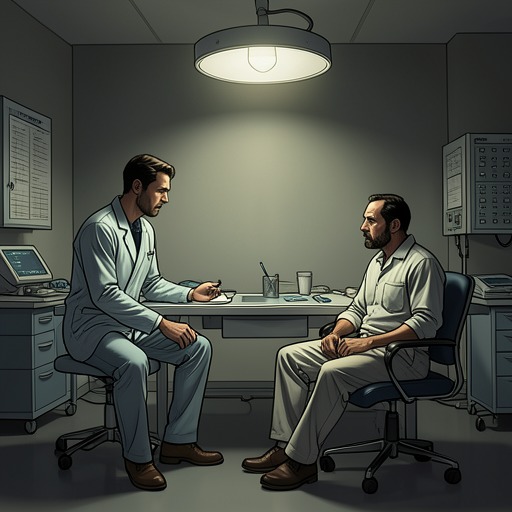
AsylumMorbid obsessional sexual compulsion is the clinical frame Peter Cleave gives to Stella Raphael’s attachment to Edgar Stark, an affair that reorganizes her sense of love, danger, and responsibility. Its force is visible not only in the affair itself but in the way Stella interprets it as irresistible, refuses to judge Edgar, and later conceals her continuing obsession from the doctor treating her. The story makes that diagnosis unstable: Cleave’s account of Stella’s recovery is itself overturned when he recognizes how much he has mistaken performance for change.
Clinical Frame
Cleave distinguishes Stella’s relationship with Edgar from the more straightforward clinical account he gives of her conduct after Charlie Raphael’s drowning. He regards her attachment to Edgar as an unusually dramatic example of morbid obsessional sexual compulsion. In his formulation, the drowning and the affair are connected: he believes that what Stella saw struggling in the water was Edgar, not Charlie or Max Raphael. This is Cleave’s interpretation of her experience, rather than an explanation Stella initially supplies herself, and the difference matters. The clinical language makes her actions legible to the psychiatrist, but it does not simply resolve their meaning.
The relationship also sits beside Edgar’s own delusional jealousy. Before his admission to the hospital, Edgar had accused Ruth Stark of infidelity and killed her, while interpreting ordinary incidents as evidence: a window opening as a motorbike passed, a crease in a pillow, or a stain on clothing. He remained convinced that the murder was justified, despite his otherwise strong functioning and the absurdity of the evidence he offered. Cleave’s juxtaposition of Edgar’s fixed suspicion and Stella’s fixed attachment places two different forms of relational distortion in the same story. It does not make them equivalent: Edgar’s delusion led to Ruth’s murder, while Stella’s attachment becomes entangled with her affair, flight, and later silence.
Formation and Course of the Affair
Stella was married to Max, a forensic psychiatrist whom Cleave considered reserved, weak, and unimaginative. That judgment belongs to the doctor’s perspective, but it establishes the context in which he understood Stella’s frustration. At the hospital, Edgar was assigned to restore the conservatory and work in the deputy superintendent’s garden. Stella often encountered him while picking vegetables or flowers. When John Archer, the supervising attendant, was not visible, she sometimes sat and talked with Edgar. She admitted that she was attracted to him almost from the start, even as she tried to dismiss the feeling and found excuses to see him again.
In her later account, the affair becomes less a choice than an inevitability. Recalling the encounter in the vegetable garden, Stella described knowing that sex would happen because it seemed impossible to avoid, postpone, or ignore. When Cleave asked whether she had experienced it as a necessity, she agreed. The word captures the way compulsion shaped her account: risk did not function as a deterrent once the supposed necessity had taken hold. Her explanation does not erase the choices around the affair; it shows how she narrated them to herself, turning desire into a force that seemed to leave no alternative.
Stella told Cleave that she had desired someone with a physical and emotional intensity she had never before experienced directly. Previously, she had mainly sensed such intensity coming from men. She described both the affair on the hospital grounds and her time with Edgar away from the hospital. Yet she did not make a moral judgment of him, even when he left without telling her or hit her. She told Cleave that criticism would require a conditional form of love, in which affection could be withdrawn if the beloved acted badly; that possibility did not arise for her. The attachment therefore survives not because Edgar behaves consistently or kindly, but because Stella’s ideal of the relationship makes his conduct seem beside the point.
The Drowning and Its Competing Meanings
At Cledwyn Heath, Stella’s dissociative state gives the relationship a terrible second setting. While Charlie was at the water’s edge, she experienced black waves, a sense that the ground was moving, and a creeping numbness. She watched him in a distant, obscured way as he played in the shallows and then lost his balance. When he struggled in deeper water, she stood in the rain and smoked, turning away and bringing the cigarette to her lips as he surfaced and went under. The controlled, repeated gesture contrasts with the danger unfolding in front of her; the scene records her passivity without turning it into an explanation of its cause.
Afterward, Hugh Griffin insisted that Stella had watched Charlie scream in the water without raising the alarm. Whether a shout from the hill could have saved him was later disputed because of the distance to the pool, but the absence of any cry or movement transformed public sympathy into horror. She was described as unnatural, evil, monstrous, or mad; she was remanded and questioned, while experiencing herself as numb and detached, watching her ordeal from within and, as it seemed to her, from a point above and beside herself. The community’s need to explain the death hardened into an opposition between monstrosity and madness, while Stella could not give the answer the authorities wanted.
Cleave initially treats the death as a recoverable trauma whose course would involve guilt, acceptance, and integration into memory and identity. He sees Stella’s later nightmares of screaming, accompanied by headaches, as the delayed emergence of guilt for Charlie’s death. He believes that Edgar no longer dominates her thoughts and that she is beginning to grieve. But he also interprets what she saw in the water as Edgar, making the drowning scene the point where her attachment and her failure to act become clinically joined. His account of this connection will itself be challenged by his later recognition that Stella has been concealing what she feels.
Treatment, Performance, and Persistence
On the female admissions ward, Stella’s adjustment appears to support Cleave’s account of recovery. She becomes conscious of her appearance and uses a shared tin of donated cosmetics before seeing him. As she learns that visible frustration could delay progress, she adopts a calm, amiable manner and tries not to let the effort show. Her transfer downstairs brings greater privacy, freedom of movement, and permission to wear her own clothes. Cleave reads her slower movements and composed appearance as signs of improvement; from the patient’s perspective, however, appearing to accept confinement is part of what earns the move. Institutional progress depends partly on self-control that staff can observe, while distress can remain hidden.
Cleave initially understands Stella’s reported screaming-child dreams as evidence that the guilt he expects is finally surfacing. He thinks this means she has let go of Edgar and can begin working through Charlie’s death. Later, he reinterprets the same signs. Recalling that he had suggested Edgar might be at the hospital and then denied that he was there, Cleave realizes that the suggestion may have kept hope alive. In his revised account, Stella understood that apparent indifference to Edgar would count as evidence of recovery, so she performed it. Her interest in laundry work, solitary time on a bench, reported dreams, and apparent remorse all become, in Cleave’s reading, ways of diverting him from the truth.
The final reversal is that the dreams were not, as Cleave first believed, the return of guilt for Charlie’s death. He concludes that the screaming belonged to Edgar in Stella’s mind and that her engagement to Cleave was also a masquerade, concealing her continued love for Edgar. This is Cleave’s late realization, not an independently confirmed account of every motive behind Stella’s behavior. Its force lies in what it exposes about both characters: Stella’s attachment has endured beneath the signs of recovery, while the psychiatrist’s confidence in his ability to read those signs has failed. The compulsion is therefore not simply a past affair to be overcome. It has become a concealed organizing force, capable of making treatment itself part of the performance that hides it.