Stella’s clinical depression
AsylumStella’s clinical depression is the collapse of the fragile routines and romantic illusions that had helped her endure an increasingly fractured life. It emerges unmistakably when Edgar Stark’s arrest in Chester ends her hope of escape, then becomes inseparable from Charlie’s drowning and Stella’s failure to call for help. The narrative distinguishes her inner experience—despair, numbness, and estrangement—from the judgments of family, police, and psychiatrist, whose explanations do not all mean the same thing.
Background and the collapse of escape
Stella had married Max Raphael while barely out of her teens, and their son Charlie was ten when the events surrounding her illness unfolded. The family moved from London to the hospital in the summer of 1959, when Max became deputy superintendent. The marriage, as the psychiatrist later understood it, had not satisfied Stella; her frustrated desires became entangled with her attraction to Edgar, a patient whose delusions of his wife’s infidelity had led him to murder Ruth Stark. That history does not itself explain Stella’s depression, but it establishes the dangerous romantic story she built around Edgar and the life she would later struggle to relinquish.
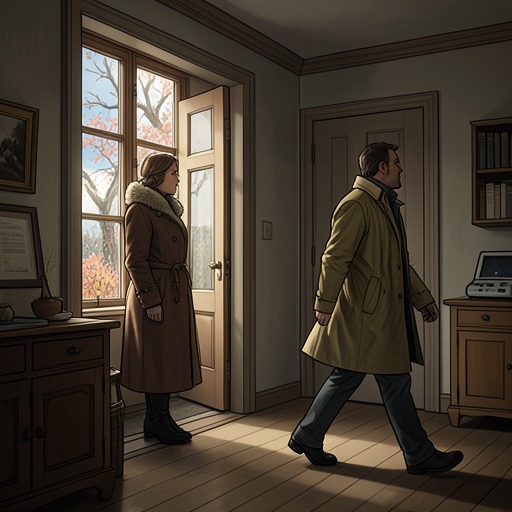
For a time, the prospect of flight gave that story a future. Edgar escaped the hospital wearing Max’s clothes, having retrieved them from hiding in the woods at the end of the Raphaels’ garden, and made his way toward London. The escape exposed weaknesses in the supervision of the hospital’s outside work parties; it also left Max under suspicion for failing to establish Edgar’s whereabouts promptly. For Stella, however, the decisive loss came later, when Edgar was found in police custody in Chester, only twelve miles away. The narrator identifies that news as the point at which the fantasy of flight collapsed and Stella sank into clinical depression proper. What had sustained her was not simply the possibility of seeing Edgar again but an imagined life beyond the constraints of her marriage and home.
Despair within domestic routine
Stella’s depression is shown first as a struggle to get through ordinary time. At night she cannot sleep. In the cold, shuddering house she paces in a jersey, nightdress, wool socks, and dressing gown, smoking one cigarette after another as her thoughts move among Charlie’s teacher’s warning, her affair with Trevor Williams, and memories of her weeks with Edgar in London. Her memories of Edgar seem to be fading like old photographs, so she tries to preserve a connection through cloud formations, birdsong, and flowers they once shared. When she searches for him in Cledwyn or Chester, she repeatedly mistakes strangers for the man she hopes to see. Even the brief lift of feeling is enough to maintain the illusion of contact.
Her home life offers no corresponding comfort. After a painful encounter involving Charlie, Stella worries that she is beginning to see him as an extension of Max and therefore part of a conspiracy against her. She recognizes this response as unfair but cannot seem to prevent it. She does not tell Max what happened, and he does not open a conversation with her that evening. Silence and estrangement gradually take the place of ordinary family exchange.
Yet Stella clings to housework and meal preparation. As despair arrives in waves, making beds, doing laundry, cooking dinner, and washing dishes give shape to a day she otherwise finds difficult to endure. She does not perform these tasks to repair her relationships; she relies on them for herself, as a structure that can hold while the household comes apart. Her horizon contracts to the immediate goal of reaching bedtime without going mad. The routine is both a limited form of self-preservation and evidence of how little she can imagine wanting from the future.
Charlie’s drowning and the experience of numbness
During a school outing at Cledwyn Heath, Stella’s mental state becomes central to a catastrophe. At the pool, while Charlie searches the shallows for newts, she experiences black waves, a sense that the ground is undulating, and an apparent veil of black dust in the air. She sees him indistinctly through what feels like a heavy scrim. When he loses his balance and struggles in deeper water, she does not shout or move to help. She turns aside to smoke, watches him go under, and repeats the same tightly controlled movement of bringing the cigarette to her lips.
The account presents the sequence through Stella’s impaired perception as well as through the observable fact of her inaction. Her detachment is not a retrospective excuse: it is the form her experience takes in the moment, when the surrounding scene seems distant and her body moves in separate, controlled gestures. But its consequences are immediate. Hugh Griffin reports that Charlie was screaming while Stella stood smoking; he believes that an alarm might have saved the boy, although that possibility is later disputed because of the distance. What changes public opinion is not only the question of whether intervention would have succeeded, but the fact that Stella appeared not to react. She is recast as a mother who watched her child drown without trying to save him, and people call her unnatural, evil, a monster, or mad.
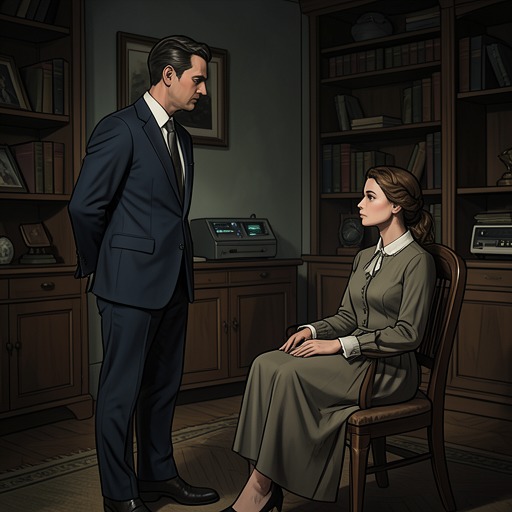
In police custody, Stella cannot give the explanation investigators seek. She is remanded, placed in a cell, questioned repeatedly, and describes herself as numb and empty, detached from the woman being moved from room to room. Her perception divides: she watches herself from within a barricaded part of the psyche and, seemingly, from a point several feet above and to one side. The psychiatrist’s arrival brings the first faint stirring of emotion she has felt for days. After he expresses sympathy, she cries. She is then able to relinquish her grip on events, sleep and drift under medication, and tell him what she had seen in the water. The visit becomes the central event of her day, while he manages the further interviews and court appearance to limit her distress. She leaves the unfolding legal process to him rather than trying to understand it herself.
Hospital recovery and the return of grief
Back at the hospital, improvement does not initially mean freedom to express distress. Stella learns that, in the downstairs ward, patients are expected to appear as though they accept confinement; calm, controlled behavior is read as progress. From her perspective, this creates a distinction between being visibly mad upstairs and suppressing signs of distress downstairs, where patients have greater privacy and freedom of movement. Her transfer brings those limited freedoms, including permission to wear her own clothes. The change matters to Stella, whose dark skirt, cream blouse, and brooch mark a return to personal presentation after the admissions ward. The psychiatrist observes that her movements and expressions have become slower and more deliberate.
Months later, the psychiatrist believes Edgar no longer dominates Stella’s thoughts. He notices instead the first possible return of the loss she had been unable to face. Stella reports terrifying, indistinct dreams that wake her in panic, followed by headaches and the lingering sound of screaming. She quickly minimizes the experience as a silly nightmare and asks only for aspirin. The psychiatrist interprets the screams as those of a drowning child and the dreams as the first stirrings of guilt; these are his clinical conclusions, not an explanation Stella herself has yet supplied. He considers this delayed confrontation with Charlie’s death evidence that her recovery is beginning, while recognizing that working through guilt will be painful. Her depression thus changes from a state sustained by collapsed romantic escape and emotional withdrawal into a condition in which grief may, at last, become perceptible.