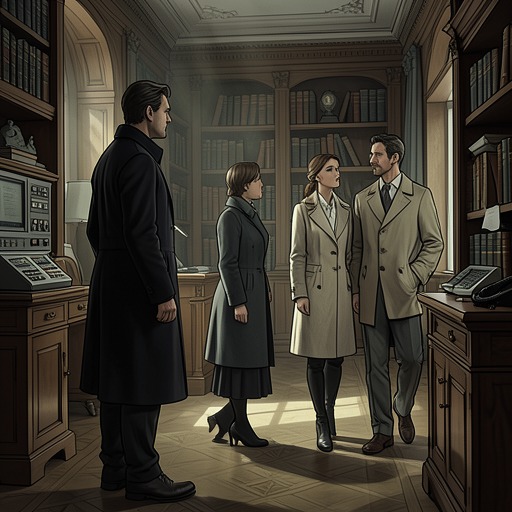
Stella’s admission to and confinement in a psychiatric hospital
AsylumStella’s admission to and confinement in a psychiatric hospital begins after she watches her son Charlie drown and is remanded on suspicion of manslaughter. Peter Cleave arranges for her to return to the hospital where she had once lived with Max, but the familiar grounds now lead to a locked ward. Her passage from police custody into treatment brings relief, disorientation, and a new dependence on the institution’s routines and on the doctor who has chosen to treat her.
Background and Return to the Hospital
Stella’s return follows years of upheaval. In the summer of 1959, she had arrived at the hospital with Max, who had accepted the deputy superintendent’s position, and their ten-year-old son, Charlie. The hospital had then been their home as well as a place of work. Later, as Stella’s affair with Edgar became entangled with his escape and the murder of his wife, the press revived Edgar’s case. Two psychiatrists testified that he suffered from paranoid psychosis, and the court accepted the insanity defense. Stella was thus forced to confront the violence behind the romantic story she had made of their relationship.
The immediate cause of her readmission was Charlie’s drowning at Cledwyn Heath. Hugh Griffin reported that Stella had stood smoking while Charlie struggled in the water and had not called for help. Whether a warning from her could have saved him was disputed, but the account transformed public sympathy into horror: she was judged either monstrous or mad. Remanded and placed in a cell, Stella remained numb and detached through repeated questioning, watching herself endure events as though from outside her own body.
Admission and Institutional Control
Cleave told Stella that she was ill, that he wanted to treat her, and that she would be going to his hospital. She agreed to treatment and named the hospital when he asked her where she was going. Yet his account makes clear that consent did not mean the decision rested with her: he believed himself the best person to treat her and had the position to make her return happen, despite recognizing that bringing her back could appear unorthodox or dangerous. He also insisted that she meet Max, presenting reconciliation as important for both of them.
The next day, police drove Stella to the hospital. She arrived with only three suitcases, although among the essentials she had chosen to bring were most of her evening clothes and her black silk dress. She entered through the female wing’s gate, not the Main Gate by which she had once passed as a resident of the deputy superintendent’s house. After the police handed over her paperwork, Cleave conducted a brief formal interview, examined her physically, and accompanied her to the admissions ward with the attendant Mary Flynn. Stella undressed, was bathed, and was given a cotton shift before being taken to her room.
The room made the change in her status unmistakable: it contained a bed, a barred window, a toilet and basin, and a barred grate in the door. Stella wanted to ask the staff not to leave or lock her in, but could not bring herself to speak. She had assumed that the nightmare of remand would end, or at least become less dreadful, once she reached the hospital. Instead, Mary shut and locked the door. When she later brought pills prescribed by Cleave, Stella asked what they were and was told simply to take them.
Ward Life and Gradual Progression
The first days passed in a drugged twilight. Stella stayed in her room, had brief, woozy conversations with attendants, and received a daily visit from Cleave. He gradually reduced her medication; as she became more alert, she began to encounter the ward beyond her room. On the fourth day she was given hospital clothes and brought to the dayroom. The sight of withdrawn women in the corridor and of patients absorbed in repetitive or private behavior made her realize at once that she did not belong among them. The dayroom’s shared space held sharply separate worlds of distress, visible through barred windows and set among tables, chairs, and couches.
Stella understood that her transfer downstairs depended on how she appeared to staff. In her view, the admissions ward treated almost any behavior as compatible with madness; downstairs, a patient seemed to be improving when she could behave as though confinement were acceptable. The performance required patience and self-control: frustration might undo weeks of progress, while visible distress could be interpreted as depression and treated with drugs that dulled alertness. Downstairs offered greater privacy and freedom of movement, as well as permission to wear one’s own clothes. After Stella maintained a calm demeanor, Cleave moved her there. She appeared in a dark skirt, an elegant cream blouse, and a brooch, and thanked him warmly for the transfer.
Treatment, Memory, and the Limits of Recovery
Cleave regarded Stella’s loss as clinically comprehensible but her attachment to Edgar as the more complex problem. He believed that she had projected onto Charlie some of the hostility she felt toward Max, while the scene at the pool had involved Edgar in her perception rather than Charlie or Max. His proposed course of treatment was to guide her through guilt, help her accept the trauma, and eventually integrate it into memory and identity. This was his clinical interpretation, not a resolution Stella had yet reached.
Later, Stella reported headaches after indistinct, terrifying dreams. She would wake in panic with the sound of screaming in her head; within seconds the dream faded, leaving only fragments and a throbbing pain. She tried to dismiss the episodes as silly nightmares and asked for aspirin. Cleave suspected that the screams were those of a drowning child and took them as the first return of guilt she had repressed. He concluded that Stella was beginning to let go of Edgar and face Charlie’s death, and expected the acute work of recovery to be relatively quick. He had not yet decided what would happen after she was well enough to leave. Her admission therefore ends, in the evidence available, not with release but with a possible beginning: the hospital remains both the institution holding her and the setting in which the memory of her son is starting to break through.